The ‘grey’ illusion of easy wins
Despite more than three decades of economic reforms, smuggling remains one of the country’s most persistent, expensive, and shadow components of the growing economy. Government disclosures indicate that annual seizures across several products such as gold, narcotics, electronics, foreign currency, wildlife products, and luxury goods are huge. The Customs department, and Directorate of Revenue Intelligence (DRI) seized over 3,000 kg of narcotics valued at more than INR3,000 crore, and 260 kg of gold worth more than INR250 crore between April and October 2025. In the fiscal year of 2024-25, there were more than 7,300 narcotics seizures (INR2,400 crore), and confiscation of more than 1,800 kg of gold (almost INR1,300 crore).
Gold dominates the air-route interceptions, driven by price arbitrage between the global and Indian prices, high import duties (which were reduced), and opportunities due to bilateral free trade deals, especially with the UAE. Beyond the bullion, customs officials flag high-end watches, smartphones, designer accessories, and cash as the preferred cargoes. They are chosen for high value-to-weight ratio, ease of concealment, and aspirations among middle and rich classes to buy the latest gadgets, or the hottest items globally. In the recent past, the Coast Guard caught massive shipments of narcotics, which indicate the importance of the sea routes, and officials cracked down on gold smuggling from China, via Tibet, which highlights the road routes. This is a high-drama world that ‘Taskaree: The Smuggler’s Web,’ a new OTT series, attempts to capture and showcase.
On paper, the premise is compelling. The focus on customs enforcement, rather than conventional police, or intelligence services, sets the series apart in the crowded crime-drama landscape. Emraan Hashmi, cast as customs officer Arjun Meena, grounds it with a restrained and credible performance. He avoids theatrics, playing the role as a man who is worn down by the system, paperwork, and incremental wins. It is a controlled portrayal, with the character having quirks, which hint at a new professional graph. However, the problem with the series is the consistency in acting by the others. While the female lead, Zoya Afroz, makes a strong first impression, both in screen presence and performance, the series needed to explore her character in greater depth. The supporting cast rarely rises to the levels of Hashmi. Several characters seem underwritten rather than being underperformed. Sharad Kelkar is let down by both writing and execution. His backstory is weakened by crude visual effects, and tonal mis-judgment. Instead of adding weight to the plot, and sub-plots, they distract the viewers.
However, the series does point at a relevant issue. Most crime-based movies, and OTT series celebrate violence, and force. Taskaree shows an intent to acknowledge combating smuggling is rarely about brute force. Information, pattern recognition, profiling, and intelligence networks are central to its art and science. Much of the work involved is monotonous, and drudgery. Another Hollywood series that focuses on immigration issues at American airports highlights that the trick is to show up, every day, without fail. Sometimes, the officials will strike it big, sometimes small, and most times nothing. Real-world customs operations rely on risk profiling, passenger data, cargo analytics, and inter-agency inputs. Informants play a role, as they do in other intelligence operations, but these are more important in police, tax evasion, and intelligence works.
This is where Taskaree begins to oversimplify. Almost every major operation in the series hinges on a leak, or a conveniently-placed source. Plant an informant, receive a tip, and make the bust. It is a clean storytelling, and flattens the reality of enforcement work, instead of providing deep insights. As mentioned earlier, the bulk of the work is slow, messy, routine, and often inconclusive. The absence of visible institutional tools, from canine units to advanced scanning systems, reinforce the idea that intelligence is primarily human and transactional. Human intel is important, even crucial, but tech has emerged as a critical alternative and substitute. Hence, the OTT series resorts to a narrative shortcut, and does not depict an accurate reflection. For example, American airports have the machines to detect the faintest of banned substances, and canine units routinely detect narcotics. There are links with hospitals.
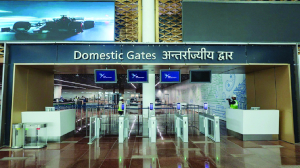
The OTT series narrows the geography of smuggling. Airports dominate the story although, as mentioned earlier, the bulk contraband (narcotics, and other goods) moves largely through seaports, across land borders, and via human couriers. While air routes may account for visibility, and hence more media and other coverage, they denote minimal volumes, and are popular for some products like gold, currency, and a small portion of narcotics. By staying within the terminal corridors, and related interrogation rooms, the series creates a restricted and limited smuggling world that feels manageable, even solvable, ecosystem. The fact remains that the shadows of the black economy extend in different directions, across sectors, across potential routes, across transport systems. More importantly, tackling it requires inter-agency partnerships, sharing of domestic and global information, and cannot be tackled by a single agency given the international networks.
As current experiences show, the world of smuggling is no longer a simple one, but involves extreme complexities. If the investigating agencies use high-tech solutions, so do the global criminal syndicates. Financial transactions encompass cryptocurrencies, cross border transfers of money through the official banking channels, slew of shelf and shell firms in secretive tax havens, and even the developed cities such as Dubai, Singapore, Hong Kong, London, New York, and many others. Criminals are more rugged and raw, as well as savvy and sophisticated. To restrict it to informers, and human intelligence, and to airports and closed interrogation rooms implies a lack of understanding of how crime has evolved over the decades. Like the Russian shadow oil economy shows, smuggling involves an elaborate and expensive fleet of ships, tankers, and planes, as well as movements of large consignments, and massive money laundering.
When it comes to narrative, Taskaree struggles with rhythm. The writing lacks consistency, and pacing becomes uneven. Early episodes do build the intrigue, but a predictable plot turns creeps in. Twists seem to announce themselves before they arrive. By the final stretch, or the end of it, the series feels stretched and thin, with the last few episodes prolonging the conflicts, rather than deepening or converging them. As a result, emotional investment never takes hold among the viewers. This is the contradiction. It wants to be a serious series, based on procedures grounded in economic reality. But it opts for convenience over complexity. It hints at the size of smuggling, yet resolves it neatly. It presents a system riddled with loopholes, yet suggests right information is enough to fix it.