Sweden: India’s strategic bet on a changing Europe
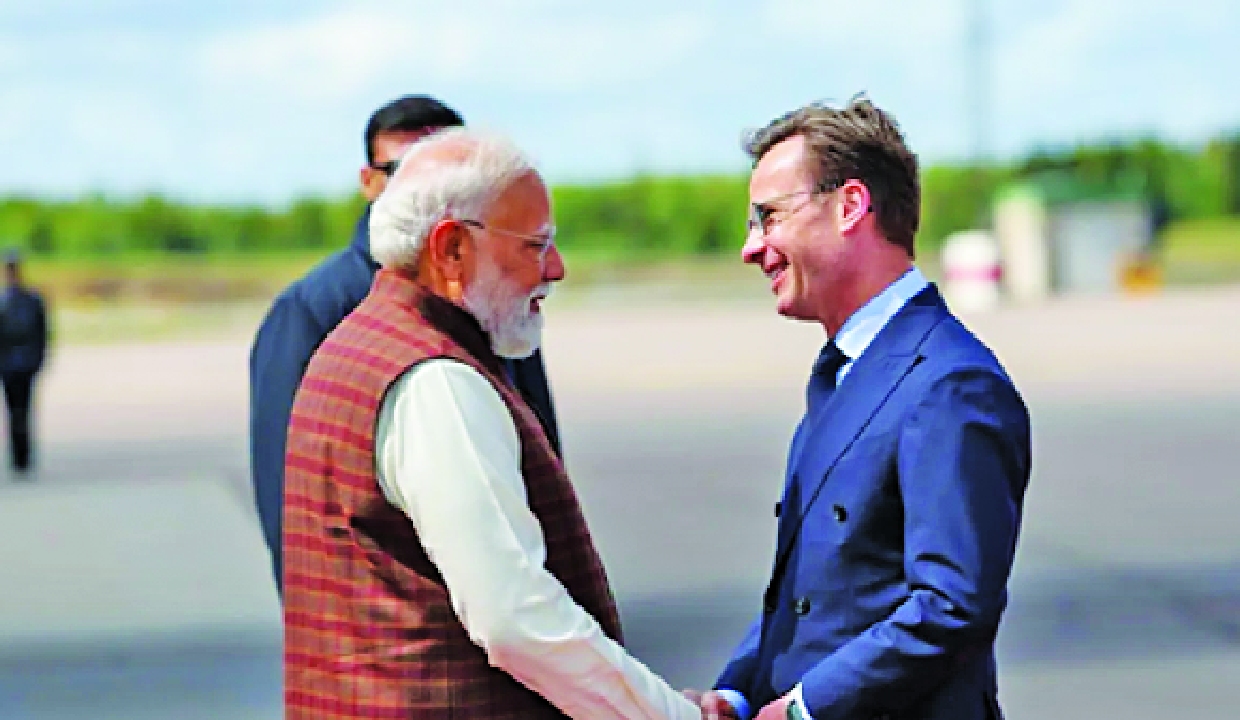
There is a telling detail in the optics of Prime Minister Narendra Modi’s recent visit to Sweden. He landed not in Stockholm — the capital — but in Gothenburg, Sweden’s industrial and port city, home to Volvo, Ericsson and the country’s manufacturing core. This was not a diplomatic courtesy call, but a deliberate choice. It was a business proposition set in a moment when the global order is fractured enough to make such propositions genuinely consequential.
Modi arrived in Gothenburg on May 17 as part of a five-nation tour — the Netherlands, Sweden, Norway and Italy in Europe, apart from the UAE. This was his first visit to Europe since the landmark India-EU Free Trade Agreement (FTA) came into force in January 2026. The Sweden stop yielded an elevation of bilateral ties to a Strategic Partnership, a Joint Action Plan for 2026-2030, the launch of Joint Innovation Partnership 2.0, and the formalisation of the India-Sweden Technology and Artificial Intelligence Corridor. Bilateral trade stands at USD 7.75 billion, with the stated ambition to double it in five years. This two-day visit to Sweden, therefore, reflects something considerably more significant than a usual diplomatic tour.
To understand this better, one must begin not in Gothenburg but in Washington — or rather, in the gradual erosion of Washington’s reliability as an anchor for its European allies. The Trump administration’s second term has been a study in the weaponisation of uncertainty. Punitive tariffs, NATO ultimatums, the threat to absorb Greenland, the abandonment of Ukraine to fend largely for itself, and a unilateral military engagement in Iran without allied consultation — each shock has compounded the previous one. European leaders witnessed the passing of 2025 with growing tensions and transactional shifts in their relationship with the US. A Carnegie Endowment (2025) study recently described what is happening as European leaders undergoing a “crisis of faith in the American system itself” — a monumental shift, not merely a political event.
It is into this vacuum that India has been purposefully stepping up its engagement with Europe. When European Union (EU) Commission President Ursula von der Leyen stood alongside Modi in New Delhi in January 2025 to seal the India-EU Free Trade Agreement (FTA), she framed it in terms that had nothing to do with tariffs on luxury cars or Indian textiles. “India-Europe ties will reduce strategic dependency at a time when global trade is being weaponised,” she said. The target of that remark was self-evident. The FTA is not just a trade agreement but Europe’s attempt to build an alternative economic architecture, with India as a reliable and supportive pillar.
Sweden’s position within this story is worth examining carefully. Stockholm has long punched above its weight in innovation: Ericsson in telecommunications, SSAB in green steel, and a start-up ecosystem that rivals almost any in the world. What Sweden lacks, and what India offers, is scale. A market of 1.4 billion people, a digital talent base of extraordinary depth, a manufacturing ambition under Make in India, and a government that has demonstrated it can move large structural deals. Swedish Prime Minister Ulf Kristersson captured the mood with unusual honesty when he said of Modi’s visit: “It is absolutely the right time, given all the chaos in world trade.” That is not usual diplomatic language, but rather a country identifying its strategic moment.
For India, Sweden offers something the US relationship does not easily provide: technology transfer without the full weight of alliance conditionality. Washington’s export control regime, tightened under both Biden and Trump, means that critical technologies arrive in India bundled with strategic expectations. Sweden, through the AI Corridor, 6G collaboration, quantum computing and the critical minerals agenda, offers complementary pathways with fewer strings attached. Looking beyond trade, technology and innovation cooperation, the visit also reiterated the importance of boosting Indo-Swedish cultural links, fostering development and strengthening heritage connections between people. This is not anti-American manoeuvring but an intelligent diversification strategy by a country that has learned, from decades of experience, not to concentrate its dependencies.
The Sweden visit is well timed and diplomatically executed. It consolidates the FTA’s multilateral promise into a bilateral strategic architecture that is harder to unravel. It builds technology partnerships, particularly in domains such as AI, 6G, critical minerals and green energy, where India’s future competitiveness will be determined. It also signals to a Europe anxious about its strategic loneliness that India intends to be a sincere and durable partner beyond opportunism.
The direction is clear. A world in which the US-Europe relationship is structurally strained, supply chains are fragmenting, and technology is becoming the primary currency of geopolitical influence is precisely the world in which India’s multi-alignment strategy has the scope and feasibility to operate. Moving beyond economic ties to strategic alignment, innovation-driven trade partnerships and joint efforts in frontier technologies, the visit reflects growing convergence on technology, security and sustainability between India and Sweden amid a changing global order. Gothenburg is more about consolidating India’s strategic autonomy at the right moment, in the right city and with the right partner. Indo-Swedish ties represent an expansive and collaborative forward-looking agenda, reflecting a broader global shift towards multipolarity and hedging in response to US transactionalism.
Abhishek Pratap Singh is an Assistant Professor at the University of Delhi and Kaustubh Tripathi is a Doctoral Candidate in the Department of Political Science, University of Delhi; Views presented are personal.
Leave a Comment
Comments (1)
Great article! Very informative