Strategic significance of speaker’s conference: An outreach to Global South
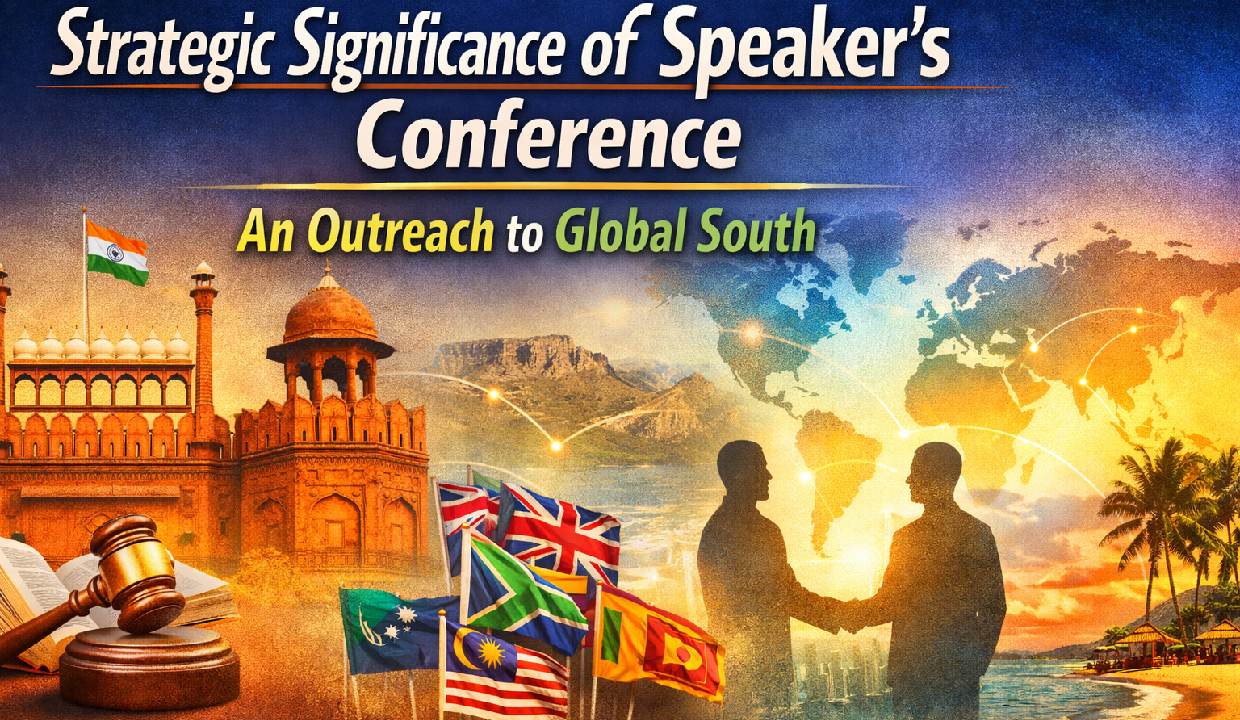
Lok Sabha Speaker Om Birla is hosting the 28th Commonwealth Speakers’ and Presiding Officers’ Conference (CSPOC) in New Delhi from January 14 to 17.
The Conference is taking place at a time when international order is buffeted by turbulence and geo-strategic challenges, with US unilateral action in Venezuela, while peace eludes Ukraine and in Iran. Although these countries are not members of the Commonwealth, these developments perforce has a bearing on world peace and stability and also on India’s foreign policy goals. The CSPOC in this context needs to be seen as an exercise and outreach of Parliamentary diplomacy, an adjunct of foreign policy. Although the Conference is going to deliberate issues such as Artificial Intelligence and other topics having a bearing on the functioning of the Parliamentary democracy, the significance of the conference cannot be overemphasised in the backdrop of recent churn in geopolitics.
India is a founding member of the Commonwealth and has been very active in Parliamentary diplomacy, both bilaterally and also at multilateral levels such as the Inter-Parliamentary Union (IPU) and the Commonwealth Parliamentary Association (CPA), the G-20 Presiding Officers Conference and the BRICS Presiding Officers Conference and the South Asia Speaker’s Conference, which is defunct now.
The Presiding officers not only occupy a very exalted position in Parliamentary polity, but they are hyphen that buckles the ruling party and the opposition and helps in promoting bipartisanship on contentious issues, including foreign policy issues. In an interconnected world, threats to peace and stability, and canons of good governance, the cardinal values of the Commonwealth, the bulk of whose members are from the Global South in Africa and Asia, are a threat to peace and stability everywhere.
When the dots are connected and aligned with the structure of the Conference, the message of India’s outreach through the Commonwealth to the Global South is loud and clear. The US one-upmanship has alienated the US from many countries in the world, including the United Kingdom and Canada. On the contrary, in spite of some rough edges, India has forged the FTAs with both the UK and New Zealand and in the process of repairing its relationship with Canada, an important member of the Commonwealth.
India’s decision to host the Commonwealth Games in Ahmedabad next year is a pointer to India’s reengagement with the Commonwealth.
In a very thoughtfully choreographed programme, the Conference begins on 14th at historic Red Fort, the icon of India’s protracted freedom struggle against British imperialism which also in a way opened the flood gates of similar struggles in Asia and Africa, the catchment of the Global South then under the canopy of the non-alignment- a movement which is dormant, but not dead today. The Conference is formally inaugurated by Prime Minister Narendra Modi on 15th in the historic Central Hall (Sambidhan Sadan), a testimony to the transfer of power from Britain to India. India’s Independence was eloquent testimony to Afro-Asian resurgence- the birth of the Global South.
The Commonwealth not only encompasses the Global South, but also is the melting pot of the industrialised rich countries such as the United Kingdom, Canada and New Zealand with Afro-Asian countries.
Further, some of the small island nations, both in the strategically sensitive Pacific and Indian Ocean, such as Sri Lanka and the Maldives, are also members of the Commonwealth. Much to the detriment of India’s security, China’s footprints in these littorals have been very pronounced in recent times. Although India has been engaging with these countries bilaterally, an outreach to them on the sidelines of the conference makes sense. It is instructive that the structure of the programme provides for Prime Minister Narendra Modi to engage with the Presiding Officers on the sidelines.
Yet another highlight of the Conference is that the programmes envisage for an address by the President of the Inter-Parliamentary Union (IPU), Dr Tulia Ackson. The Geneva-based IPU is an apex world Parliamentary body which had brokered peace in many strife-torn conflict zones in the world.
Earlier, the Indian Parliamentary Group, of which the Speaker of Lok Sabha is the President, had invited the then President of IPU, Duarte Pacheco, in 2021 in the wake of COVID-19 to address the members of the Indian Parliament in the historic Cantal Hall. India also organised the G-20 Speakers Conference. It would be indeed be thoughtful on the part of the Parliamentary Friendship Groups of the Indian Parliament to engage with their peers on the margins of the Conference.
The writer is a former senior fellow at the Monohar Parrikar Institute for Defence Studies and Analyses and currently Consulting Editor of the Journal of Parliamentary Information. Views are personal.