Smoke & mirrors, sins & errors
It was bound to happen. Like it or not, GST 2.0 is having a much-higher negative impact on government revenues, compared to the official estimates. Thus, it was a matter of time before the policy-makers acted to shore up revenues. The easiest target was to impose higher taxes on products that attracted the highest ‘sin’ GST of 40 per cent. Tobacco, cigarettes, and tobacco products were the obvious choices. The new duties will be applicable from February 1, 2026, and provide a cushion of extra revenues for two months before the end of the fiscal year (2025-26). It may partially safeguard the fiscal deficit, which is under pressure due to lower-than-expected nominal GDP growth rate despite higher-than-estimated real growth rate.
Stock markets reacted adversely, as expected. ITC’s share price fell by more than INR50 in the past two trading sessions, and shed more than 12 per cent. In the past two months, the stock plummeted from more than INR420 to INR350, or a loss of INR70 (nearer to 17 per cent), after it inched up due to GST 2.0. Most brokerages downgraded ITC to ‘reduce,’ ‘neutral,’ or ‘hold’ depending on their earlier advice. For ITC, it is a rude reminder that despite its efforts over the past 1-2 decades to wean its operations away from cigarettes, and emerge as FMCG major, it is still seen by investors and analysts as a primary tobacco-driven one. Stock price lies in perception.
According to experts, the Government had little choice. In November 2025, the gross GST collections went up by less than one per cent year-on-year. The numbers reflected the sales in October, which was the peak festive season. Hence, despite higher sales, taxes came down. Higher collections on imports, and lower refunds saved the day. The domestic figure was a negative 2.3 per cent. The overall net collections were no better, or just 1.3 per cent higher. In December 2025 (sales in November), the gross collection was just over six per cent higher. But in this case too, the situation was saved due to higher taxes on imports. The increase in domestic revenue was just 1.2 per cent. Overall net revenues were 2.2 per cent higher.
The situation was untenable. Lower revenues would impact the fiscal deficit, which would lead to other complications. In addition, since the fiscal deficit-to-GDP percentage is calculated on the nominal GDP, which has not grown adequately, the fear was larger. The Government needed to act, and act fast. On January 1, 2026, it notified an extra duty on cigarettes, which ranged from just over INR2,000 per 1,000 stocks for those with lengths equal to, or less than, 65 mm, and INR8,500 for ‘other’ cigarettes. This came as a shocker because the Centre had, according to a media report, “kept taxes stable over FY19-26, with only one double-digit increase in FY21.” Hence, cigarette sales boomed because of the tax stability, and predictability. ITC being the market leader gained.
According to an official assessment, since the taxes remain unchanged for several years, it was time to increase them. This is crucial to reduce the smoking addiction levels in the country. More importantly, despite the recent hike, the taxes are much lower than in other nations. For example, the World Health Organisation allows a levy of up to 75 per cent. The new tax in India, feels PL Capital, takes the overall figure from 50 per cent to 61 per cent, and is still lower than the WHO figure. In a few developed nations, the taxation level is 85 per cent. “Further, as the new rates imposed are 29-43 per cent lower than peak rates mentioned in Central Excise (Amendment) Act, 2025, this opens a pandora's box for future increase in excise duty,” states a report by PL Capital.
“On the existing MRP (maximum retail price), we see the tax payout per stick rising by over 50 per cent across KSFT (king-size), LSFT (larger-size), and RSFT (regular-size), and by 26 per cent for DSFT (deluxe-size). We expect the portfolio to witness price hikes of around 32 per cent in a staggered manner,” Emkay Global said about the impact on ITC’s products. Hence, Motilal Oswal ruled, "It will be a huge task for the company to protect its profitability. Its price hike strategy will be critical to gauge the volume/EBIT sensitivity. We model six per cent EBIT contraction in FY27, and will monitor the price hike process.” Earnings pressure on cigarettes, it added, would take away the near-term catalysts (soft tobacco prices, recovery in the FMCG sector, and paper segment), and comfort on
valuation.
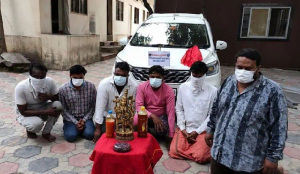
Of course, the tobacco lobby will try to oppose the new taxes. One of its favourite assertions will be that higher taxes will give incentives for smuggling, and sale of fake and illegal cigarettes. Smaller firms will aim to avoid and evade the taxes through various means. The lobby invariably cites the example of the US, where high price differences due to higher taxes in some of the states like California and New York lead to excessive smuggling. The Government’s logic is that the main cause of smuggling is not taxation, or price differentials, but lacunae in the distribution system, and official monitoring. The two measures can reduce, and curb the illicit trade. Moreover, it is in the corporate interests to help the Government to reduce smuggling, which cuts into the former’s profits.
At the end of the day, the overriding official logic is safety, and addiction. Like in the case of money-based gaming, where it imposed a complete ban despite the economic benefits, this regime wants to act aggressively against addiction. It lays more emphasis on societal benefits, rather than revenue concerns. In gaming, the Government let go of a huge source of revenues. The same is true of cigarettes if the use, and addiction levels come down. The health of the nation is more valuable than the wealth of the nation. The idea is to curb tobacco use, which is linked to more than a million deaths every year, and move closer to the WHO’s recommended taxation benchmark. “These measures are part of India’s broader strategy to protect public health… aligning with global best practices for tobacco control.”