
The stairs to the podium
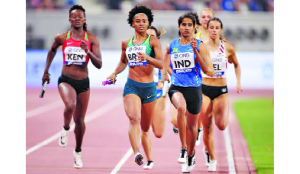
In the summer of 1934, six Indians boarded a ship for London. They were headed to the second edition of what was then called the British Empire Games, the tournament the world now knows as the Commonwealth Games. When the Games ended, India had exactly one medal to show for the journey: a bronze, won by wrestler Rashid Anwar. Ninety-two years later, Commonwealth Games, Glasgow, 2026, a very different India walked out. A contingent of 122 athletes competed across ten sports and came home with 39 medals: 13 gold, 17 silver and nine bronze! And eight of those thirteen golds were won by women. The distance between those two contingents, six athletes and one bronze, versus a nation now expecting to place among the top handful of Commonwealth countries, is the real story of Indian sport.
It is not a story written slowly, by athletes who trained day and night, by coaches who worked relentlessly, by parents who gave their everything. But it is impossible to tell the new India’s story without placing Prime Minister Narendra Modi close to its centre. Who, more than any leader before him, chose to treat sport as a national priority rather than an afterthought. By providing support to athletes who had never been funded, building the schemes that changed their odds, and lending the prestige of his office to a boxer or a javelin thrower the way earlier prime ministers reserved for statesmen.
After the lone 1934 bronze, the medals came slowly. It took until 1958, in Cardiff, for India to win its first Commonwealth gold, and it was won by a man whose life had begun in tragedy. Milkha Singh, the “Flying Sikh,” had survived the horrors of Partition as an orphaned teenager before he ever set foot on a track. When he stormed to victory in the 440 yards, he became the first Indian to top a Commonwealth podium. The same Games saw Stephanie D’Souza and Elizabeth Davenport become the first Indian women ever to compete at the event, a quiet milestone that took a full generation to fully bloom.
Through the 1960s, ‘70s and ‘80s, India’s fortunes rose in fits and starts, carried mostly on the backs of wrestlers and, later, weightlifters and shooters. Jaspal Rana’s shooting brilliance and Raghavan Chandrasekaran’s weightlifting hauls kept the tricolour flying. But for most of these decades, the story of the Indian athlete was a story of scarcity: sport was something you pursued despite the system, not because of it. Lack of facilities, foreign exposure was rare, and funding was an afterthought. To understand how much has changed, it helps to sit with one story. Saikhom Mirabai Chanu grew up in a village in Manipur, the kind of place where a child’s first “weight training” is carrying firewood up a hill. As a teenager training in Imphal, her childhood coach has recalled, there were days Mirabai did not have even Rs 10 for the bus fare home. She would say she had gone home for just five days in five years, so complete was her devotion to the sport. But the new India tells another story.
In April 2021, three months before the Tokyo Olympics, Mirabai needed to reach a specialist strength-and-conditioning coach in the United States. The Delta wave was raging; countries were shutting their doors to Indian travellers. The entire trip, from treatment to a sparring partner, boarding, lodging and travel, was budgeted at around Rs 70 lakh. According to her coach, the sanction came through in a single day. “I never thought a day like this would come,” he said, “when you could even ask for an amount like this.” She flew out just before the travel ban slammed shut, trained, and returned to win an Olympic silver medal, India’s first medal of those Games!
The girl who once lacked bus fare had her elite overseas training approved in twenty-four hours. The funding that reached Mirabai was not luck. It flowed through a set of programmes built up over the last decade, and Mirabai is not the only one. In 2014, Hon’ble Prime Minister Shri Narendra Modi launched TOPS (The Target Olympic Podium Scheme). The scheme was designed to do one focused thing: identify India’s top sports talent and remove money as an obstacle. Under TOPS, the government funds not just the athlete but the entire support structure: foreign coaches, physiotherapists, sparring partners, video analysts, airfare and medical insurance. TOPS helped javelin thrower Kishore Jena when he needed 78 days of training in Australia before Paris 2024. When PV Sindhu trained in Germany and Neeraj Chopra’s whole athletics setup was backed to the hilt, TOPS was the reason. Khelo India, launched in 2018, works at the other end of the pipeline.
Through the Khelo India Youth Games and University Games, held annually, the system scouts for talent at the school and college level and channels promising athletes into structured support long before they are famous. In early 2025, after the National Games in Uttarakhand, the Prime Minister singled out a clutch of young Khelo India products by name- sprinters, jumpers, a teenage swimmer, as evidence that the pipeline was working. Prime Minister understands the emotional register of sport. Congratulating national award winners the other day, he said: “There is no elevator to success - you have to take the stairs.” In later years, initiatives like Fit India and his repeated emphasis on fitness in Mann Ki Baat have made such a deep impact because they change what an ambitious young person from a small town believes is possible for them. India has now openly declared its intent to bid for the 2036 Olympic Games and is set to host the Commonwealth Games again in 2030. Ask any Indian medallist who made them, and the first names are always the same: a coach who refused to give up on them, their parents who sold or mortgaged what little the family had. That will never change, and it shouldn’t. But something new has entered that circle of gratitude over the last decade, and the athletes themselves have been the ones to put it there.
When the Tokyo Olympics contingent, India’s best-ever haul of seven medals, gathered at the Prime Minister’s residence in August 2021, they did not arrive empty-handed. Neeraj Chopra handed the PM the very javelin he had thrown to India’s historic gold. PV Sindhu gave her badminton racquet, Lovlina Borgohain her boxing gloves, Bhavani Devi her fencing sword, the hockey teams their autographed sticks. When young javelin thrower Navdeep Singh wanted to place a cap on Modi’s head, the Prime Minister sat down on the floor so the athlete could reach him. This is the humility and respect the Prime Minister has always given to the athletes, and these are the gestures of people who feel genuinely seen. In fact, that feeling of being seen is, in a way, the whole point, and it began before the medals. Back in 2016, when Modi personally hosted a send-off for the Rio-bound contingent, Abhinav Bindra, India’s only individual Olympic gold medallist, tweeted his astonishment: it was the first time a Prime Minister had ever sent the Olympic team off in person. When a nation’s leader treats its athletes not as an afterthought but as the face of what the country can become, something shifts in every small-town child who dreams of the podium. That is the quiet inheritance Narendra Modi leaves Indian sport.
The writer is the Secretary General, Archery Association of India and the Executive Board Member, World Archery Asia; Views presented are personal.