
Guarding against cognitive warfare and grey zone tactics
A positive outcome of the democratic contagion is the vindication that Parliament is the self-correcting and self-healing mechanism and is the barometer of people’s hopes, aspirations, nay, frustrations. Indian Parliament is the unique institution to turn challenges into opportunities. Its resilience is its strength
If the recent protests were motivated to fix systemic lacunae, one can empathise with the students; but the fact is that the agitation aimed at destabilising an elected government
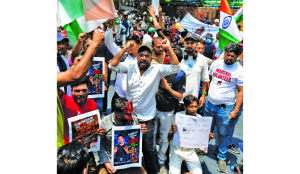
The protests against the paper leak last month, which snowballed into a political agitation, can be seen through the prism of ‘cognitive warfare’ and grey-zone tactics. Cognitive warfare has gained traction in the age of new media. The agitation reached a crescendo on 20 July, when the Monsoon Session of Parliament started. The agitation was pre-planned and was not coincidental with the commencement of the Parliament session. In a democratic polity of a ‘soft state’ like India, protests and agitation within and outside Parliament are aspects of democratic discourse. What is bemoaned is the organised effort to ask for regime change of an elected government. Its execution was meticulously orchestrated with moral and material support from within and outside, including inimical forces in India’s neighbourhood and beyond. The simultaneous demonstrations abroad in support of the agitation are intriguing, suggesting a wider network in connivance with domestic political forces to destabilise India and stymie India’s growth and development. The biased news reports and write-ups in foreign media outlets were suggestive of the jaundiced outlook of the Western media. While the paper leak issue is a serious issue and the bona fide students’ angst warranted urgent remedial action, the anger and anguish of students were very adroitly calibrated and reinforced in the political space, when Parliament was in session, to create an optic of mayhem.
When an agitation of such magnitude occurs, some law-and-order issues are bound to crop up. Although there have been some cases of injuries sustained by both the students and the police, the agitation was deftly handled by both the government and the police without serious casualties. The revelation by the police that there was a sizeable chunk of hardcore criminal elements, as identified by a facial recognition system, is intriguing.
Political protests and agitation are part and parcel of India’s adversarial and contested politics, which has been in existence since the country’s protracted freedom struggle. Post-independent India has also witnessed such protests and movements, the most important in our recent memory being the ‘Total Revolution’ in Bihar and the Navnirman Movement in Gujarat, spearheaded by Jayaprakash Narayan in 1974, which eventually brought the first non-Congress government in the country in 1977 after the National Emergency. The Mandal agitation of 1990 is also in our minds. All these agitations had the strong support of the student community. But none of these movements ever had any overt or covert support from abroad, as is alleged in the recent protest against the paper leak. All the previous movements, except the farmers’ agitation of 2020, were home-grown and were led by towering leaders of impeccable credentials.
While wars have been transformed from conventional warfare to nuclear warfare to drones, the battlefields themselves have been expanded to trade war, cyberwar and cognitive warfare, and what the Chinese often resort to as ‘united front’ tactics. Strategists of cognitive warfare aim to exploit people’s resentment, frustrations and cynicism to unseat a ruling regime. They attempt to paint a narrative of defeatism, taking advantage of the vulnerability of a soft state, democracy and constitutional guarantees of freedom of expression, including freedom of protest, and the existence of an independent and zealous judiciary and civil society. Though the paper leak was a serious issue and students had genuine grievances, the issue was effectively choreographed through a ragtag coalition of forces and endorsement by celebrities.
It is no exaggeration to say that while gullible students were hypnotised, lumpen elements were hired to indulge in arson and vandalism. The masterminds of the protest and agitation have done a great disservice to Gen Z, who are in adolescence and at an impressionable age. There is a need to understand their socio-psychological state of mind and engage them creatively in their career-building, in alignment with nation-building. Unlike their previous generations, Gen Z have grown up in relatively better economic security, some even in affluence. Consumerism, under the impact of globalisation, has induced their material aspirations, added to and abetted by demonstrative effects. Their desires have become demands. This ‘wired generation’ has not seen the hard way their parents brought them up and their tenacity to fight against adversities, including hunger and poverty. They almost got things on a platter. Growing up in a protective environment, they lack the killer instinct or fire in the belly.
If the recent protests were purely motivated to fix systemic lacunae, one can empathise with the students; but the fact is that the agitation aimed at destabilising and changing an elected government. Taking the fight to the streets may be a democratic way of protest, but taking the law into one’s hands and vandalising public property is not acceptable. Constitutional rights are not a licence to take the law into one’s hands and indulge in filthy and abusive verbiage. No wonder, therefore, that the builder of modern Singapore, Lee Kuan Yew, lamented the ‘exuberance’ of democracy as detrimental to development. It is ironical that while the West criticises India’s ‘messy democracy’, it has no qualms about instigating instability in the country. The hidden agenda of the West behind awarding leaders of civil society and litterateurs with coveted honours such as the Magsaysay Awards, Fulbright Scholarships, Ford Foundation awards or Booker Prizes are concealed, and these are long-term investments in individuals to incubate narratives to destabilise the country. This, however, does not reflect on the merits of the awards.
One need not be a rocket scientist to identify such Trojan horses.
A positive outcome of the democratic contagion is the vindication that Parliament is the self-correcting and self-healing mechanism and is the barometer of people’s hopes, aspirations, nay, frustrations. Indian Parliament is the unique institution to turn challenges into opportunities. Its resilience is its strength.
Post-independent India has also witnessed such protests and movements, the most important in our recent memory being the ‘Total Revolution’ in Bihar and the Navnirman Movement in Gujarat, spearheaded by Jayaprakash Narayan in 1974, which eventually brought the first non-Congress government in the country in 1977 after the National Emergency
The writer is a former Senior Fellow of the Indian Council of Social Science Research and currently a Consulting Editor of the Journal of Parliamentary Information; Views presented are personal.