
A fitting response to Mecca pact
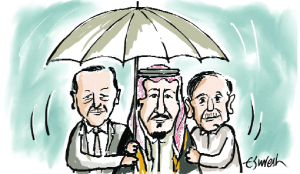
The Saudi Arabia-Pakistan-Türkiye defence pact may be premature to call an ‘Islamic NATO’, but it signals a changing security architecture in West Asia. For India, the challenge is not to counter the emerging grouping with another alliance, but to leverage its strategic autonomy, strengthen its maritime capabilities and deepen its partnerships across the region
Pakistan-Saudi military relationship, combined with Türkiye’s defence capabilities, could give Islamabad greater strategic and diplomatic space
The new defence pact between Saudi Arabia, Pakistan and Türkiye has opened a new chapter in West Asian geopolitics. It is already being called an “Islamic NATO”, though that description may be premature. The three countries bring different strengths to the table. Pakistan is a nuclear-armed state with a large military, Türkiye is a NATO member with a growing defence industry, and Saudi Arabia is an oil-rich power with enormous financial resources and influence in the Muslim world. Their closer security cooperation is significant because it comes at a time when the old security architecture of the Gulf is changing rapidly. For India, Pakistan’s role in this new arrangement makes the development particularly important.
For decades, the United States provided the main military shield for the Gulf. American bases, naval forces, aircraft and missile-defence systems offered protection to Saudi Arabia and other Gulf states. Recent conflicts involving Iran, Israel and the United States have exposed the limitations of depending entirely on an external power for regional security. Gulf countries are increasingly looking for their own partnerships and security arrangements. The Mecca pact reflects this wider search for strategic independence. It does not have NATO’s permanent command structure or integrated military forces, but the direction is clear: West Asia is moving towards a more complicated system of regional security partnerships.
India cannot ignore this change. A stronger Pakistan-Saudi military relationship, combined with Türkiye’s defence capabilities, could give Islamabad greater strategic and diplomatic space. At the same time, India has enormous interests in the Gulf. Millions of Indians live and work there, the region is crucial for India’s energy security, and the Strait of Hormuz remains vital for global trade and oil supplies. Any major military confrontation in the Gulf can quickly affect India’s economy, energy prices and maritime trade. India therefore needs to watch the new security equation carefully without treating it as an immediate military threat. The biggest danger would be a wider regional conflict in which Pakistan becomes directly involved.
India’s answer should not be to create another military bloc. New Delhi’s greatest advantage is its ability to maintain relationships with competing powers. India has strong partnerships with Saudi Arabia and the Gulf countries, strategic relations with the United States and Israel, and important ties with Iran and other West Asian states. This diplomatic flexibility should become a strategic asset.
The American experience also provides a lesson: decades of military protection did not eliminate instability in the Gulf. India should therefore strengthen its own capabilities rather than depend on another country’s security umbrella. Dharma diplomacy, understood as responsible, balanced and dialogue-oriented statecraft, can complement India’s traditional strategic autonomy.
The most natural arena for India’s growing influence is the Indian Ocean. India’s movement from SAGAR-Security and Growth for All in the Region-to MAHASAGAR-Mutual and Holistic Advancement for Security and Growth Across Regions-should become the centre of its maritime strategy.
The Arabian Sea links India directly with the Gulf, while the wider Indian Ocean connects India with Africa, Southeast Asia and Europe. India can strengthen maritime surveillance, protect commercial shipping, expand naval cooperation, conduct humanitarian operations and help smaller countries build their maritime capabilities. Vasudhaiva Kutumbakam, the idea that the world is one family, can give this strategy a wider diplomatic purpose: India’s security need not depend on permanent confrontation with another country.
India also has another strategic opportunity-artificial intelligence. The future balance of power will not be decided only by nuclear weapons, fighter aircraft and naval fleets. AI, semiconductors, data, cyber technology and advanced computing will increasingly determine national power. India’s MANAV approach, centred on moral and ethical systems, accountable governance, national sovereignty, accessibility, inclusion, validity and legitimacy, can provide a distinctly Indian voice in the global AI race.
Pakistan may have nuclear weapons, Türkiye may have advanced defence technology, and Saudi Arabia may possess immense financial power. India’s answer can be a combination of technology, economic strength, maritime power and diplomacy. The message from Mecca should therefore push India towards MAHASAGAR-not towards another military alliance, but towards becoming a stronger maritime, technological and diplomatic power.
India also has another strategic opportunity-artificial intelligence. The future balance of power will not be decided only by nuclear weapons, fighter aircraft and naval fleets
The writer is Professor Centre For South Asian Studies, School of International Studies & Social Sciences Pondicherry Central University, India; Views presented are personal.