
‘Super monday’: Boredom as ballot, spectacle as sovereignty
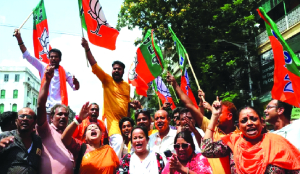
On the fourth of May, three sitting Chief Ministers lost power and a film star became the likely next Chief Minister of Tamil Nadu. The vocabulary that surrounded these results was, as always, ceremonial: "mandate," "popular verdict," "historic upheaval" — words that imply an electorate exercising considered judgment. That courtesy is not incidental to electoral democracy; it is load-bearing. Without it, the ceremony would be required to account for itself more honestly, and that accounting, if attempted with any seriousness, might prove considerably more troubling than the results it would explain.
Mamata Banerjee, who had governed West Bengal for fifteen years with what her admirers called an unshakeable popular bond, lost her own seat at Bhavanipur as her party was reduced to roughly ninety-four seats in a 294-member assembly against the BJP's hundred and seventy-six. M.K. Stalin, carrying the full weight of Dravidian legacy and what the DMK had long described as an organic, almost civilisational connection with the Tamil voter, lost his own Kolathur seat to a TVK debutant in a contest that left a film actor's first-ever electoral formation leading in roughly a hundred and seven of two hundred and thirty-four seats. In Kerala, the last surviving bastion of organised left politics in India, the CPM collapsed to single digits and its ally the CPI to four, after a decade of consolidated dominance that had been read as the end of the state's alternation pattern. And in Tamil Nadu, the man who will in all likelihood be the next chief minister is Vijay, a film star who entered politics so recently that his manifesto is considerably newer than some of his blockbusters. The analysts called it a historic upheaval. A new phase of popular consciousness, one commentator ventured. The vocabulary worked overtime.
What actually happened is considerably simpler, and considerably less flattering to the idea of the voter as a sovereign exercising considered judgment: the voter got bored.
This is not anti-incumbency, and the distinction is not academic. Anti-incumbency implies a specific and relatively dignified form of disappointment, a government that made promises, fell short of them, and was held to account by an electorate that was paying attention, evaluating, comparing what was promised against what was delivered, and arriving at a conclusion through some form of genuine reckoning. What the results across these four states reveal, when examined without the scaffolding of political commentary, is something far more ordinary and far more intractable. The ego, which is the actual unit of electoral action beneath all the aggregated data, has a structural relationship with its objects: it seeks them, uses them, grows accustomed to them, grows tired of them, and moves toward the next available option. Not because the object failed to deliver in any decisive sense, but because the ego's restlessness is not produced by the object at all. The source of the restlessness is the ego itself, a fact it will not examine, and so it keeps changing what surrounds it in place of changing what it is.
Consider what the DMK-AIADMK history in Tamil Nadu actually reveals. For close to fifty years, the Tamil electorate sorted itself between two parties sharing a genealogy, a vocabulary of symbols, and a shared claim to represent something deeper in the Tamil voter than mere preference for a face. If that commitment had been real, the kind of commitment capable of surviving inconvenience and resisting novelty, the abandonment could not have happened at the speed and scale at which it happened. Deep commitments do not dissolve overnight for a more charming alternative; what dissolved was not commitment but attachment, and attachment is an entirely different thing: it has shallow roots, which is precisely why it can be uprooted so quickly when someone arrives with a more luminous image. Vijay's ascent does not represent a rejection of Dravidian politics; it represents the unmasking of what Dravidian politics, for the majority of its voters, always was: an attachment to a style of performance. When the performance grew familiar and another, more spectacular and more recently minted, became available, the audience drifted toward it. Nothing in this deserves the name of democratic awakening.
Bengal makes the same argument from a different angle, and the angle is worth examining. When the CPM's long dominance ended in 2011 and Trinamool came to power, a large proportion of CPM cadres quietly migrated across, the street-level functionaries, the neighbourhood organisers, the men who had for decades been the party's visible presence in every locality. They did not cross over in ideological distress, because ideology had never been the actual basis of their affiliation. They revised their membership cards because the organisation they belonged to had ceased to be the winning one, and the ego will not remain in a losing organisation when a winning one is equally willing to absorb it. The old container emptied; the same people poured themselves into the new one. And now Bengal has changed once more, by the same logic and in the same direction, the same faces in reconfigured arrangements, the same cadres with revised colours.
The most instructive Indian example of this pattern, however, is not from Super Monday but from nearly half a century ago, and it remains the most complete demonstration of what the ego's electoral restlessness actually amounts to. The 1977 general election, fought in the immediate aftermath of the Emergency, produced what appeared to be the most morally charged verdict in independent India's history. A population that had suffered suspension of civil liberties, forced sterilisations, press censorship, and the full machinery of authoritarian consolidation voted the Congress out with a ferocity that swept even safe seats. The Janata Party, a coalition assembled in some haste and held together more by shared antipathy to Indira Gandhi than by any coherent governing vision, came to power as what the commentators of the time called a popular uprising for democracy. Within three years, the coalition had collapsed under the weight of its own internal ego operations, every constituent formation pulling in the direction of its own interest and image. And in 1980, the same electorate, the very people who had voted in passionate defence of democratic values, returned Indira Gandhi to power with a majority as sweeping as any she had received before the Emergency. The voter who had risen up against the suspension of democracy voted back the person who had suspended it, within a single electoral cycle. If anti-incumbency were a real phenomenon, a considered verdict of a deliberating electorate, this reversal would be inexplicable. As an expression of the ego's boredom cycle, it requires no explanation at all: the ego exhausted the Janata object, found it wanting in the ways that all objects are eventually found wanting, and returned to the familiar with the relief that follows an unsuccessful experiment.
There is a dimension of the ego's operation in this process that standard political commentary never reaches, because reaching it would require looking below the surface of visible political behaviour into the ego producing it. The ego does not only substitute one external object for another, one CM for another, one party for another, one face for another; it is equally capable of substituting one version of itself for another, and presenting that substitution as transformation. The voter who described herself as politically indifferent can reinvent, by the next cycle, as passionately committed. The voter who was previously committed can reinvent as principled opponent of everything he previously endorsed. The structure underneath remains exactly as it was; what has changed is only the costume the ego wears within that structure. This is why elections can produce enormous surface movement, landslides and historic reversals and upsets that fill entire news cycles, while leaving unchanged the thing that would actually need to change for the word "change" to carry any of the weight being placed on it.
This pattern is not particular to India, and locating it only here would itself be a form of the ego's outward-pointing tendency, the comfortable habit of finding the problem elsewhere. Assam, which renewed its incumbent in the same set of results, is not the counter-example to this thesis but its quiet confirmation. The same voter who chose Congress for half a century now chooses the BJP, and will choose something else the moment the ego registers the current offering as familiar. Loyalty, in the ego's economy, is rented; it is never owned. The renewal of an incumbent and the toppling of one are not opposed phenomena; they are different points on the same cycle, depending only on how recently the object was first acquired. In 2015, Delhi handed the Aam Aadmi Party a majority so complete that the opposition was reduced to three seats in a seventy-member assembly. The verdict was read, by those who wished to read it that way, as the arrival of a new politics, a politics of the ordinary citizen against the entrenched system. A decade on, the structural complaints about governance in Delhi, about air quality, about water, about the reliability of public institutions, have not changed substantially in their register or their intensity from the complaints that preceded AAP's arrival. The new face absorbed the old frustrations and, in time, generated its own. Elsewhere, the ego's operation is if anything more visible precisely because the scale is larger. Italy has had around seventy governments since the end of the Second World War, cycling through every conceivable coalition arrangement, every available ideological combination, under the same republican constitution, with the same foundational complaints about corruption and institutional inefficiency recurring across every administration. The arithmetic of Italian politics is the boredom thesis rendered as a statistical table. And in 2008, Barack Obama's election produced what was described, without irony, as the most significant democratic moment in a generation: a genuinely new kind of face, a genuinely new register of political speech, a campaign built on the single word "Hope" as though hope were itself a governing programme. The foreign policy continuities with the preceding administration, the expansion of the drone programme, the Wall Street bailouts that followed within months of the inauguration: none of this was what the voter believed he was choosing. He had found a spectacular new object and called the finding a revolution.
What the actor-politician reveals, in this light, is not an aberration but a confession, and the South deserves credit for the candour that its critics mistake for political naivety. Tamil Nadu and Andhra Pradesh have a long history of electing professional actors to their highest offices: MGR, NTR, and now, in all probability, Vijay. When a state elects a film star as its chief minister, it is not making an error in judgment; it is acknowledging, without the decorum that dresses the same reality up elsewhere, that the electorate has always been choosing between images and has simply decided to stop pretending that the image conceals a statesman. The professional actor has trained for precisely what electoral competition demands: the projection of an image that an audience will find compelling, and the calibration of emotion for people who did not gather to be informed but to be moved.
The North tends to be more discreet about this. Its politicians are also actors, the rally, the roadshow, the calculated display of righteous anger, the tears that arrive on cue, the grandfatherly warmth switched on before a camera and switched off after, but they do not describe themselves in those terms, and the voter colludes in not naming what is clearly visible. The South has, in this specific and limited sense, arrived at a more transparent arrangement. When Vijay stands on the floor of the Tamil Nadu assembly as its chief minister, the contract between performer and audience will at least be candid about its terms. The North's statesmen are shooting continuously; they simply do not publish the footage under the correct category.
If the South is to be faulted for anything, it is not for electing an actor; it is for sharing with the rest of the country the deeper condition that makes the actor-politician the natural outcome of an unexamined polity, not the exception. We do not know who sits behind the face we present to the world, and we therefore cannot know who sits behind the face that comes to us seeking a vote. People get married, after years of courtship, without genuinely knowing each other, and this is not because they did not have the time; it is because knowing is not particular to the other person. The capacity to see another clearly is exactly the capacity to see oneself clearly, and where the one is absent, the other is absent too. The voter who has never examined what operates beneath his own preferences and choices will not examine the candidate either; he will read the image and call the reading a judgment. The depth of political scrutiny a democracy can produce is a precise reflection of the depth its citizens bring to the examination of themselves, which is to say it is, almost everywhere, very shallow indeed.
The turnout figures will be cited, in the days that follow, as evidence to the contrary: ninety-three per cent in Bengal, eighty-five in Assam, eighty-five in Tamil Nadu, almost ninety in Puducherry, the highest participation those states have ever recorded. These numbers will be read as democratic vitality, the citizen at last fully present to his political responsibility. Participation, however, is not awareness, and a ninety-three per cent crowd at a multiplex on opening weekend is also a crowd. Showing up to vote and showing up to a sale are governed by the same machinery, appetite arriving at its object, not insight arriving at its decision. The fact that more people turned up does not establish that more people were thinking; it establishes that more people were moved.
The outward direction of this shallowness has a specific political consequence that is almost never named. When things go wrong, the electorate asks what is wrong with the government, as if governments arrive from somewhere outside the societies that produce them, as if they drop from the skies already constituted and installed, leaving the voter a passive recipient of whatever falls. It is a democracy; the people have been casting votes and constituting these governments, season after season, with apparent enthusiasm. If the government was what it was, the electorate that returned it repeatedly has some reasonable claim to the result.
This outward orientation is not merely a political failing. A democracy of people who have not examined themselves is also, necessarily, a democracy that carries violence within it as a permanent and unresolved potential, not as an occasional pathology that better administration might contain. The ego is, at its structural core, a separation: I am not you, and because I am not you, there is no principle inherent in things as such that compels me to take your interests as seriously as I take my own. If you are not me, why should I protect you, or refrain from exploiting you, or hesitate before harming you when doing so happens to serve what I take to be my interests? This is not the aberration of any particular ego, to be remedied by better ethical instruction; it is what every unexamined ego is doing, holding violence beneath the surface when concealment serves it, and surfacing it when concealment no longer does. The election changes the calculus of concealment; it does not introduce violence where none previously existed.
In fact the violence is present long before any result is announced. The polling process itself can be an act of internal bloodletting in which not a word is raised loudly nor a single shot fired: when a manifesto is constructed around the production of an enemy, when the voter is taught that his dignity depends on another's defeat, when ballots are cast on lines of caste or religion or region, violence is already in motion, quieter in form and more respectable in register, but not structurally different from what appears afterward in the streets. The polling booth and the riot are not as far apart as the political calendar would like them to appear; they are consecutive moments in the same unbroken operation, the ego's constitutive separation made visible at different levels of intensity. When promises of freebies were made and received with enthusiasm, that too was a form of violence, a transaction in which the voter sold a piece of his judgment for an object, and the leader purchased a piece of the voter's sovereignty with public money that was never his to spend. None of this required a riot. All of it was violence.
A political manifesto is, in this light, the ego's own prospectus: a document in which a formation of egos promises its intended voters more of what they already want, framed as public service. No manifesto produced by any serious political formation in India has placed climate change at the centre of its programme with the urgency the scientific record now demands. Kolkata, among the cities most exposed to inundation as sea levels rise, has projections that are neither ambiguous nor distant. Yet the subject appears in manifestos, if at all, as a decorative line item rather than as the governing emergency it is. The left tends to produce more educated candidates and more internally coherent economic reasoning than most of its rivals, but this relative sophistication cannot reach the climate question, and the reason is structural rather than a matter of will or courage. Marxist analysis locates consciousness as a product of class position: the worker thinks as he does because of where he stands in the relations of production, and his false consciousness, where it exists, is a distortion imposed from above by the class that controls both capital and ideology. The problem, in this framework, is always in the arrangement of classes, never in the individual ego as such. The proletarian ego, the organising ego, the sincerely progressive ego: these are structurally exempted from blame, because the analytical framework has no category for the self's own restlessness and hunger as the root of the problem. Climate change, however, is not produced by the bourgeois ego alone; it is produced by the structure of the self that takes itself to be separate from the world and therefore entitled to consume it without remainder. The left cannot say this without implicating its own voter, its own cadre, its own historical subject. No manifesto will carry that argument. The manifesto is itself an ego operation, and the ego, with all its considerable ingenuity, does not compose its own obituary.
The voter who surveys the Super Monday results and asks what went wrong with Mamata's Bengal, or with Stalin's Tamil Nadu, will find abundant material: misgovernance, administrative complacency, accumulated resentment, the usual inventory. All of it is available, and some of it is real, but none of it reaches the root. The fifteen years of Trinamool rule were chosen, ratified, and extended by the same people who have now chosen something else. If the government was what it was, it is in significant part because the electorate was what it was, and the electorate is not substantially different now: only restless in a new direction, bored of the last face, freshly attached to the current one.
The consolation of changing governments is not nothing; it is one of democracy's more functional features, that the ego can cycle through its objects without the catastrophic violence that regime change requires in less permissive political arrangements. But a consolation is also, by definition, a substitute: what one performs instead of the thing one cannot bring oneself to do. Toppling a chief minister is what the voter does in place of examining himself. It is the change that keeps the real change at bay, the noise that fills the silence in which an inconvenient question might have become audible. Genuine democratic awakening would look like the opposite of today's results, not their amplification: voters becoming steadier across cycles because their judgments are anchored in something prior to the offer in front of them, punishing performance and rewarding substance, holding through electoral weather rather than being moved by it. What today reveals is the inverse: the more dramatically the voter appears to decide, the less he is actually choosing, and the more thoroughly he is being moved by media, by celebrity, by arithmetic, by the ego's appetite for the next object. What no change of government can deliver is the one thing the voter is actually seeking beneath all his electoral enthusiasms: the kind of fulfilment that no external appointment can provide. What cannot satisfy him is not a political leader who disappoints, nor even a more competent one who delivers; no outsider can fulfil the one who is seeking to be fulfilled from the outside. This is not a counsel of political disengagement. It is the only honest description of what elections, by their very nature, cannot provide. Even the most apparently radical electoral disruption, the kind that presents itself as a break from the entire existing order rather than a choice within it, follows the same arc. In France in 2017, Emmanuel Macron arrived as precisely such a disruption: neither left nor right, a new political species, a movement rather than a party, positioned explicitly as the termination of the old ideological binary. The restlessness that produced him has since produced the sustained rise of Marine Le Pen's formation, now the largest single party in the National Assembly, because the ego, having exhausted the novelty of disruption, began looking for its next available object. The disruption of the system was not the end of the ego's cycling; it was simply the system's next cycle.
The image of real change that has fixed itself in historical imagination is the crowd: the storming masses, the burning palace, the collective fury that overwhelms the old order in a single luminous event. This image is misleading about where change actually originates. Crowds are not the source of transformation; they are its lagging indicator, the mass that moves after the individual has already moved, often by decades, and often in conditions of considerable solitude. That solitude is not a deficiency to be remedied; it is the precise condition of any voter who knows what she is doing and why. The voter who tells herself that her vote for the right candidate is wasted because he will not win anyway is performing, in miniature, the same abdication that produces the governments she will spend the next five years resenting. What she names as political realism is, underneath, the fear of being alone in her clarity, of being the one person in the neighbourhood whose hand went up in the wrong direction. Love, when it appears in political choices at all, appears exactly here: not as solidarity with the crowd, but as the willingness to act from one's own judgment without requiring the crowd's company or the prediction market's permission.
And the test of whether any of this has been received, rather than merely read, is interior. If the response to today's results is excitement at one outcome, dismay at another, vindication, rage, satisfaction at the toppling of a face one had wished to see toppled, then nothing here has been received; the reader has only located himself within the phenomenon being described. The vote is downstream of the inner state. Every surface judgment about today's results is a piece of evidence about the judge.
There is, beneath all the noise of Super Monday, only one question worth asking, and it will not be put to air on any channel: if the voter has changed his government for the seventh or the tenth or the fifteenth time, and if the quality of what is governed has remained recognisably constant across all those changes, and if the problems said to have motivated each successive verdict, dignity, employment, security, fairness, ordinary safety, continue in their essential form despite every renewal and every fresh mandate, at what point does the continuous ceremony of changing governments begin to look less like the exercise of popular sovereignty and more like the elaborate, inexhaustible activity of a self that has decided, with extraordinary thoroughness, never to examine what has not changed?
Acharya Prashant is a philosopher and author whose work centres on self-inquiry and its application to contemporary life; Views presented are personal.
Leave a Comment
Comments (25)
It is important to change our self, look our self, who m I?, ego, greedyness, explosion
मतदाता, ठीक उपभोक्ता की तरह, अपनी आंतरिक स्थिति को नहीं बदलता वह केवल अपने सामने मौजूद वस्तु या चेहरे को बदलता है।
Caught the centric problem
🙏🏽caught a
The article presents a deep perspective on modern democracy and voting behavior. It explains how political change often becomes more of a spectacle than true transformation when people themselves remain inwardly unchanged. I found the connection between inner psychological states and collective political outcomes very thought-provoking.