Sitharaman set to break record with 9th Budget
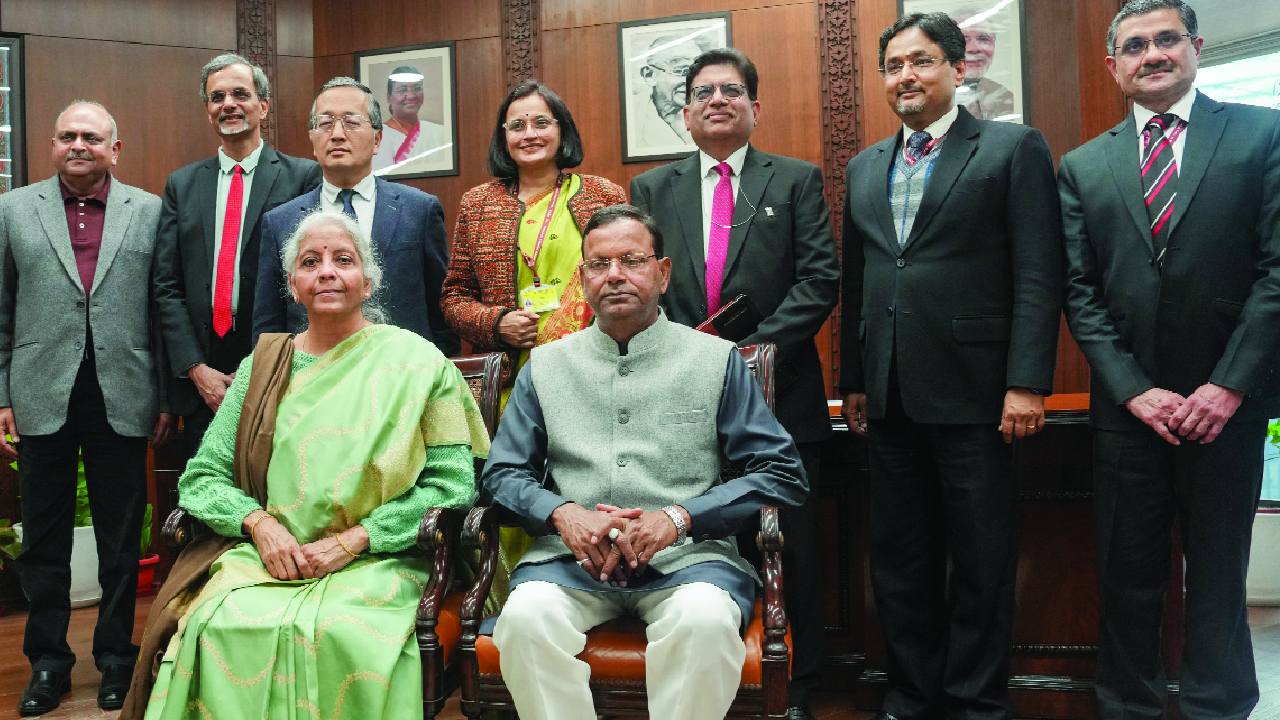
Surpassing her own as well as others’ records, Finance Minister Nirmala Sitharaman will present her record ninth straight Budget 2026-27 on Sunday (February 1) — effectively making her the longest serving finance minister in the country in terms of uninterrupted Budget presentations.
This is the first time in independent India’s history that the Budget will be presented on Sunday. The Budget is expected to unveil measures to sustain growth momentum, maintain fiscal discipline, and contain reforms that could buffer the economy from global trade frictions, including US tariffs.
The Budget comes at a time when India remains one of the fastest-growing major economies, even as global growth moderates due to geopolitical uncertainties, tight financial conditions and slowing demand in key markets. The annual Budget is not just an economic exercise but one of the most closely watched economic and policy events in India, shaping everything from household finances to industry sentiment.
Overall, Sitharaman’s FY27 Budget is expected to prioritise continuity over surprise, reinforcing the Government’s long-term growth strategy while navigating near-term economic risks. Markets will look for reassurance that India can sustain. Sitharaman had, in her first Budget in 2019, replaced the leather briefcase — which had been in use for decades for carrying Budget documents — with
a traditional bahi-khata wrapped in red cloth.
This year’s budget will be in paperless form, as done in the last four years. Since first presenting the Budget in 2019, she has become the longest-serving Finance Minister under the same PM and is now approaching Morarji Desai’s record of 10 Budgets. She also equals former Finance Minister P Chidambaram’s total of nine.
Historically, budgets have been presented on working days. In 1999, when the scheduled date of February 28 fell on a Sunday, Finance Minister Yashwant Sinha presented the Union Budget a day earlier on February 27 (Saturday), although, as per the convention, then customary to present the Budget on the last day of February.
The Budget 2026-27 comes against a complex backdrop. While domestic demand has held up and inflation has moderated from recent highs, global uncertainties - including geopolitical tensions, volatile commodity prices and uneven monetary easing by major central banks - continue to cloud the outlook. At home, the Government faces pressure to boost consumption, accelerate job creation and step up capital spending, while keeping the fiscal deficit on a downward path. However, the tax cuts have nibbled into Government revenue, limiting her options to support the economy in the new Budget.
Her biggest challenge will be to find a new growth driver, particularly against the backdrop of a global economy ravaged by heightened uncertainty and fragmentation, financial markets on a precipice, and global commodity prices on a continued uptrend.
Sitharaman’s sweeping income tax and GST cuts, together with spending on infrastructure and the RBI’s interest rate reductions, have so far helped the Indian economy withstand the punitive 50 per cent tariff US President Donald Trump has imposed on Indian goods. But now, she has to come up with measures to sustain the momentum.
Former Prime Minister Morarji Desai holds the record for presenting the highest number of Union Budgets. Desai presented 10 Budgets, and it remains a record. He presented his first Budget on February 28, 1959. Former Finance Minister P Chidambaram occupies the second spot, having presented the Union Budget on nine occasions. Chidambaram presented his first Budget in 1996 during the United Front Government, followed by another in 1997.
Key numbers to watch out in Budget
- Fiscal Deficit: The budgeted fiscal deficit, which is the difference between the Government expenditure and income, for the current fiscal (April 2025 to March 2026 or FY26), is estimated at 4.4 per cent of GDP.
- GST: Goods and Services Tax (GST) collection in 2025-26 is estimated to rise 11 per cent to `11.78 lakh crore. FY27 GST revenue projections will be closely watched
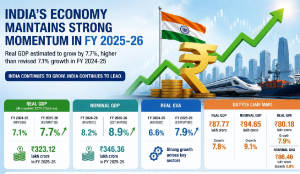
- Nominal GDP: India’s nominal GDP growth (real GDP plus inflation) in FY26 was estimated to be 10.1 per cent, while the real GDP growth estimated by NSO is 7.4 per cent.
- Spotlight would also be on spending on key schemes like G RAM G, as well as key sectors like health and education.