Sensex, Nifty extend losing streak on Trump tariff fears
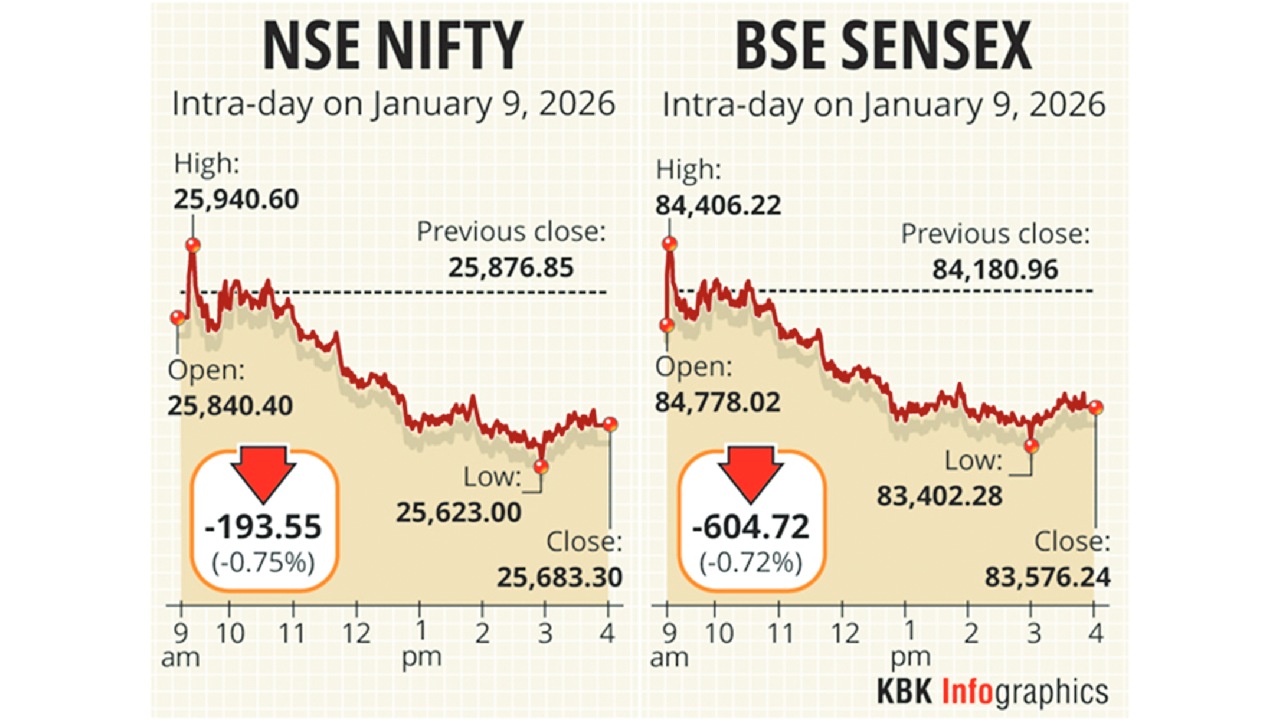
Dalal Street’s losing streak showed no signs of easing on Thursday as Indian equities slid for a fifth consecutive session, rattled by intensifying global trade and geopolitical concerns. The Sensex tumbled 604.72 points, or 0.72 per cent, while the NSE Nifty dropped 193.55 points or 0.75 per cent to 25,683.30, pushing benchmark indices deeper into the red after a bruising week.
The fresh decline came amid heightened market anxiety triggered by a sweeping sanctions bill approved by US President Donald Trump. The proposed legislation includes provisions to impose tariffs of up to 500 per cent on countries purchasing large volumes of Russian oil and gas. For India, the threat has proved particularly destabilising, given its significant energy ties with Russia and the uncertainty over how aggressively such measures could be enforced.
Against this backdrop, Trump has given his nod to the bipartisan Graham-Blumenthal Russia Sanctions Bill, a move that could have wide-ranging consequences for countries such as India, China and Brazil. The bill seeks to intensify economic pressure on Moscow by targeting nations that continue to trade in Russian oil, gas and uranium.
Republican Senator Lindsey Graham, one of the bill’s principal architects, said the president has “greenlit” the proposal following a meeting at the White House earlier this week. A White House official later confirmed the development to the Associated Press.
If enacted, the legislation would empower the US president to impose steep tariffs and secondary sanctions — up to 500 per cent — on countries that knowingly purchase Russian energy resources or nuclear materials. Supporters argue that such trade helps finance Russian President Vladimir Putin’s military campaign in Ukraine.
“This will be well-timed,” Graham said in a statement, asserting that Ukraine is making concessions in pursuit of peace while Russia continues military operations. He accused Moscow of prolonging the conflict despite ongoing diplomatic efforts.
The sanctions package, jointly drafted by Graham and Democratic Senator Richard Blumenthal, is intended to choke off key revenue streams supporting Russia’s war effort. Beyond oil and gas, the bill also covers uranium and other exports, significantly expanding Washington’s leverage over third-party trading partners.
Graham indicated that the Senate could consider the bill as early as next week, though the timeline remains uncertain. Lawmakers are expected to first address a revised government funding package, followed by a Senate recess scheduled around the Martin Luther King Jr Day holiday.
The legislation has drawn broad bipartisan support, with dozens of co-sponsors in the Senate and a companion bill introduced in the House of Representatives by Republican Congressman Brian Fitzpatrick. However, the White House has previously sought revisions to ensure the president retains flexibility in implementing the sanctions, and it remains unclear whether those changes have been finalised.
The development comes as the Trump administration intensifies efforts to negotiate an end to the nearly four-year-old war in Ukraine, with special envoy Steve Witkoff and Jared Kushner, the president’s son-in-law, leading US talks.
If passed, the sanctions bill could have far-reaching implications for global energy markets and for countries maintaining economic engagement with Russia, at a time when investor confidence is already under pressure from escalating trade and geopolitical risks.