SC hears RAKIA’s plea for Rs 543 cr deposit in UAE decree enforcement case against industrialist
The Supreme Court has heard arguments in the high-stakes enforcement proceedings arising from a UAE civil judgment against Hyderabad-based industrialist Nimmagadda Prasad, and hinted that substantial security may be needed if the judgement debtor wanted to contest the decree.
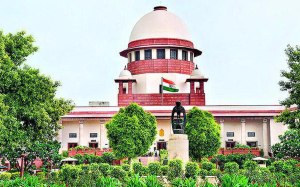
A bench comprising Chief Justice Surya Kant and Justice Joymalya Bagchi heard the submissions in part and deferred the arguments on behalf of Matrix Pharmacorp Pvt Ltd and Nimmagadda Prasad to February 25.
The bench expressed strong displeasure over what it characterised as a “mockery of the law” through the systematic dissipation of assets and dilatory tactics.
Representing the Ras Al Khaimah Investment Authority (RAKIA), the investment arm of the UAE emirate, senior advocate Abhishek Singhvi said his client has been unable to recover a single rupee despite winning at every level of the UAE judicial system, including the Court of Cassation. “This case reminds one of the Privy Council’s statements. The woes of an Indian decree holder start after the date of the decree,” Singhvi said.
He alleged that Prasad has created a “remarkable web” of 20 companies involving his daughter, Swathi Gunupati Reddy, and son-in-law, Pranav Reddy Gunupati, to shield assets from execution.
RAKIA is seeking to enforce a UAE civil judgment for AED 267,941,374 (approximately Rs 543 crore principal and Rs 643 crore with interest).
The case stems from the ‘Vanpic Project’, a failed 2008 joint venture to develop ports and an airport in Andhra Pradesh.
RAKIA alleges that Prasad, in collusion with former RAKIA CEO Khater Massaad, misappropriated $120 million intended for the project.
Singhvi detailed a history of alleged fraud, claiming Prasad transferred shares and properties to family members immediately following investigations by the CBI and ED, and after RAKIA initiated legal action.
Specifically, RAKIA pointed to the recent acquisition of API assets from Viatris through Tianish Laboratories and Matrix Pharma, claiming these transactions breached court undertakings and status quo orders.
“What business does he have to make this web and not deposit a penny,” Singhvi asked, requesting a forensic audit of Prasad’s family-run entities.
Defending the industrialist, a senior advocate argued that the UAE judgment was flawed and unenforceable under Section 13 of the Civil Procedure Code.
He contended that the civil decree was based on an in absentia criminal conviction in the UAE, which Prasad did not participate in.
He said RAKIA still holds a 51 per cent stake in the Vanpic project, which includes a land bank of 13,000 acres in Andhra Pradesh. “The project is in existence.
My assets have been attached,” the senior lawyer said, adding that the decree does not follow the principles of Indian law regarding causation and damages.
“Why don’t you deposit the decretal amount and then contest? We will not allow this harassment of different platforms and making a mockery of the law of this country.
If we are convinced (by RAKIA), it will take five minutes to deliver judgment,” the CJI said.