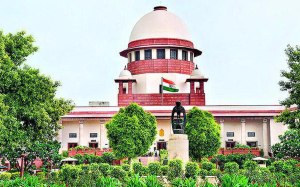
RERA doing nothing except facilitating builders: SC

The Supreme Court on Thursday said it is high time all states rethought the constitution of the real estate regulatory authority (RERA) as the institution is doing nothing, except facilitating defaulting builders. A bench of Chief Justice Surya Kant and Justice Joymalya Bagchi said the people for whom RERA was created were “completely depressed, disgusted and disappointed” and asserted that it won’t mind if the institution was abolished.
The observations came from the bench, which permitted the Himachal Pradesh Government to shift the office of RERA to the place of its choice.
The bench issued notice on a plea filed by the Himachal Pradesh Government and others challenging an order of the Himachal Pradesh High Court in a matter pertaining to the shifting of the state RERA office from Shimla to Dharamshala.
The High Court had earlier stayed a June 2025 notification concerning the shifting of the RERA office till further order.
Later, in its order passed on December 30, 2025, the High Court directed the continuance of the interim order.
The top court stayed the High Court’s December 30 direction.
“Except for facilitating the builders in default, this institution is doing nothing. Better abolish this institution, we don’t mind that,” the CJI said.
“High time that all the states should revisit and rethink of even constituting this authority,” the bench said. In its petition filed in the apex court through advocate Sugandha Anand, the state said the decision to shift the Himachal Pradesh RERA office from Shimla to Dharamshala was taken to “decongest” Shimla city, and it was purely on administrative considerations.
Senior advocate Madhavi Divan, appearing for the state, told the bench about the matter and said, “This is about the RERA, which we seek to shift to Dharamshala”.
An advocate, appearing for the respondent, said 90 per cent of the projects with which the authority deals are in Shimla, Solan, Parwanoo and Sirmaur, which are within a radius of a maximum of 40 km.
He said around 92 per cent of complaints which are pending before RERA are only from these districts, and there are only 20 projects in Dharamshala.
When the bench was informed that a retired IAS officer was appointed in RERA, the CJI said, “In every state, it has become a rehabilitation centre. These authorities are all occupied by these persons.
“The people for whom this institution was created, they are completely depressed, disgusted and disappointed. None of them are getting any effective relief.
For whom this institution actually is now serving, you will find out when you meet these people,” the CJI said.
The top court also observed that Shimla is “completely over exhausted”.
While issuing notice on the plea, the bench said, “The state is permitted to shift the office of RERA to the place of its choice. However, it shall be subject to the final outcome of the writ petition pending before the High Court”.
The advocate general of Himachal Pradesh told the bench that, as per a policy decision, the state is developing Palampur, Dharamshala and other cities.
The CJI asked, “What is the logic of having a retired bureaucrat? How he will be able to help in developing Palampur. You need to avail the services of some architect who is environment friendly, who knows the Palampur area, the Dharamshala area and these entire areas. Only those persons will help”.
The bench was also informed that the district judge, Shimla, hears the appeals against the orders passed by RERA.
“With a view to ensure that the persons affected by the orders of RERA are not caused any inconvenience to visit Shimla for the purpose of filing appeals, it is further directed that appellate power may be shifted from the principal district judge, Shimla, to the principal district judge of Dharamshala,” the bench said.
On February 9, in a separate matter, the apex court set aside an interim order of the Himachal Pradesh High Court staying the decision of the state Government to shift the OBC commission from Shimla to Dharamshala.
The top court had said such issues pertain to policy decisions and ordinarily do not fall under the judicial domain.