Rajaji tree felling intensified amid national highway protests
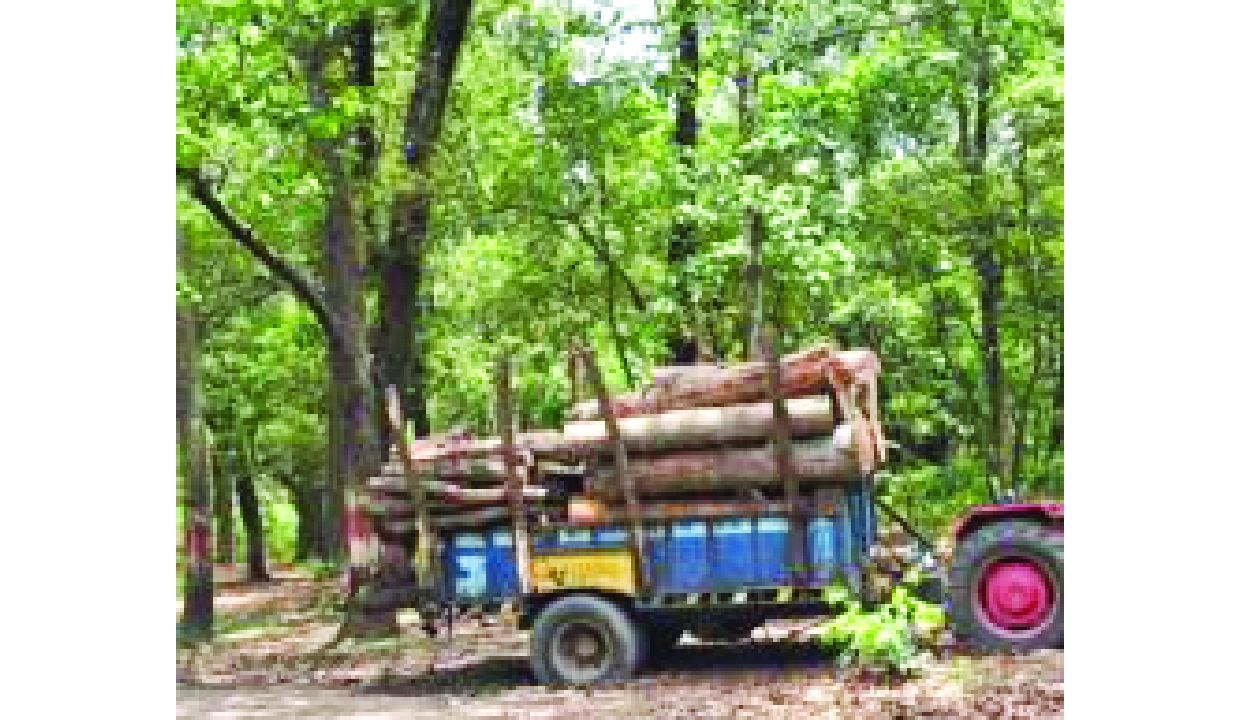
Amidst public agitation against the proposed Rishikesh-Bhaniyawala four-lane National Highway project, which passes through a sensitive elephant corridor in Rajaji National Park, the felling of trees was intensified on Monday.
Bina Verma, who has been travelling about 30 km daily from Dehradun to reach Saat Mod over the past few days, said, “Natural heritage cannot be destroyed in the name of development. Lush green trees are being cut down continuously. I fear that in the future, we might have to tell our children that a dense forest once existed here.”
Under this widening project, there is a plan to cut around 3,000 trees in the ‘Saat Mod’ area of the Doon Valley. For the past several days, environmentalists, social activists, students, and local citizens have been staging protests and sit-ins, demanding the protection of the forests and the wildlife inhabiting them.
As a reminder of the ‘Chipko Movement’ led by Gaura Devi decades ago, the protesters hugged trees in an effort to save them. However, amidst the intense protest, the police forcibly removed them and took them away from the site.
Subsequently, several trees were cut down one by one. Many protesters were moved to tears during the process. They accused the government of “murdering trees” in the name of development.
Holding placards, the protesters asserted that natural heritage cannot be destroyed in the name of development.
According to environmentalists, the project will result in the loss of thousands of trees, adversely affecting the natural habitats and movement of wildlife, including elephants.
Maintaining that the area serves as a crucial corridor for elephants, the experts said large-scale tree felling raises the risk of increased human-wildlife conflict, increased soil erosion, lower groundwater recharge, and long-term damage to the region’s biodiversity.
They have urged the government to consider alternative routes or engineering techniques for the project that would minimise damage to the forests.
Renowned environmentalist Anoop Nautiyal remarked on the irony that, while citizens are encouraged to plant trees in the name of ‘Mother’ and the nation, decades-old trees are simultaneously being cut down for development projects.
Meanwhile, defending the project, the National Highways Authority of India (NHAI) said that its objective is not merely to construct a modern and safe road but also to ensure environmental conservation and wildlife safety.
NHAI’s Project Director for Dehradun, Saurabh Singh, explained that while designing the project, special emphasis was placed on minimising environmental impact alongside increasing the road’s capacity.
He said that the width of the land acquired for the road (right-of-way) within the forest area has been kept as limited as possible. Furthermore, based on technical recommendations from the Uttarakhand Forest Department, WWF-India, and the Wildlife Institute of India (WII), scientific structures such as underpasses and culverts have been proposed to facilitate the safe movement of elephants and other wildlife.
According to Singh, these measures will maintain the natural movement of wildlife and reduce incidents of wildlife fatalities in road accidents.
He affirmed that the NHAI is committed to meeting future traffic demands while adhering to high standards of environmental balance and wildlife conservation.