President Murmu hails India’s self-reliance
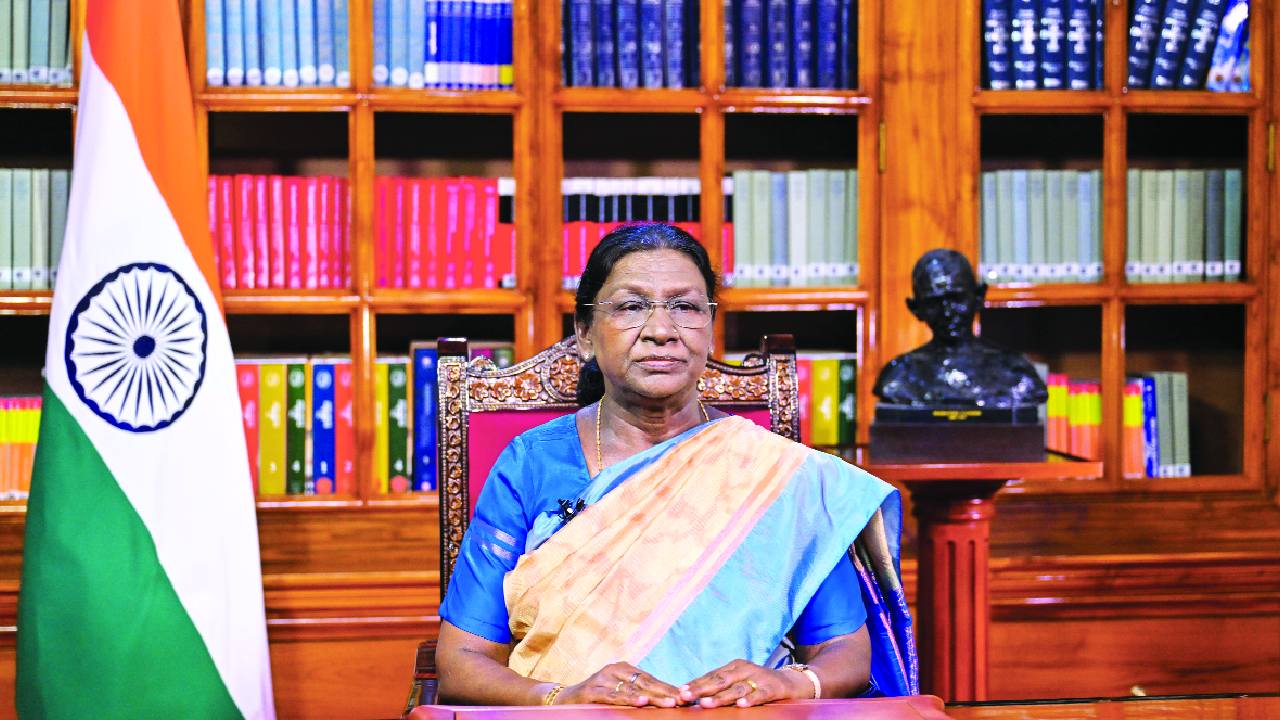
India’s rise as the third largest economy of the world and success of Operation Sindoor backed by self -reliance were the two key features underscored by President Droupadi Murmu in her address to the nation on Sunday on the eve of the Republic Day. She also mentioned about the role of women in shaping the destiny of the nation.
She highlighted the pillars of India’s democracy, the legacy of national icons, and the collective efforts of citizens in building a stronger nation. She underlined that in the journey of shaping the country’s economic destiny, Atma-nirbharata and Swadeshi are the guiding principles.
During her speech, the President underscored a firm commitment to national security by highlighting the recent success of Operation Sindoor, a precision strike that dismantled terror infrastructure across the border.
"Last year, our country launched precision strikes against terror infrastructure...Terror centres were destroyed, and many terrorists met their end," she said, highlighting country's "self-reliance" in the field of defence that powered the historic success of Operation Sindoor.
Underling the growth of the nation, she said India is the world’s fastest-growing major economy and continues to register steady growth despite global uncertainties, the President said in her address to the nation. The President said that the country is marching forth towards achieving its goal of becoming the world’s third-largest economy in the near future. She said that the journey toward becoming the third largest economy is being guided by the twin principles of 'atmanirbharta' and 'swadeshi' and the government's focus on world-class infrastructure and labour reforms is expected to further accelerate the development of enterprises.
She spoke about the Constitution’s ideals, the cultural and patriotic significance of Vande Mataram, and the inspiration of Netaji Subhas Chandra Bose. The president further talked about the achievements of women, the contributions of farmers, tribal communities, workers, and youth, as well as India’s economic growth and reforms.
Reflecting on the strength of the Armed Forces, the President recalled personal visits to the Siachen Base Camp and sorties in the Sukhoi, Rafale, and the submarine INS Vaghsheer. "Based on the strength of the Army, Air Force, and Navy, people have complete trust in our defence-preparedness," she said, linking the military readiness to India's ability to advocate for peace from a position of strength.
In her address, President Murmu hailed the rise of "nari shakti" (women power) as the cornerstone of India's journey toward becoming a developed nation by 2047. She emphasised that the "active and empowered participation of women is extremely important for the development of the country".
From the depths of rural self-help groups to the frontiers of space and defence, the story of modern India is increasingly being written by its daughters, she said. The President noted that over 10 crore women associated with self-help groups are currently redefining the grassroots economy.
She said that women now make up nearly 46 per cent of representatives in Panchayati Raj institutions and the Nari Shakti Vandan Adhiniyam is set to take political empowerment to "unprecedented heights", ensuring women-led development remains a national priority. The past year served as a "golden chapter" for Indian women in the global arena, the President said, as she took special pride in the dominance of India's daughters in sports, specifically citing the historic win at the ICC Women's Cricket World Cup and victory in the Blind Women's T20 World Cup.
President Murmu highlighted that women are making significant marks in the Armed Forces, space research, and entrepreneurship, proving that no field remains a "traditional stereotype" for the women in the country. The 'Beti Bachao, Beti Padhao' campaign was credited with encouraging girls' education across the country, she said. "With increasing contribution by women, our country will set an example of an inclusive Republic based on gender equality," the President remarked, signalling that the future of Viksit Bharat is inseparable from the empowerment of its female citizens. She also underscored India's transformative progress in poverty alleviation, noting that millions of citizens who struggled with poverty for decades have finally been lifted above the poverty line.
Embodying the spirit of 'Antyodaya', the government's focus remains on ensuring these citizens do not fall back into the "poverty trap", she said. The President affirmed the core ideal that "no one should go hungry in our country", with various central government schemes currently providing vital support to nearly 81 crore beneficiaries. She emphasized that the path to a 'Viksit Bharat' must be inclusive with special focus placed on tribal and marginalised communities through targeted interventions. "Such efforts for the welfare of the poor give concrete shape to Mahatma Gandhi's ideal of Sarvodaya (progress for all)," she said.
President Murmu also announced that the Constitution of India is now available in all 22 languages listed in the Eighth Schedule and said the milestone aims to foster "constitutional nationalism", allowing citizens to engage with the nation's foundational document in their mother tongue. The administration has pivoted toward a citizen-centric model by stripping away bureaucratic hurdles. Key efforts include deregulation of thousands of unnecessary rules that have been repealed and compliance requirements eliminated, she added. The President highlighted that national goals are now being achieved through unprecedented public participation, transforming government campaigns into powerful mass movements.
She also highlighted a significant push toward cultural decolonisation saying the government has reaffirmed its commitment to eradicating the "vestiges of colonial mindset" in a time-bound manner. She emphasized that self-reliance is not merely economic but also cultural and by placing a renewed emphasis on Indian languages and indigenous knowledge systems, the state is providing a distinct cultural foundation for its pursuit of total self-reliance. A cornerstone of this economic transformation has been the Goods and Services Tax (GST), which the President described as the most significant decision for economic integration since Independence.
She also highlighted the legacy of Vande Mataram and its role in uniting the nation. She noted that poet Subramanya Bharati composed the Tamil song “Vande Mataram Yenbom”, meaning “Let us chant Vande Mataram”, which helped connect people across regions with the patriotic spirit. She described Vande Mataram, composed by Bankim Chandra Chattopadhyay, as the country’s lyrical national prayer. She said, “The great nationalist poet Subramanya Bharati composed the song “Vande Mataram Yenbom”, in the Tamil language, meaning “Let us chant Vande Mataram”, and connected the masses on an even larger scale with the spirit of Vande Mataram. Translations of this song in other Indian languages also became popular. Sri Aurobindo translated this song into English. Vande Mataram, composed by the venerable Bankim Chandra Chattopadhyay, is our lyrical national prayeR.