Pragati Portal: A Game Changer in Accelerating India’s Dedicated Freight Corridor Project
Dedicated Freight Corridor (DFC) Project is one of the most ambitious rail infrastructure initiatives undertaken since Independence. Designed to provide a high-capacity, technology-enabled rail corridor for freight transportation, the DFC aims to help Indian Railways regain its freight market share by offering faster, safer, more reliable and cost-effective logistics solutions. The project is also expected to catalyse the development of multimodal logistics parks, thereby reducing logistics costs and improving efficiency across the supply chain.
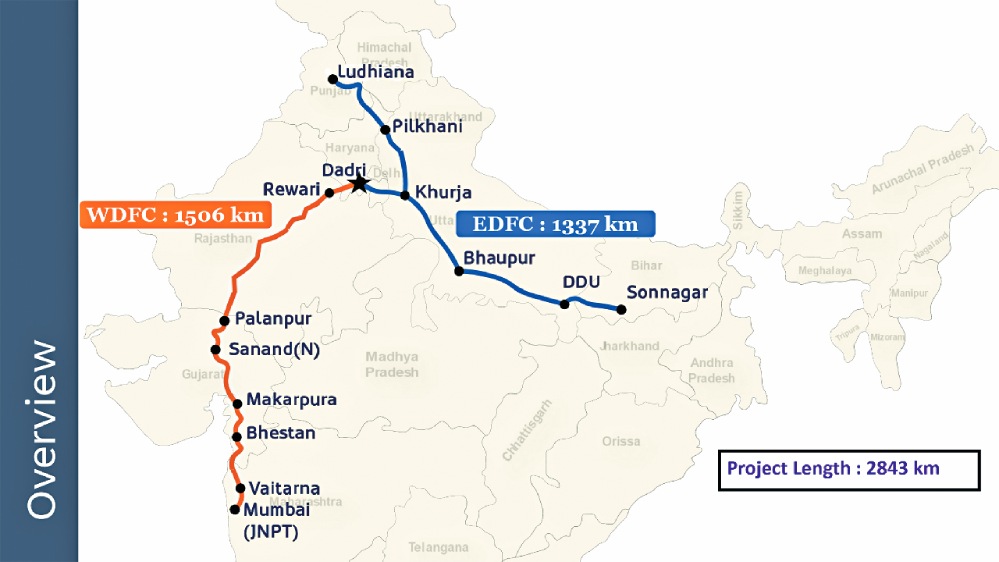
With an estimated cost of over INR 1.2 lakh crore and a total length of 2843 km, the DFC has two major arms:
Eastern Dedicated Freight Corridor (EDFC): 1337 kmStretching from Sahnewal (Ludhiana) in Punjab to Sonnagar in Bihar, the corridor passes through Punjab, Haryana, Uttar Pradesh and Bihar.
Western Dedicated Freight Corridor (WDFC): 1506 km Stretching from Dadri in Uttar Pradesh to Jawaharlal Nehru Port Trust (JNPT) near Mumbai, it traverses Haryana, Rajasthan, Gujarat, Maharashtra and Uttar Pradesh.
Together, the DFC alignment passes through 7 states and 56 districts, cutting across forest areas, wildlife sanctuaries, mangrove stretches and creek zones - making project execution inherently complex.
Challenges That Threatened Timely Completion: Although the project was initiated in 2008, progress was hampered for several years due to multiple bottlenecks:
- Acquisition of about 11,000 hectares of land, including removal of structures and encroachments.
- Obtaining statutory clearances for forest land, wildlife sanctuaries, mangroves, tree cutting, creek crossings, etc.
- Elimination of over 900 level crossings through construction of Road Over Bridges (ROBs) and Road Under Bridges (RUBs), each requiring joint GAD approvals and land acquisition for approaches.
- Shifting of high-tension electric lines, gas and oil pipelines.
- Approvals from Defence authorities, NHAI, state highways, irrigation departments for canal crossings, and permissions for earth borrowing.
- Post-COVID financial stress on contractors, leading to poor cash flows.
The absence of encumbrance-free land severely impacted construction schedules and exposed the project to potential claims.
Pragati Portal - The Turning Point: The launch of the Pragati Portal by the Prime Minister's Office (PMO) proved to be a watershed moment for the DFC Project.
Through the portal, unresolved issues were uploaded with detailed documentation by DFC officials. What made Pragati truly powerful was the visibility and accountability it created: concerned ministries, state governments and authorities knew that progress was being monitored at the highest level, including by the Hon'ble Prime Minister himself.
Issues that had remained pending for years despite relentless follow-ups were resolved within weeks — sometimes even days. In cases where immediate compliance was not feasible, authorities committed to firm target dates, which were then rigorously adhered to.
A New Culture of Governance and Accountability
- The Pragati Portal emerged as a highly effective platform for:
- Real-time project monitoring
- Escalation of issues across multiple tiers simultaneously
- Inter-ministerial and inter-state coordination through a single window
Within DFC, a similar internal monitoring framework was institutionalised. Weekly reviews of major contracts, intensive site visits and continuous tracking of committed milestones became the norm. Since all timelines placed on the portal were on record, it also instilled a sense of responsibility within the project team to honour its commitments.
Tangible Impact on Project Execution: The faster resolution of complex issues significantly boosted construction progress and safeguarded the organisation from potential claims arising out of delays in providing encumbrance-free land. More importantly, Pragati transformed the overall governance culture by embedding transparency, responsiveness and accountability into day-to-day project management.
Conclusion
The Pragati Portal stands today as a live example of effective digital governance in action. For a mega project like the Dedicated Freight Corridor - cutting across multiple states, departments and regulatory jurisdictions - Pragati proved to be not just a monitoring tool, but a catalyst for change.
By ensuring faster decision-making, reducing inter-departmental friction, and enforcing accountability at every level, Pragati has played a decisive role in steering the DFC Project towards successful and timely completion, while setting a benchmark for future infrastructure programmes in India.
The writer is former MD, DFCCIL; views are personal