Polish Literature as a Keeper of Nationhood
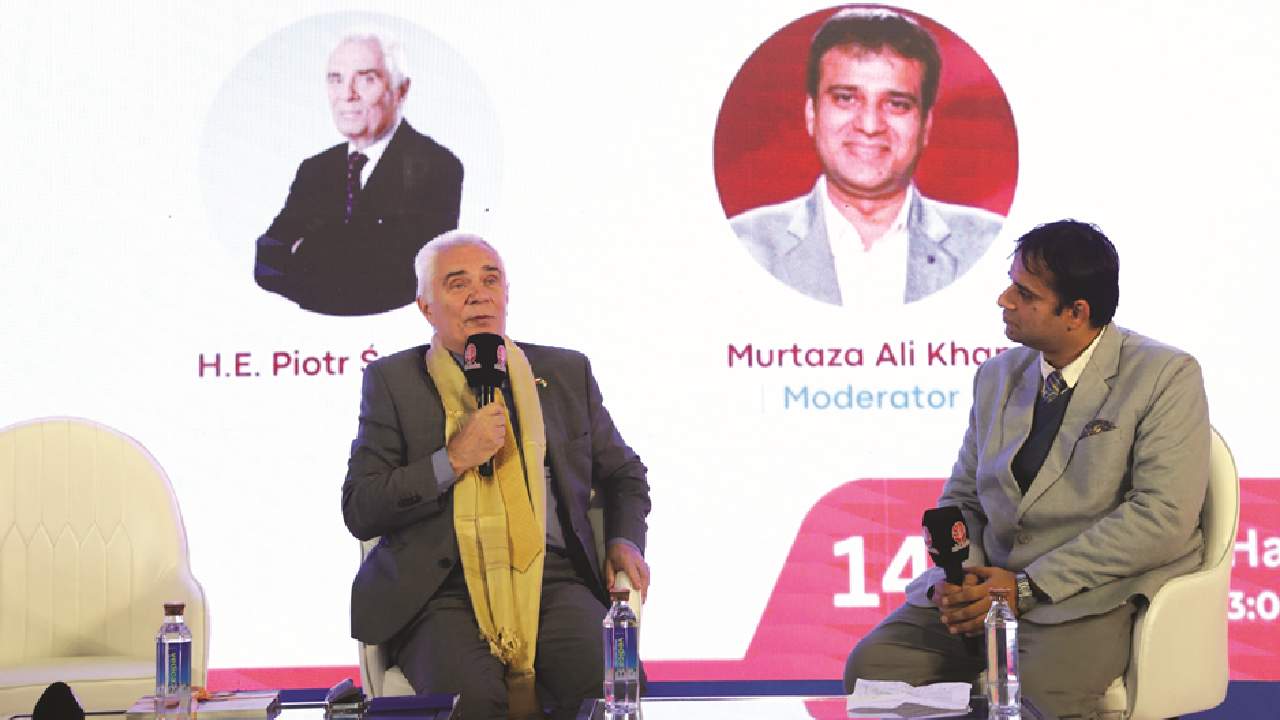
Dr Piotr Antoni Switalski, Head of Mission of the Republic of Poland at the New Delhi World Book Fair, delves into the nuances of Polish literature through times India and Poland may be poles apart geographically, but they share the scars of history and the trauma lived through political and social upheavals. This thus becomes the basis of the literature of the two countries that is both resilient and vividly captures the trauma of the times of partition, separation, and human will to endure and survive.
It reflects the longing for freedom and liberty. This is why Polish literature, though European in essence, finds resonance in India—a country that has seen it all; the experiences have been similar. It is thus natural for Polish literature to draw crowds in the New Delhi World Book Fair, as literature lovers and cultural enthusiasts gathered for a session on Polish literature and why it matters to all of us. His Excellency Dr Piotr Antoni Switalski, Head of Mission of the Republic of Poland, engaged in a thought-provoking conversation with cultural commentator Murtaza Ali Khan, tracing the remarkable role of Polish literature in sustaining national identity during one of Europe’s most turbulent eras.
The period between 1795 and 1918, when Poland disappeared from political maps, partitioned among Russia, Prussia, and the Austro-Hungarian Empire, was indeed the period of great trauma for the people. As Dr Switalski put it, “Poland vanished as a State, but it survived in language, literature, and imagination.” He emphasises the resilience of cultural expression in the face of occupation and oppression.
Highlighting the Romantic period, Dr Switalski discussed how poets such as Adam Mickiewicz turned literature into a moral and spiritual force. Writing often from exile, these literary figures nurtured a shared national consciousness rooted in sacrifice, resistance, and hope. The discussion then turned to the aftermath of the 1863 January Uprising. With armed resistance crushed, Polish intellectuals embraced Positivism, prioritising education, social reform, scientific progress, and civic responsibility.
Dr Switalski emphasised that this shift revealed a profound truth: survival itself could be an act of resistance, and nurturing civic values was crucial for preserving national continuity. It was but natural to talk about the Young Poland movement, which embraced modernism and symbolism while asserting Poland’s cultural identity. “Even while questioning tradition, these writers affirmed Poland’s creative freedom, keeping the nation’s intellectual spirit alive,” he remarked.
The dialogue also highlighted towering literary figures of the 20th and 21st centuries. Czeslaw Milosz, whose works grappled with war, exile, and moral responsibility, and Olga Tokarczuk, whose narratives bridge the local and global, continue Poland’s legacy of literature as ethical inquiry and cultural dialogue. Popular genre-defining writers like Stanislaw Lem, whose philosophical science fiction examines humanity and technology, and Andrzej Sapkowski, whose Witcher series draws on Slavic mythology, illustrate how Polish literature continues to evolve while remaining deeply rooted in its heritage.
Dr Switalski also reminded the audience of Poland’s soft power and the country’s rebirth in 1918. He emphasised that Poland regained independence not as a culturally diminished State but as a nation whose linguistic, literary, and intellectual identity had been safeguarded by generations of writers and readers. This is what we Indians can greatly admire, as the writings on colonial independence safeguarded Indian values and kept hope alive during difficult times when British imperialism had taken over every aspect of Indian life.
From the lyrical verses of Jan Kochanowski and Adam Mickiewicz to Nobel-winning novels by Henryk Sienkiewicz and Olga Tokarczuk and the imaginative worlds of Lem and Jacek Dukaj, Polish literature offers a rich tapestry for readers of all ages. The session was a compelling reminder that while empires may fall, literature endures—preserving nations, nurturing hope, and keeping culture alive across centuries.