PM Modi gets White House invitation
Rubio pushes for US energy partnership amid Iran conflict
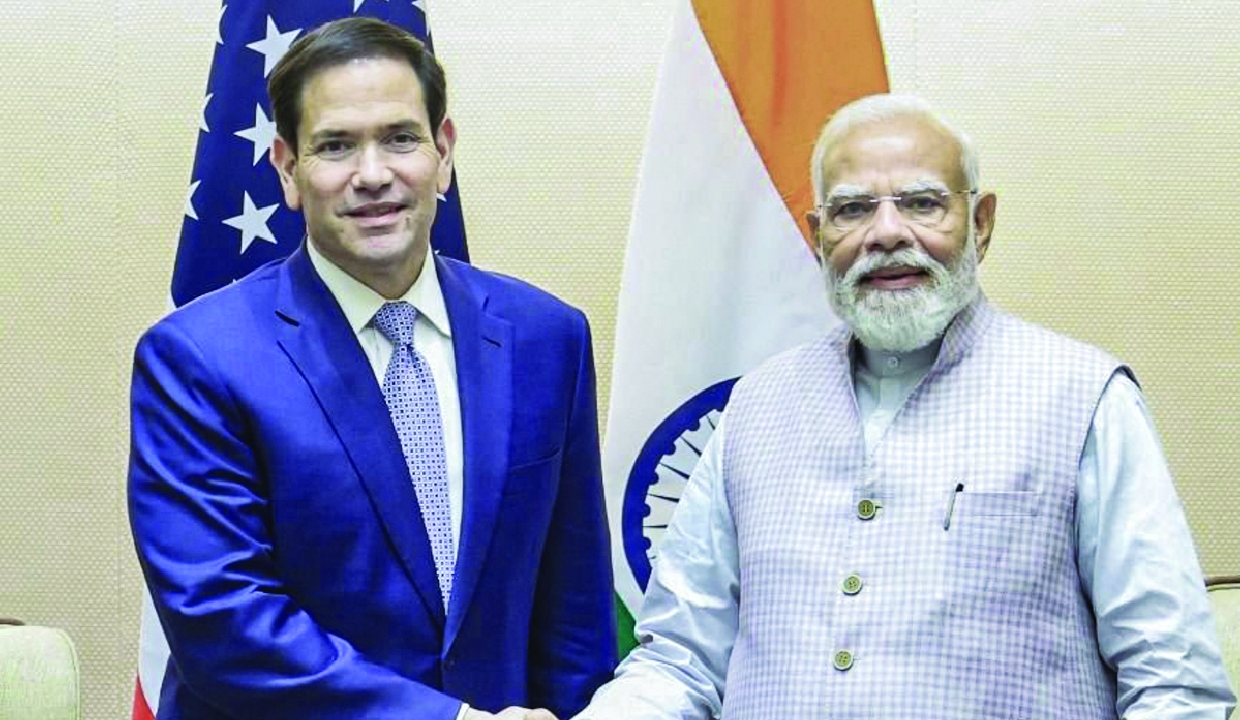
Prime Minister Narendra Modi on Saturday held high-stakes discussions with US Secretary of State Marco Rubio on trade, regional security, and energy cooperation, as Washington sought to deepen strategic ties with New Delhi amid growing instability in West Asia following the Iran conflict.
During the meeting, Rubio conveyed an invitation from US President Donald Trump for Modi to visit the White House, signalling Washington’s intent to maintain close engagement with India despite recent tensions over tariffs, energy purchases, and trade negotiations under the Trump administration’s second term.
The three-day visit by Rubio comes at a delicate phase in India-US relations. While both countries continue to strengthen defence and strategic cooperation, economic disagreements have increasingly tested the partnership.
Trade disputes, concerns over market access, and differing positions on energy imports have complicated ties in recent months, even as both Governments publicly stress the importance of the relationship.
The ongoing conflict involving Iran has added a new layer of urgency to the discussions. Global energy markets have witnessed renewed volatility amid fears of supply disruptions and rising oil prices, placing major import-dependent economies such as India under pressure.
According to officials familiar with the talks, Marco Rubio pitched the United States as a stable and long-term energy partner capable of helping India diversify its energy basket during a period of geopolitical uncertainty.
Washington has been seeking to expand crude oil and liquefied natural gas exports to India, which remains one of the world’s fastest-growing energy consumers.
The US has repeatedly argued that closer energy cooperation would not only strengthen economic ties but also reduce India’s dependence on politically unstable regions.
Senior US envoy Sergio Gor, who accompanied Rubio during the talks, said discussions also covered the Indo-Pacific region, where both countries have increasingly coordinated efforts in response to China’s expanding military and economic footprint.
“The United States and India share a common vision for a free, open, and stable Indo-Pacific,” officials familiar with the meeting said, underscoring concerns in Washington over Beijing’s growing assertiveness in the South China Sea and along critical maritime trade routes.
India has long been viewed by successive US administrations as a crucial strategic counterweight to China in the region. Defence cooperation between the two nations has expanded significantly over the past decade, with growing collaboration in military exercises, technology sharing, and intelligence coordination. However, analysts note that New Delhi has continued to maintain its strategic autonomy, balancing ties with Washington while preserving relations with countries such as Russia and Iran.
The Modi-Rubio meeting also touched on broader regional security issues, including maritime security, supply-chain resilience, and emerging technologies. Officials said both sides reiterated their commitment to strengthening cooperation through forums such as the Quad grouping, which includes India, the United States, Japan, and Australia.
Diplomatic observers believe the White House invitation extended to Modi is aimed at reinforcing political momentum in the relationship at a time when global geopolitical alignments are rapidly shifting. The invitation also comes as both governments prepare for a fresh round of trade negotiations that could shape the future direction of economic ties between the two countries.
Despite periodic disagreements, India and the United States have continued to deepen engagement across defence, technology, and strategic sectors, reflecting what both sides describe as one of the most consequential partnerships of the 21st century.