Paryushan : A cuisine shaped by mindfulness
Some festivals announce themselves through abundance. Paryushan enters the home by asking what can be relinquished. The kitchen grows quieter, ingredients disappear from the shelf and appetite itself becomes a subject of reflection. Yet this deliberate simplicity does not diminish food culture. It reveals another kind of richness, shaped by ahimsa, discipline, seasonality and care.
Indian festivals are not simply occasions marked on a calendar. They are among the most enduring carriers of India’s cultural memory. Through rituals, stories, prayers, family customs and food, values pass almost imperceptibly from one generation to the next. Every traditional dish forms part of this inheritance: its ingredients speak of geography and season, its preparation preserves household knowledge, and its place within a festival recalls why and when it was made. Recording such traditions therefore preserves not merely recipes, but the cultural meaning that gives them life. In 2026, Shvetambara Paryushan begins on Tuesday, 8 September and continues for eight days until Samvatsari on Tuesday, 15 September. Across those sacred days, many Jains fast completely, while others eat within carefully chosen limits. For those who cook, every decision, from selecting a pulse to boiling drinking water, can become an expression of reverence for life.
Paryushan is among the most important annual observances in the Shvetambara Jain tradition. Its name carries the idea of drawing closer to the self, quietening passions and shedding karma through austerity. It falls during the monsoon Chaturmas, when Jain monks and nuns remain in one place. The rains bring forth insects and minute forms of life, making travel more likely to cause unintended harm. Staying put therefore reflects ahimsa as a discipline practised in response to the living world.
Over eight days, devotees deepen prayer, meditation, scriptural study and self-examination. The Kalpa Sutra, which includes accounts of the Tirthankaras and Lord Mahavira’s birth, is read in Shvetambara congregations. Pratikraman encourages reflection upon faults in thought, speech and action. The observance culminates in Samvatsari, when forgiveness is sought with the words “Micchami Dukkadam”, acknowledging hurt caused knowingly or unknowingly. Digambara Jains mark the related but distinct ten-day Das Lakshan Parva, devoted to ten virtues. The distinction preserves Paryushan’s particular religious setting while recognising a shared Jain commitment to purification.
Food participates in this inner work because Jain philosophy asks the eater to consider the life affected by every meal. Underground vegetables such as potatoes, onions, garlic, carrots and radishes are avoided because uprooting them destroys the plant and disturbs organisms in the soil. During Paryushan, many households adopt further restrictions, including fresh greens, certain fruits and ingredients whose use can involve greater harm during the monsoon. Meals are prepared and consumed before sunset, although exact practices differ among families and sanghs. Taken together, these choices give Paryushan a distinctive philosophy of food. What is eaten, when it is eaten, how it is prepared and even what is consciously left uneaten become expressions of ahimsa, restraint and responsibility towards other forms of life. Its cuisine is therefore not simply religious food, but an ethical system practised in the kitchen.
There is no single Paryushan menu because the observance includes different forms of tapasya. Some undertake upvas and consume no food, often taking only boiled water within prescribed hours. Ekasana permits one sitting for a meal, while Biyasana permits two. Ayambil is stricter, centring on one plain meal without rich flavouring, oil, ghee, milk products or sweets. The dishes described here belong to the wider food culture surrounding Paryushan, especially among Gujarati and Rajasthani Jain families eating restricted meals. They are not suitable for every fast or expected of every devotee.
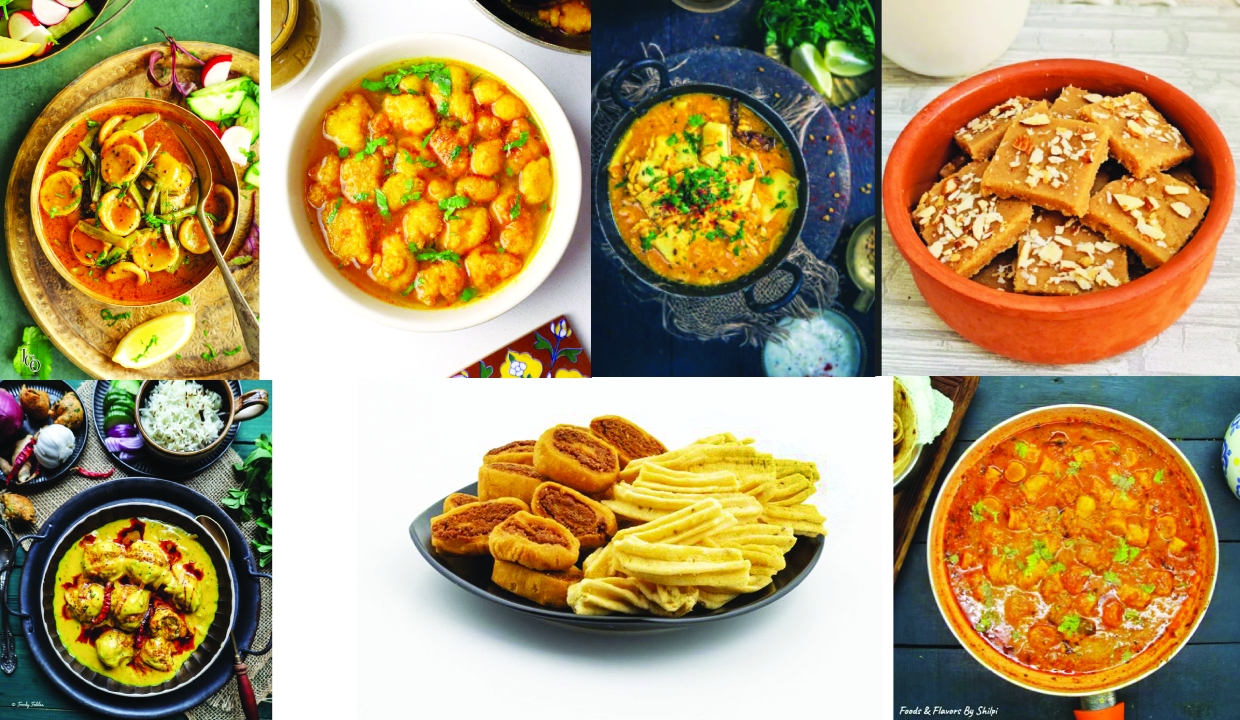
Within those limits, western Indian Jain kitchens have developed an extraordinary pantry intelligence. Dried vegetables, gram flour, pulses, grains, dairy where permitted and preserved foods can carry an entire meal without underground produce. Gujarati Gathiya nu Shaak captures this resourcefulness. Thick chickpea-flour gathiya are simmered in a spiced gravy, often based on curd, buttermilk or dry masala adapted to family rules. They soften at the edges while retaining some bite and are eaten with rotli or another permitted flatbread.
A related pantry dish, Papad nu Shaak, turns roasted lentil papad into pieces that soften in a curd-based or spiced gravy. Its salty, toasted character gives body to a meal when fresh vegetables have been set aside. Moong Vadi nu Shaak follows the same logic. Sun-dried nuggets made from moong paste are cooked until tender in a restrained gravy, providing texture without fresh produce. Ingredients dried before the monsoon thus become especially valuable during sacred days.
The Gujarati repertoire continues with Chana Dhokli nu Shaak, in which pieces of firm gram-flour dough are simmered with chickpeas and dry spices until they absorb the surrounding flavours. The dish is substantial without relying on root vegetables and is served with rotli as part of a daytime meal. For a different balance of sweet and savoury, Pakka Kela nu Shaak uses ripe banana rather than raw plantain. Slices are gently cooked with cumin, chilli, turmeric and a souring element allowed by the household, creating a soft shaak in which the natural sweetness of the fruit is checked by spice. Bananas also appear in Kelawada, small fritters made by combining mashed ripe banana with flour and seasonings before frying spoonfuls until golden. Where frying is permitted, they are enjoyed warm as a compact snack rather than an unrestricted indulgence.
Another ingenious preparation is Banana Chivda, made from thin banana slices fried until crisp and tossed with salt, pepper or selected dry spices. It keeps well, requires no green garnish and is eaten in modest portions during permitted hours. Alongside it, Sing Daliya ni Chutney combines crushed roasted peanuts, dry coconut, sesame or permitted spices. Ground without fresh herbs or garlic, this dry, nutty accompaniment enlivens rotli and gram-flour dishes. Both show how flavour can be created without weakening the observance’s restraint.
Across Rajasthan, an arid landscape had already taught cooks to make exceptional use of gram flour, dried berries and little water. Gatte ki Sabzi is therefore naturally at home in many Paryushan kitchens. Besan is kneaded with spices into firm cylinders, boiled, sliced and simmered in a curd gravy. The dumplings absorb the tangy sauce and are eaten with rotis, turning shelf-stable ingredients into a complete dish.
The desert’s most distinctive contribution is Panchkuta, traditionally built from dried ingredients such as ker berries, sangri beans, kumatiya seeds, gunda and dried mango. The components are soaked, cleaned, boiled and cooked with oil and dry spices. Each contributes a different sensation, from the sharpness of ker to the fibrous bite of sangri, while dried mango supplies acidity when fresh lemon is avoided. This is not a generic festival vegetable, but an expression of a regional ecology in which scarcity, preservation and respect for resources have long shaped taste.
Curd and gram flour also meet in Pakodawali Kadhi, a Rajasthani preparation in which small besan fritters are immersed in a gently simmered yoghurt gravy. The tempering is adjusted to Paryushan rules, relying on asafoetida, cumin, mustard seeds and dried chilli rather than fresh aromatics. The soft pakodas make the kadhi more substantial and it may be paired with rice during a permitted meal. Each of these savoury dishes is adaptable, but adaptation must remain honest. A recipe becomes appropriate only when every ingredient, preparation method and eating time agrees with the discipline observed in that particular home.
Sweet preparations require the same qualification. They are not part of Ayambil and have no place during a complete fast, but some families prepare them for those who are eating, for children, for communal hospitality within permitted rules or for the parna meal after a period of fasting has formally ended. Gujarat’s Mohanthal is among the most prized. Coarse besan is rubbed with ghee and milk to form a grainy texture, roasted slowly until nutty, then set with sugar syrup, cardamom and sometimes saffron. Cut into dense squares, it rewards patient roasting and is served in small pieces.
Wheat takes a more rustic form in Churma Laddoo. Coarse-flour dough portions are fried or baked, crushed into crumbs and mixed with melted ghee, jaggery or sugar and cardamom before being shaped into balls. Barfi Churma begins with a similar crumb but is pressed into a tray and cut into squares or diamonds, giving the familiar flavours of churma a firmer, sliceable form. Both preparations preserve an older household knowledge of judging texture by touch, knowing when the flour is roasted enough and adding just sufficient ghee for the mixture to hold.
In Sukhdi, also called Gol Papdi, wheat flour is roasted in ghee until aromatic, removed from intense heat and mixed with jaggery so that it melts without turning hard or bitter. The mixture is spread quickly and cut while still warm. Its short ingredient list makes precision essential. Lapsi develops sweetness more slowly. Broken wheat is roasted in ghee, cooked until the grains swell and then sweetened with jaggery or sugar, often with cardamom and nuts. Served warm, it retains a pleasantly separate grain and carries the comfort of a sweet made from the everyday grain cupboard rather than elaborate decoration.
Gram flour returns in Magaj, but with a texture distinct from Mohanthal. Fine besan is gently roasted in ghee and combined with powdered sugar and cardamom to create a soft, rich sweet that may be shaped or set. Moong Dal Halwa, associated especially with Rajasthan, demands still more patience. Soaked moong dal is ground and roasted slowly in ghee until its raw aroma disappears, then cooked with milk or water and sugar until glossy. Kalakand completes the sweeter spread where dairy is allowed. Milk is reduced or gently curdled and cooked with sugar until moist granules form, then set and cut. None of these sweets defines Paryushan by itself, but together they show how regional Jain households accommodate different ages and levels of observance without confusing nourishment with spiritual licence.
Even beverages are governed by attention. Boiled water holds the central place for many devotees because water is filtered and boiled to reduce harm to minute life, then consumed only within the time and storage limits prescribed by one’s tradition or sangh. Those not undertaking a strict fast may drink plain milk, lightly flavoured Masala Milk prepared with cardamom, saffron or permitted dry spices, ordinary tea, a mild dry-ginger infusion or water sweetened with mishri. Such drinks are neither universal nor interchangeable. Milk, sugar and spices are excluded from stricter practices such as Ayambil, while someone observing upvas may take only boiled water. The beverage chosen is therefore another declaration of the vow being followed.
This is what makes Paryushan cuisine remarkable. Its depth lies not in a celebratory thali but in the moral reasoning that precedes the meal. A papad becomes a vegetable, dried desert produce replaces a market basket and ripe banana supplies both shaak and snack, while the empty plate of a fasting devotee remains just as meaningful as another’s carefully restricted meal. Both express the effort to loosen appetite’s hold and turn attention inward.
The Paryushan kitchen has also served as an informal classroom of culture. Recipes were rarely transmitted in isolation. Along with a method came an explanation: why one ingredient was avoided, why another was preserved, why food was prepared before a particular hour and why a dish belonged to a season or sacred occasion. Younger generations should therefore be invited to roast besan for Mohanthal, clean ker and sangri, shape gatta and grind a dry chutney while learning the values behind each act. Cuisine can carry knowledge without calling itself education. Preserving Paryushan’s food traditions means passing on both recipe and reasoning, so the observance remains not only marked on a calendar but understood through choices made at the stove, at the table and, sometimes, through the profound choice not to eat at all.
The writer is Secretary, Cuisine India Society; Views presented are personal.