Partition took place because Hindu sentiment was forgotten: RSS chief
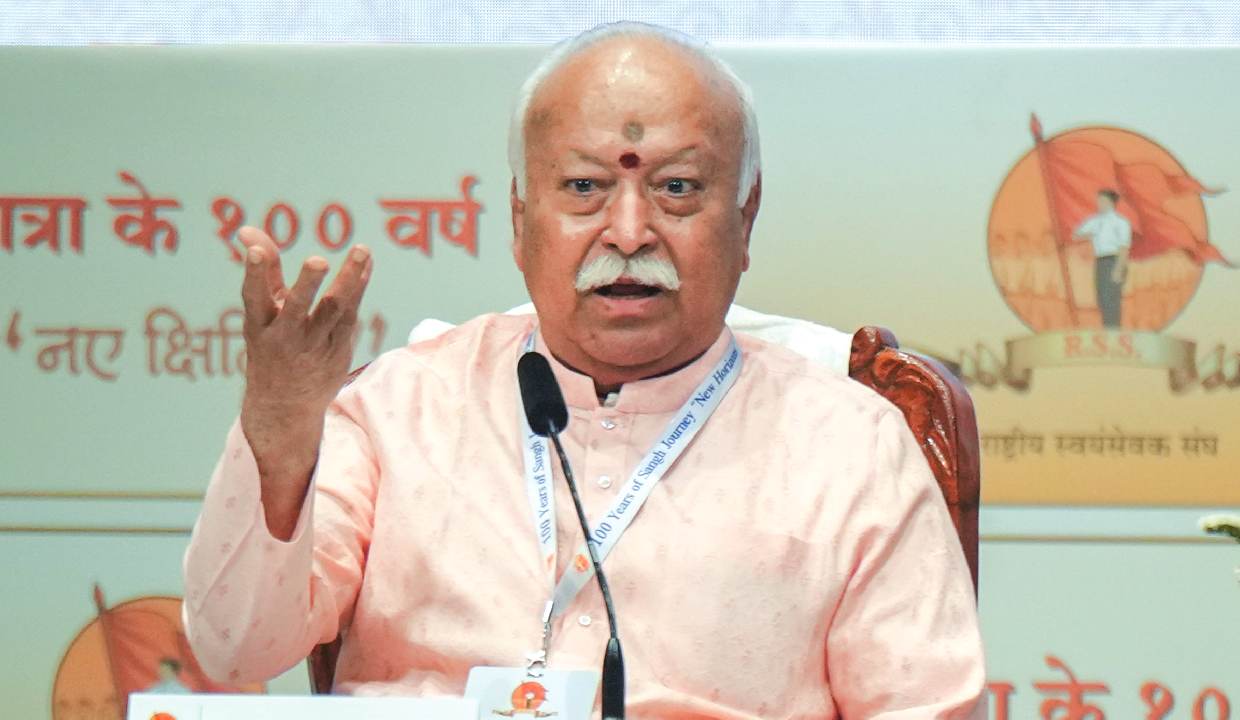
Rashtriya Swayamsevak Sangh (RSS) chief Mohan Bhagwat on Saturday said the partition of India took place because the “Hindu bhav” (sentiment) was forgotten.
Speaking at a programme titled ‘100 years of the Sangh journey’ here, he also said that the Rashtriya Swayamsevak Sangh cannot be understood without a dialogue.
While ‘swadeshi’ (reliance of indigenous production) was necessary, global dependence was also needed, Bhagwat said, while adding that such dependence should not be driven by “tariffs.”
“Partition happened because of religion. We said we respect all religions, because we are Hindus. There are people who say this was wrong. Islam, Christianity still exist in India. There are skirmishes, but the country has remained united....’ Hindu bhav ka vismaran’ (Hindu sentiment being forgotten) led to the partition of India,” Bhagwat added.
He further stressed that being Hindu does not mean a person should stop practising their own religion. “You don’t lose anything by accepting Hindutva, (neither) your religious practise, (nor) your language. Hindutva is a guarantee of your safety,” the RSS chief said.
A person’s faith, food habits and language may be different, but we are all one as a society, culture and nation, he said, adding, “We call this Hindutva, and you may say (call it) Bharatiyata.”
He also said that Hindu-Muslim unity is a wrong phrase because “you unite two (different) people and not those who are already one.”
Dialogue was necessary to understand the RSS and the nature of the organisation cannot be understood on the basis of perception and propaganda, Bhagwat said, adding that if there was any Opposition to the Sangh on a factual basis, “we will improve”, but “to know the facts you must come to us.”
The strength of righteous and peaceful co-existence needs to be activated and we need to complement each other, he said.
Dialogue within families is necessary to ensure that the younger generation does not take to drugs or is not driven to suicide, Bhagwat said, adding that the inculcation of self-pride (“Swa ka Gaurav”) and understanding of the self (“Swa ka bodh”) are necessary.
Bhagwat also said the Sangh is not “against anyone”, and it does not seek power or popularity.
“But still it is seen, to some extent, that the work of giving a direction to society and creating an (enabling) environment is not happening,” he said.
The RSS was not “against anyone” and did not work as a reaction to any incident, Bhagwat said, adding that its focus was supporting and strengthening positive efforts underway in the country.
The Sangh was also not a paramilitary force even though it conducts route marches, and though its volunteers wield the lathi, it should not be seen as an “akhada” (wrestling club), Bhagwat said.
Nor is the RSS involved in politics, though some individuals with the Sangh background are active in political life, he added.