
- HOME
- INDIA
- WORLD
- BUSINESS
- STATES
- LAW & JUSTICE
- ENTERTAINMENT
- SPORTS
- VIEWPOINT
- LIFESTYLE
- TECH
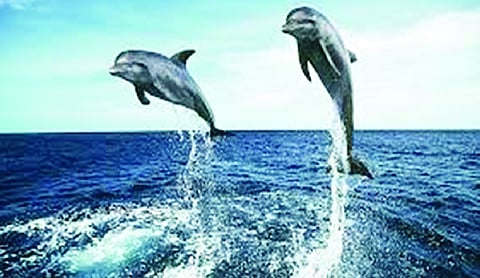
The National Mission for Clean Ganga (NMCG) has highlighted signs of ecological revival in the Ganga under the Namami Gange programme, citing large-scale afforestation and the return of key aquatic species, including the endangered Gangetic dolphin.
In a post shared on social media earlier this week to mark 12 years of the Namami Gange programme, the NMCG said, “For decades, Ma Ganga’s banks grew thinner, and her water grew quieter. Trees that held the soil disappeared. The dolphin our grandparents saw stopped appearing. The fish a fisherman could once count on became a memory.”
The agency said 33,024 hectares of forest now stand along the river’s banks and 6,324 Gangetic dolphins have been recorded in India’s first nationwide survey of the species.
Explaining the connection between afforestation and biodiversity recovery, the NMCG said, “The two numbers are not separate.”
“When the trees come back, the soil holds. When the soil holds, the water clears. When the water clears, the fish come. When the fish come, the dolphin follows,” it said.
The NMCG also referred to the return of turtles, otters and hilsa fish to stretches of the river where they had previously declined, describing them as indicators of improving ecological conditions.
“A river is not only water. A river is a forest, a fish, a mammal, a livelihood, all moving together. Twelve years of Namami Gange has begun to put each of those back,” the NMCG said.
The mission said the impact of these changes is visible to local communities dependent on the river.
“A fisherman on the Vikramshila stretch knows this without reading a report. So does the village downstream that no longer loses its land to the monsoon,” it said.
While noting that the river has not fully regained its historic ecological richness, the NMCG expressed optimism about the direction of change.
“It is not yet the river of a thousand years ago. But for the first time in our lifetimes, life is moving back to her, not away,” the post said.
The Namami Gange programme was launched in 2014 with the objective of reducing pollution, improving river ecology and conserving the Ganga and its tributaries.
According to recent government data, the afforestation work has been carried out through a forestry intervention project implemented by the NMCG in collaboration with state forest departments along the main stem of the Ganga.
The project has covered 33,024 hectares with an expenditure of about Rs 414 crore.
The programme has also undertaken biodiversity conservation measures, including the release of 203 lakh Indian Major Carp fingerlings to improve fish biodiversity and strengthen the prey base for river dolphins.
Government assessments have reported increased sightings of dolphins, otters, turtles, gharials and hilsa in several stretches of the river.
India’s first nationwide river dolphin survey recorded 6,324 Gangetic dolphins and three Indus dolphins, taking the total river dolphin population estimate to 6,327.