Ordnance Factory Day : Forging Peace With Fire
“For want of a nail, the shoe was lost; For want of a shoe the horse was lost;
For want of a horse, the rider was lost; For want of a rider, the battle was lost;
For want of a battle, the Kingdom was lost; And all for the want of a horseshoe nail.”
“Anonymous (1629)”
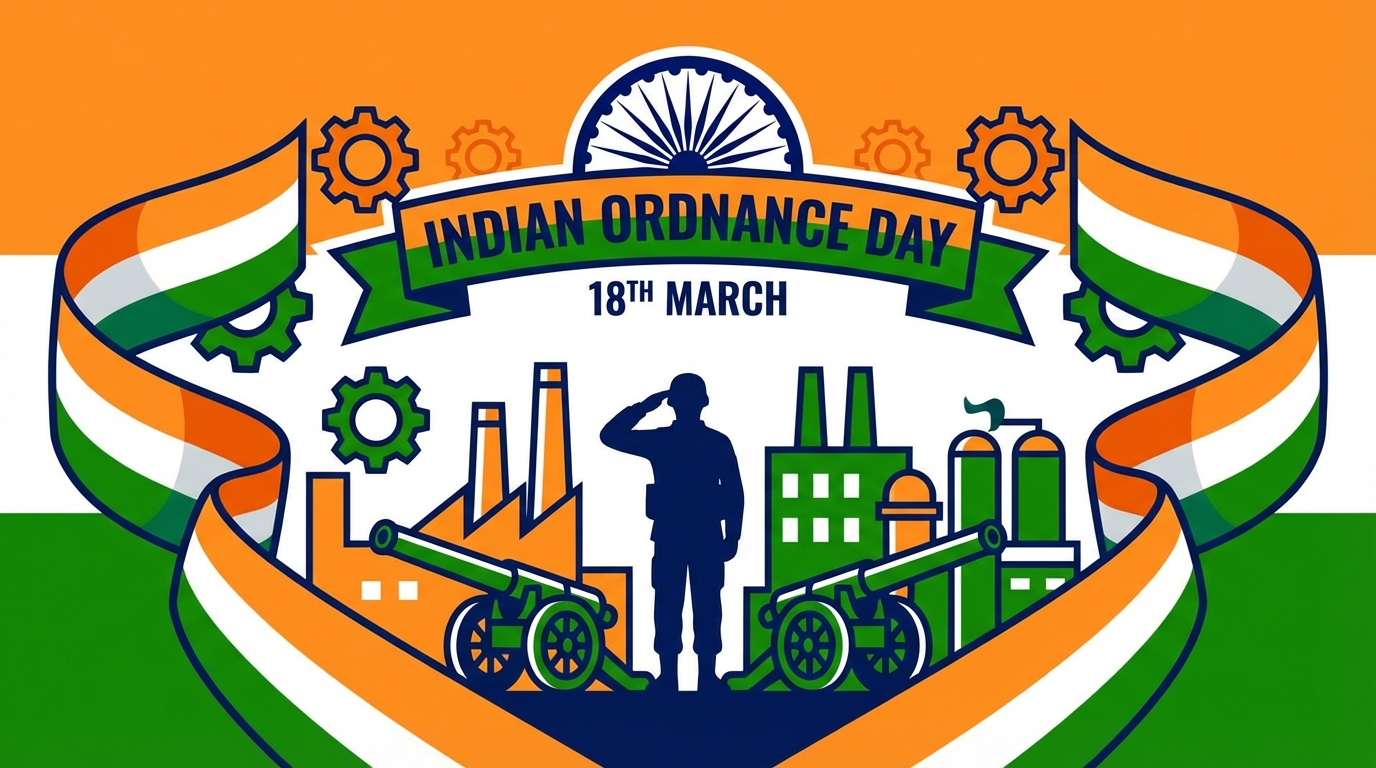
Official beginning of the Army Ordnance in India is marked by establishment of the Board of Ordnance at Fort Williams, Calcutta on 08 April, 1775 by the East India Company under recommendations of Lt Gen Sir John Clavering. The Ordnance Corps of Indian Army traces its roots to this institution. This also marked the beginning of India’s indigenous military production which later led to establishment of the Gunpowder Factory at Ichhapore in 1787 and the Gun Carriage Agency at Cassipore in 1801 which started production in 1802 – on a day that is celebrated as Indian Ordnance Factory Day. 18 March is a date which pulses with the heartbeat of our nation’s self-reliant defence spirit! At present there are 41 ordnance factories which represent over two centuries of indigenous firepower, evolving from British-era necessities into the backbone of India’s military might. It will be a befitting tribute to recount their journey, achievements, and potential synergies for our National emergence.
The Ordnance Factories’ story in fact, began even earlier, in 1712, with a modest Dutch gunpowder mill at Ichhapur. Later establishment of Rifle Factory in 1787 made it the subcontinent’s first small-arms hub. The pivotal Cossipore establishment, operational by 1802, crafted gun carriages for the East India Company’s artillery during the Napoleonic Wars, marking India’s entry into precision manufacturing. Post 1857, factories like Jabalpur and Kanpur sprang up to arm British troops against princely states.
Independence in 1947 handed us 16 ordnance factories; which were placed under the Ministry of Defence to achieve self-reliance in defence production. In 1979 a new overarching organisation, the Ordnance Factory Board (OFB), was created which became the world’s largest government-owned defence conglomerate with 41 units employing over 80,000 skilled workers across 23 states.
In 2021 these 41 factories were reorganised into seven DPSUs as under:-
- Munitions India Ltd (MIL).
- Armoured Vehicles Nigam Ltd (AVNL).
- Advanced Weapons and Equipment India Ltd (AWEIL).
- Troop Comforts Ltd (TCL).
- India Optel Ltd (IOL).
- Gliders India Ltd (GIL).
- Yantra India Ltd (YIL).
This corporatisation gave greater functional independence, leading to enhanced efficiency, competitiveness and innovation. In Nov 2025 three out of the above i.e Munition India Ltd, Armoured Vehicles Nigam Ltd and India Optel Ltd were granted the status of ‘Mini Ratna’ of the Govt of India. This recognition was a reflection of their growing efficiency, autonomy and contribution to the defence sector. In a spirit of collaboration and self-reliance, Yantra India Ltd has signed an MOU with two other DPSUs (Hindustan Aeronautics Ltd and Bharat Dynamics Ltd) to support its modernisation efforts and establish a 10,000 ton Forging Press facility.
Throughout my service, Ordnance Factory products were the constants that defined infantry combat. Rifle Factory Ishapore (RFI) produced the iconic 7.62x51mm SLR (Indian No.1 Rifle), IOF .32 pistols, and 9mm 1A1 carbines. Small Arms Factory, Kanpur churned out INSAS rifles (5.56x45mm), LMGs, and the advanced Joint Venture Protective Carbine (JVPC).
Ordnance Factory, Dum Dum pioneered polymer magazines for INSAS, and now the renowned plastic furniture manufacturer ‘Nilkamal’ supplies high-strength magazines for INSAS rifles and LMGs, showcasing private sector integration even pre-corporatisation. Field Gun Factory, Kanpur produces 9mm pistols which equip not just our defence services but are exported to 30 odd countries.
No soldier can do without reliability of Ordnance ammo. Ammunition Factory, Khadki (Pune) and Muradnagar produce 5.56mm to 155mm rounds, 81mm/120mm mortars, 40mm grenade launchers, and fuzes—over 1,000 tonnes of propellant annually! High Explosives Factory, Pune crafts RDX, HMX, and bulk TNT; Ordnance Factory, Khamaria (Jabalpur) specialises in 76mm naval shells for INS Vikrant and anti-submarine rockets like RGB-60 for RBU-6000 systems.
Heavy Alloy Penetrator Project (Trichy) forges tungsten penetrators for 120mm APFSDS rounds used in T-90 tanks. In tank battles, Heavy Vehicle Factory, Avadi (Chennai) has always been legendary, assembling 2,400+ T-72 and T-90 Bhishma tanks, Arjun Mk1A variants, bridge-laying tanks (T-72 BLT), and mine-clearing T-72 mine ploughs.
Vehicle Factory, Jabalpur (VFJ) delivers 8x8 Stallion high-mobility trucks (10,000+ units), Rakshak mine-protected vehicles, and Pinaka MBRL systems—key in Kargil and recent border skirmishes.
Gun & Shell Factory, Cossipore (Kolkata) and Gun Carriage Factory, Jabalpur produce Dhanush 155mm/39 calibre howitzers, Sharang 155mm/39 up gunned from Soviet-era stocks, and ATAGS prototypes. Field Gun Factory adds 105mm light guns and 76mm Super Rapid Gun Mounts (SRGM) for naval frigates.
Opto-Electronics Factory, Dehradun equips night fighters with thermal imagers, laser rangefinders, and UAV payloads for Heron and Searcher drones. Ordnance Parachute Factory, Kanpur supplies 25,000+ parachutes yearly, including steerable AccuGlide for Garud Commandos, Gemini RFDs, and inflatable raiding craft; it also produces CBRN suits, bulletproof vests (NIJ Level III/IV), and K-6 combat free-fall rigs.
Clothing Factories at Shahjahanpur and Kanpur deliver 5 lakh uniforms, g-suits, and anti-G trousers annually. Missile Factory, Tiruchirappalli contributes solid propellants for Agni, Prithvi, Akash, Astra, BrahMos, and even ISRO’s GSLV scramjet motors.
Gun & Shell Factory, Cossipore builds AK-630 Close-In Weapon Systems and 100mm AK-100 deck guns for destroyers. Ordnance Factory, Medak (now AVNL) integrates Su-30MKI avionics; bombs, rockets (S-8, S-13), and 250kg/500kg retard bombs which arm Tejas & Jaguar fighters, and Rudra helicopters. Torpedoes from Ordnance Factory, Jabalpur bolster Varunastra lightweight torpedoes.
We now have joint venture of India Russian Rifles Private Ltd, inaugurated in 2019, manufacturing AK-203 rifles to replace INSAS rifles. It is a joint venture between India’s Advanced Weapons and Equipment Ltd along with Munition India Ltd; and Russia’s Rosoboronexport and Kalashnikov Concern. This involves 100% technology transfer and 100% indigenization.
The inauguration of DPSU Bhawan in Nov 2025 also saw the launch of a comprehensive compendium ‘SWAYAM’ as a major step towards sustainable defence manufacturing. Anchored in the Comprehensive Energy Efficiency Action Plan (CEEAP) 2023, SWAYAM details efforts to enhance energy efficiency, expand renewable energy adoption, and reduce carbon emissions across the defence production ecosystem. Supported by the digital tools like the SWARNA Dashboard and DPSU Energy Efficiency Index, the initiative is a reflection of official commitment to combining sustainability with self-reliance.
As we celebrate this day in 2026, Ordnance DPSUs will do well to deepen ties with private giants like Tata Advanced Systems, L&T, Mahindra Defence, Bharat Forge, and Kalyani Strategic Systems, and also with many more next gen technologically innovative startups. Corporatisation enables joint ventures, tech transfers via iDEX (500+ startups), and co-production, slashing import reliance from 70% to under 30%.
Imagine MIL-Nilkamal scaling polymer components; AVNL-Tata building next-gen FRVs; AWEIL-Bharat Forge perfecting 155mm smart shells. This synergy will accelerate drones, hypersonics, and AI munitions, boost exports, and realise close to 100% indigenisation—true Atmanirbhar and Viksit Bharat by 2047; if not earlier!
I echo the words of Shri Rajnath Singh, our Raksha Mantri; who while inaugurating the DPSU Bhawan on 10 Nov 2025 had said, “Let us all resolve to not only make India self-reliant in defence production but also establish it as a global manufacturing hub.”
Maj Gen Balraj Mehta