No changes at Vrindavan’s Bankey Bihari temple: SC
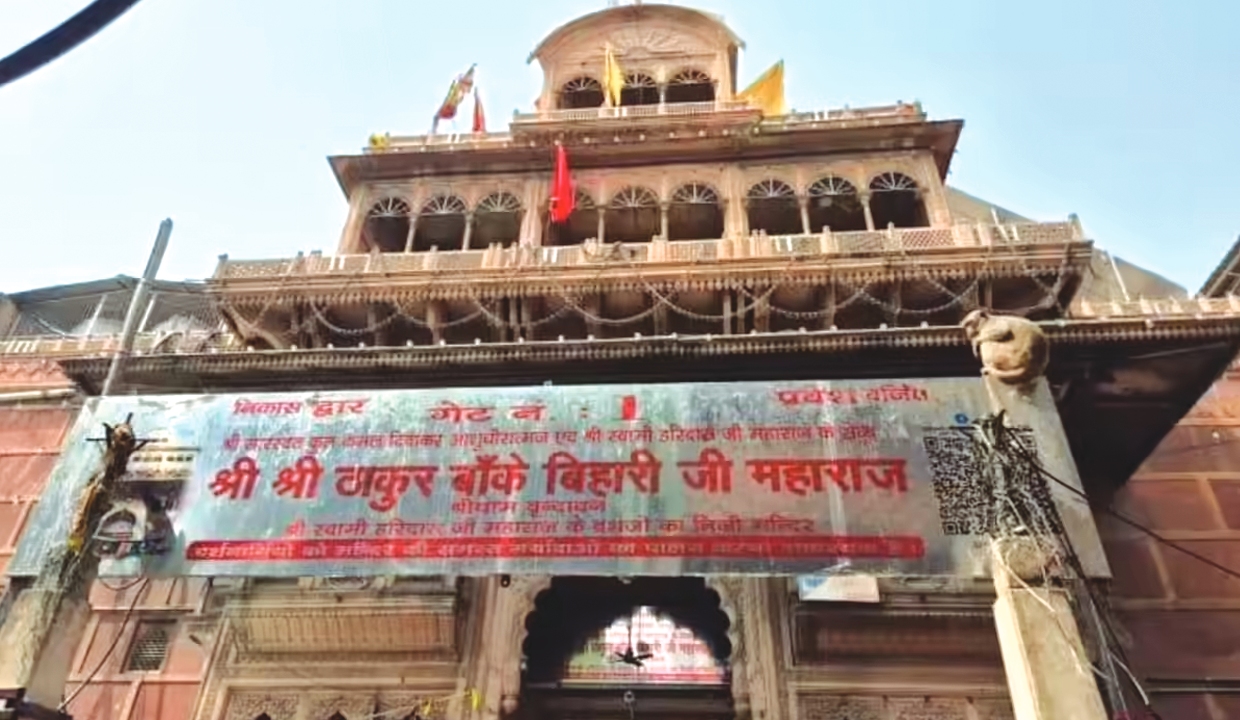
The Supreme Court of India (SC) on Monday made it clear that it would not make “any structural changes” to the present arrangement with regard to religious practices at the famous Bankey Bihari temple in Vrindavan.
A bench of Chief Justice Surya Kant and Justice Joymalya Bagchi took note of the submissions of senior advocate Shayam Divan and lawyer Tanvi Dubey, and directed that the matter be listed after two weeks to allow the parties to respond to a recently-filed status report.
The top court was hearing a petition filed by the management committee of the Thakur Shree Bankey Bihari Ji Maharaj Temple and Sevayats (priests).
The petitioners have challenged recent administrative decisions taken by a court-appointed High-Powered Committee (HPC) that have allegedly interfered with age-old religious traditions.
Earlier, the court had stayed parts of the Uttar Pradesh Shri Bankey Bihari Ji Temple Trust Ordinance, 2025, and formed the 12-member HPC headed by retired Allahabad High Court judge Ashok Kumar to oversee the temple’s operations. Divan told the court that he was given a status report late on Sunday evening and that he be granted two weeks to respond.
“We are not inclined to make any structural changes to the present arrangement,” the CJI said while adjourning the hearing.
Additional Solicitor General KM Nataraj said the HPC wants to go in accordance with the court’s directions and no adversarial stand will be taken in this case.
The apex court, on December 15, 2025, issued notices on the plea and the status report was filed on Sunday.
The bench also issued a notice on an application that has raised certain factual and other grounds, which require modifications or clarifications.
The petitioners have raised concerns on how the interpretation of wide powers has been done by the HPC that has passed certain orders touching upon the essential religious rituals of the temple, including a change in the “darshan” timing, closing the Dehri puja ritual, exorbitant charges imposed on Sevayat Goswami’s charging for phool bangla service, etc.
The challenge in the plea is mainly related to the change in the “darshan” timing of the temple and also the stopping of certain essential religious practices, including the Dehri puja.
The petitioners have submitted that the temple has historically followed strict seasonal timings and distinct schedules for summer and winter that are closely intertwined with internal rituals, including the waking and resting of the deity.
It was argued that recent changes in timings, effected pursuant to office memoranda issued in September 2025, have disrupted the essential religious practices at the temple.
Emphasising the temple’s unique and sacrosanct nature, the petitioners have explained that there is a unique timing for morning and evening “darshan”, rooted in tradition and religious purpose.
The petitioners have also highlighted that the discontinuation of the age-old “Dehri puja”, performed exclusively by the Goswamis, is a part of the Guru-Shishya parampara, arguing that its suspension on the ground of crowd management is unfounded since the ritual is performed when the temple is closed to the public and at a limited, specific location.
The bench issued a direction to hear both the application and the main plea after two weeks.
On December 15 last year, the bench had expressed unhappiness over the practice of allowing people to do “special pujas” at temples after paying money, disrupting the “resting time” of the deities.
It had also sought a response from authorities on a plea challenging the changes in the “darshan” timings and practices at the Bankey Bihari temple in Vrindavan.
It had issued a notice to the HPC and the Uttar Pradesh Government, and listed the matter for further consideration.
“What they do is, after closing the temple at 12 noon, they do not allow the deity to rest even for a second and they exploit the deity like anything. The so-called affluent people, those who can afford to pay hefty amounts, are allowed to do special pujas,” the CJI had observed orally.
The Uttar Pradesh Shri Bankey Bihari Ji Temple Trust Ordinance, 2025, seeks to replace this scheme with a State-controlled trust, triggering a debate over Governmental involvement in religious institutions and its impact on established traditions.
In August 2025, while hearing a challenge to the ordinance, the top court had declined to examine its constitutional validity, leaving that issue to the Allahabad High Court.
It had, however, stayed the operation of the ordinance, which rests administrative control of the shrine with the State, till the High Court decides its validity.
However, it had also constituted the HPC to manage the temple’s day-to-day affairs.