New technologies chugs Indian railways
The Indian Railways is in a reset mode, for a change. The train has chugged up the hill in Kashmir and Mizoram. The sight of a rail winding through the mountains and the terrains overwhelmed the residents in Kashmir and Mizoram (Bairabi-Sairang railway line) held back in growing alienation by history and geography for ages. Their inclusion into ever expanding ambit of Indian transport is a step stone to prosperity. The promise of the incredible North East or even Kashmir had long been buried deep into status quo.
The three capitals of the Northeast, Guwahati, Agartala and Itanagar, are already connected to the national rail network. The Shokhuvi-Molvom section in Nagaland was completed in March 2025, with further sections to Kohima (Zubza) under construction and expected to open by 2026-2029. The Murkongselek — Sille stretch in Arunachal Pradesh is to open in a couple of months, if not earlier, with the Sille-Pasighat section following in February 2026.
Assam saw new Amrit Bharat trains and new railway links approved, boosting connectivity and economic prospects. The Indian Railways has also illuminated several areas of darkness like Palamu, Jharkhand, the only state in the country where the operation of Rajdhani Express was limited and irregular.
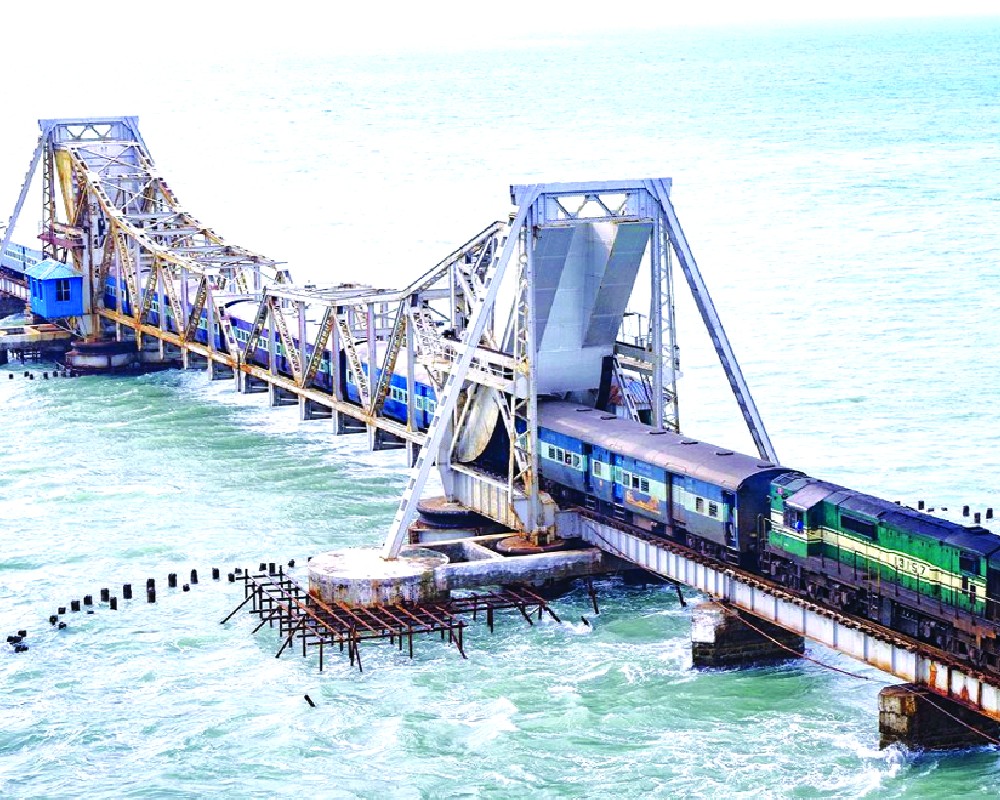
Connecting Kashmir to Kanyakumari, completion of Udhampur-Srinagar-Baramulla Rail Link (USBRL) included the construction of the Chenab Bridge, the world’s highest railway bridge, and the Anji Bridge, India’s first rail cable bridge. The New Pamban Bridge, India’s first vertical lift sea bridge, replaced the 105-year-old Pamban Bridge. The inauguration left many gasping with awe and admiration across the world, given the audacity of the magnitude defying the geography and the technology. The inspiration is drawn from the leadership up the order.
Union Minister of Railways, Ashwini Vaishnaw is often sitting with the driver running down a test drive fraught with the risks of an inaugural drive. The Minister is neither bound by a rule nor required by a custom to tread an un-trodden path. Needless to say, the message is quietly communicated to keep moving without fear. Even in the aftermath of the railway accidents, the Minister himself remains present at the site of the accident like a common passenger or victim, sitting on the tracks or on the culvert even at night to inspect. Of course, the criticisms keep flying thick and fast. The opposition and the doomsayers are always far removed, and for a purpose as well. The distance lends enchantment too.
But if it was so easy, why could the previous ministers worthy of salt not set such an example? After all, it is neither an obligation under any rule nor a requirement. However, a new start is not a hostage to the past for a person possessed with a mission. The relief and distribution work in the aftermath of an accident is best completed in an overdrive. Minister’s presence ensures the precious time is not lost to save a victim from the clutches of red tape always ready with salt to injury of the victims already reeling under the misfortune. Even small act of gratitude is beautiful, leave alone the huge leaps. Playing Chhath songs and music on loudspeakers at stations and in the trains ferrying the devout passengers to Bihar was another unforgettable pleasant surprise to all the passengers that has never happened before and may never happen in the future. But resonating so small but inner chords deep in the hearts of passengers is a memory that will be cherished for the rest of their lives. Railways also successfully made up for the previous mismanagements with a heart and compassion.
Treating our passengers as a part of its own, this compassion for their well-being adds a touch of sweetness to help overcome the obvious discomforts of a difficult journey, the horrific crowds and the stretched system during Chhath. This is a reflection of the
fundamental change taking place within Indian Railways.
That’s not to say everything is perfect and there’s nothing left for an improvement. There’s still a lot to correct. But the wheels are turning, the engine is roaring strong, and most importantly, the priorities are clear and right. The statistics below bear a testimony to the wheels of the Railways chugging into unchartered territories. Renewable energy capacity reached 2,014 MW, with 375 MW solar and 103 MW wind energy commissioned in 2024-25. Production milestones included 700 locomotives by CLW and 477 by BLW, setting new annual records. Coach production also saw a 9 per cent growth, with 7,134 coaches manufactured. Track renewal reached 6,450 km, turnout renewals 8,550, and 6,200 km of rails were renewed, with speed upgrades on 2,000 km to 130 kmph and 7,200 km to 110 kmph. Freight loading reached 1,473 million tonnes (MT), showing a 3.86 per cent growth, supported by Dedicated Freight Corridors (DFCs) which facilitated over 72,000 train runs. Average speed of goods trains improved by 18.1 per cent, from 13.40 to 15.82 kmph and mail/express punctuality stood at 93.78 per cent for the year. A record 136 Vande Bharat trains were introduced, with the launch of the first Namo Bharat Rapid Rail. Vande Bharat now operates on over 40 routes nationwide.The Amrit Bharat Station Scheme saw work start on 1,198 stations out of 1,337 targeted, modernising station infrastructure. Over 10,000 locomotives were equipped with Kavach, the indigenous train protection system, enhancing safety. Indian Railways electrified a record 7,188 km of railway lines, averaging 14.5 km per day, surpassing previous years and advancing the goal of 100 per cent electrification. The Amrit Bharat Station redevelopment scheme is modernising stations across the country, improving amenities and accessibility.
Indian Railways has prioritised digital transformation, renewable energy adoption, and eco-friendly practices to ensure a sustainable future. These developments collectively demonstrate a clear upward trend in Indian Railways’ operational efficiency, safety and passenger experience over the last five years. Over 23,000 track kilometers have been upgraded to support speeds up to
130 kmph, and 54,337 km upgraded for 110 kmph, enhancing both passenger and freight transit efficiency. Electrification of broad-gauge tracks has advanced rapidly, with 6,577 route kilometers electrified in 2023 alone. Modernisation efforts include the introduction of LHB coaches, onboard Wi-Fi at over 9,000 stations, smart ticketing and enhanced safety technologies.
Author is a senior journalist and political communications expert; views are personal