New India would not hesitate to protect its people: PM
Prime Minister Narendra Modi on Friday said previous Governments may have hesitated to respond after a terror attack, but the new India neither bows nor hesitates from protecting its people.
The PM said the crux of national security is believing in taking everyone along but stand up to protect Dharma.
“Previous Governments used to sit idle after a terror attack but the new India neither bows nor hesitates from protecting its people,” the Prime Minister said, addressing people in the temple town of Udupi.
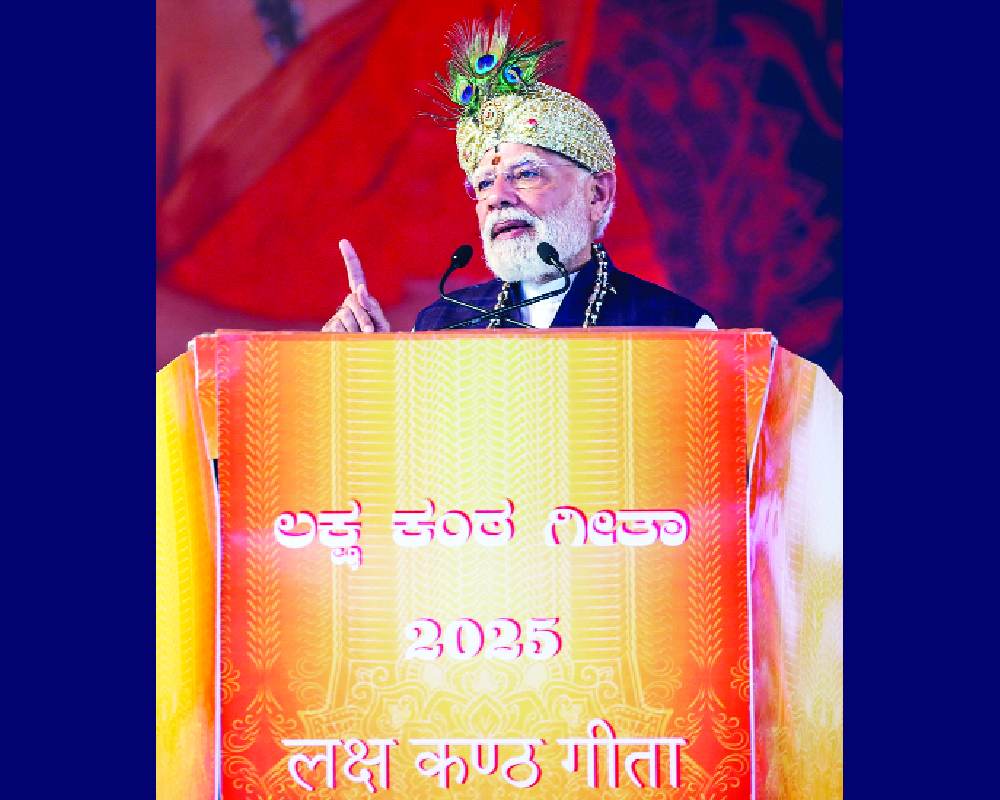
He was here to take part in the “Laksha Kantha Gita Parayana,” where one lakh people recited the Srimad Bhagwad Gita. The event was organised by Sri Krishna Math in Udupi.
“Gita teaches us to strive for peace and truth and also the need to crush perpetrators of atrocities. We believe in Vasudhaiva Kutumbakam (Mother Earth as one family) and also recite ‘Dharmo Rakshati Rakshitaha’ (Dharma protects those who protect Dharma).”
Recalling the Pahalgam terror attack in April this year in which 26 persons, mostly tourists, were killed, Modi said people from Karnataka were among the victims.
He said the nation saw the Government’s Resolve during Operation Sindoor, India’s military response to the ghastly incident where precision attacks were carried out on terror launchpads in Pakistan.
“We give Krishna’s message of compassion from Red Fort and also announce Mission Sudarshan Chakra,” he said.
Explaining, he said Mission Sudarshan Chakra provides a security wall around key locations, industrial and public places. Hailing Udupi, he said the town presented a new governance model five decades ago, which today guides national policies on cleanliness and water supply.
Lauding Swami Vishwesha Teertha of Pejavara Math of Udupi, he said the whole nation knows how big his role was in the Ram Janma Bhoomi movement.
His guidance to the temple movement led to flag hoisting at the Ram temple in Ayodhya recently, he said.
Modi told the gathering that the Ram temple in Ayodhya is significant for Udupi because a special arch gate has been built dedicated to Sri Madhwacharya, the founder of the Madhwa sect of Dwaita (dualism) philosophy.
Speaking about the important of the Bhagwat Geeta in public life, Modi said its teachings have been relevant in every era as it continues to give direction to formulate national policies.
“Lord Sri Krishna tells us in the Gita to work for public welfare. Slogans like ‘Sabka Saath Sabka Vikas’ and ‘Sarvajan Hitaya’ are inspired by the verses of the Geeta.”
“It tells us to help the poor which helped us lay foundation for policies like Ayushman and PM Awaas Yojana,” Modi said.
The Prime Minister said the lessons on women safety and women empowerment from the life of Bhagwad Gita guided the Centre to formulate “Naari Shakti Vandan Adhiniyam” (Women’s Reservation Act).
Earlier, Modi visited the historic Kanaka Mantap, here and offered floral tributes to Kirthanakar Kanakadasa, the revered 14th-15th century AD saint-philosopher.
Kanakadasa is credited with the legendary episode of Lord Krishna’s idol turning westward at the Udupi Sri Krishna Temple.
Later, the Prime Minister participated in the “Laksha Gita Pathana” accompanied by Paryaya Puthige Math seer, Sugunendra Thirtha, Karnataka Governor Thawarchand Gehlot and others. The PM read out the hymns.
Modi also offered prayers at the Sri Krishna Temple, where he was received with traditional honours by Sugunendra Thirtha, along with the Diwan of the Math and senior temple officials.
The PM spent time inside the sanctum precincts, acknowledging the significance of Kanakadasa’s devotion and the enduring cultural legacy associated with the temple.
He was given a Poorna Kumbh swagatham (welcome with traditional honours) as he entered the Krishna Math precincts. He was presented with a silver-clad Tulasi Japa maala and Mudras containing Shankha, Chakra, Gada, and Padma, which the Madhwas and most of the Brahmin communities use for their daily Pooja rituals in South India.
Modi had visited the Krishna temple in 2008 when he was the Chief Minister of Gujarat. Even then, the same Swamiji was the administrative head of the Krishna Math.
Upon his arrival at the temple town, Modi held a grand road show. The PM landed at the Mangaluru Airport and proceeded to Udupi by a helicopter.
PM unveils world’s tallest 77-ft bronze lord Ram statue
Panaji: Prime Minister Narendra Modi on Friday unveiled a 77-feet high bronze statue of Lord Ram, the tallest in the world. He said the path to Viksit Bharat goes through people’s unity, adding that India today is experiencing a cultural renaissance.
Addressing a gathering in Goa after the unveiling ceremony at Partagali, in Cancona, South Goa, as part of Shree Samsthan Gokarn Jeevottam Mutt’s 550th year celebrations, Modi said just days after he unfurled a saffron flag atop Ayodhya’s Ram Mandir, it was a matter of immense happiness for him to have the opportunity to unveil the world’s tallest Lord Ram statue. The unveiling ceremony was part of part of Shree Samsthan Gokarn Jeevottam Mutt’s 550th year celebrations.
Underlining unity, the Prime Minister said, “When the society unites, when each sector stands together, then the country makes a big leap.” He said, “Today, India is experiencing a cultural renaissance. The restoration of the Ram Temple in Ayodhya, the extensive renovation of the Kashi Vishwanath Dham, and the expansion of the Mahakal Mahalok in Ujjain all exemplify the nation’s renewed awareness and vigorous revival of its spiritual heritage.” Despite several difficult situations, Goa has not only maintained its original culture but also revived it with the passage of time, he said.
There were times when Goa’s temples and local traditions had to face crises as pressure was exerted on language and cultural identity, but these circumstances could not weaken the soul of society; rather, they made it even more resolute, Modi said. “This is Goa’s unique characteristic: that its culture has preserved its original form in every change and has also been revitalised with time,” he said.
Lauding the mutt, Modi said over the past 550 years, this institution has endured “countless cyclones” of time. “Eras changed, periods changed, many transformations occurred in the country and society, but amidst changing eras and challenges, the mutt did not lose its direction; rather, it emerged as a Centre that provides direction to people, and this is its greatest identity,” Modi said.