New head to coax Fed to see red?
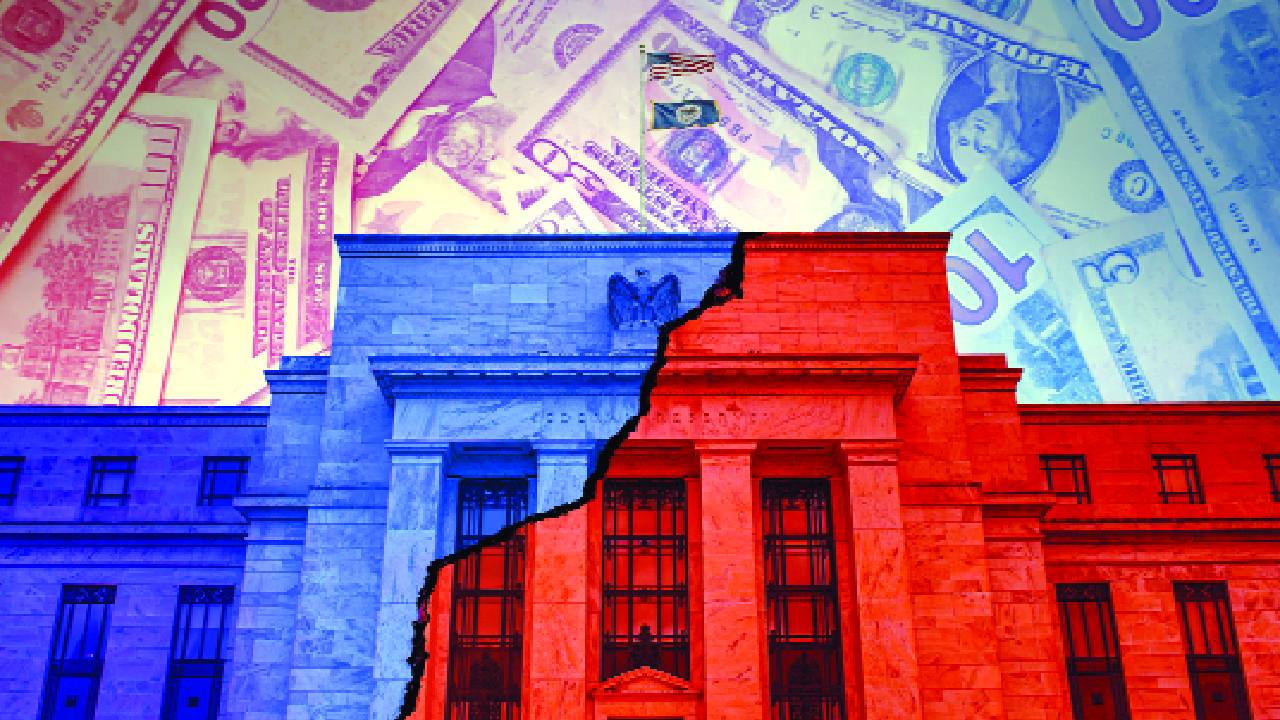
The metaphorical concept of a red pill possibly became famous because of ‘Total Recall,’ a Hollywood flick where the protagonist, Arnold Schwarzenegger, is asked to swallow a red pill if he wishes to return to reality, and shed the dream-like fantasy. But it became acceptable after ‘The Matrix’ movie, when Keanu Reeves (Neo) is offered a choice by Laurence Fishburne (Morpheus), “You take the blue pill… the story ends, you… believe whatever you want to believe. You take the red pill… you stay in Wonderland, and I show you how deep the rabbit hole goes.” Fishburne, or Morpheus, tries to tell that Neo lives in a simulated computer-game-like world, and the red pill will allow him to see the reality as it exists, and gets ‘unplugged’ from the make-believe world that we see, live in, and accept. Both Jerome Powell, the existing head of the Federal Reserve Board, and Donald Trump, the US president, have different interpretations.
Powell believes he swallowed the red pill, and sees the real world of America’s growth, jobs, and inflation. Trump, with his blue pill fascination, is cut off from it. Trump thinks that Powell has ingested the blue pill, and needs to take the red one. For months, ever since Trump returned to power, he has belittled Powell for making the wrong choices, and not reducing the interest rate faster than he should. The Fed chief has resisted, countered, fought back, and stuck to his thinking. With a new head of Fed imminent by May 2026, and Trump, as he claims, ready with a new name, experts feel that the board may change track immediately, go down the interest rate rabbit hole, so to say, and slash rates. However, it will not be an easy task for several reasons. Trump may still have another fight ahead. The interesting tussle for interest rates may continue.
Although, generally, and over time, Trump does get what he desires, at least in most cases, and with most people, even nations. But the fact remains that, at present, Powell has the upper moral hand. In the last press conference, after the Fed decided to ‘pause’ on any rate cuts, he gave a ‘strong defence’ of why the central bank needs to be independent of the legislative, and executive, and why the central bank is a “cornerstone of modern democracies, a safeguard against the politicisation of the monetary policy.” He added confidently, as he strode ahead on his moral high-horse, “The point of independence is not to protect policy-makers…. It is just an institutional arrangement that has served the people well, and that is to have a separation between (central bank and other branches), to not have direct elected official control over the setting of monetary policy).”
Apart from the Democrats, and some Republicans, a section of the public believes in such an independence. Trump, obviously, wishes to bulldoze people and institutions, and force them to do his bidding. But only the judiciary can stop the president. Three seminal cases will decide his future fate. The first is when the Supreme Court delivers its verdict on whether the unilateral and singularly-decided tariffs against nations were constitutional. The fact that the court has sat on its decision for weeks may imply both outcomes. The ruling is against the president and, hence, the delay. The ruling is in favour, but may attract criticism and, hence, the delay. The second case will deal with the Department of Justice’s criminal case against Powell, which may enthuse future Fed heads, or instill them with the potential wrath of the presidents. The third is the one that is cooking headily, and involves Lisa Cook, a former Fed governor, who was sacked by Trump on allegations related to mortgage fraud.
In January 2026, before the interest rate pause, Powell attended the oral arguments in the Cook’s case in the Supreme Court. Media reports stated that this was an “unusual step for a Fed chair to take.” At the latest press conference, Powell responded, “I would say that case is perhaps the most important legal case in the Fed’s 113-year history. In addition, Paul Volcker (the former head) went to a Supreme Court case… I guess, 1985 or so, so it is precedented, and I thought it was an appropriate thing, and I did.” Although a president can remove a Fed governor, it needs to be only “for cause.” One is not sure if a cause is one that relates to a ‘technical’ fraud, which was committed before Cook became a member of the board. If Cook wins, Trump will find it difficult to berate, and browbeat the Fed Board in the future. His new nominee as the chair may not be able to influence the various governors, some of whom may oppose the former.
Some of the indications emanate from the way the Fed board voted in the last two meetings on interest rates. In both cases, Powell's thinking was supported by a huge majority. In both the meetings, the majority was in favour of the decisions taken, the first time to cut the rate by a lower level, and the second time to maintain it at the current one. Stephen Miran, a Fed governor recently handpicked by Trump opposed the moves both times. At the last meeting, another governor, Chris Waller, sided with Miran. Still, a 10-2 consensus to opt for the pause implies that there are members of the board that still do not agree with Trump. Based on what the Supreme Court decides in Cook’s and Trump’s tariff cases, they may either be emboldened to pursue independence, or cow down to the president. Thus, the judiciary is more likely to decide the future course.
More importantly, as mentioned earlier, there is a growing dissenting voice within the Republicans against Trump’s incessant interference in the affairs of independent institutions. Many of them did not like the sacking of Cook, and the criminal case against Powell. They voiced their concerns publicly through the media. With the midterm elections this year, which will decide the new majorities in both the Senate and Congress, Trump feels that institutions need to do what he wants for the Republicans to win. Some Republicans, who oppose him gingerly, and publicly, think that Trump’s antics may derail the party’s electoral chances. It is an internal political tussle, as much as an open battle between the Democrats and Republicans. Maybe politics, and not judiciary or criticism, will be the final arbitrator.