Nepal: Missing roadmap to economic revival

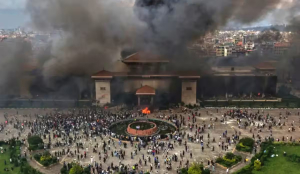
A peaceful demonstration against Corruption and misrule in Nepal on September 8, 2025 turned violent with use of brutal force leading to damage and destruction across the length and breadth of the country, leaving no district spared of losses, damage, and injuries. The events of September 8-9th send shockwaves within and outside Nepal with 77 dead and thousands injured. The peaceful and friendly Himalayan state was full of smoke, sadness, and suffering. The Interim Government led byPrime Minister Sushila Karki instituted a committee to assess and quantify the damage caused by what was referred as Gen Z Demonstrations/Movement of September 8-9, 2025.
Within 75 days since the September violent events, the Committee submitted the Report on Damages/Lossesand Reconstruction on December 11, 2025 to the Government estimating significant losses across the three-tiered government with majority of destruction and damage at the federal level (68%) followed by the local level (22%) and the provincial level (10%).
The Committee estimated totalphysical damage amounting to Nepali Rupees 84.45 billion based on affected 2168 public offices/institution. The Report stated 2671 public buildings were damaged with losses quantified as Nepali Rupees 39.31 billion. Further states, total of 12659 vehicles damaged resulting in losses amounting to Nepali Rupees 12.93 billion. Losses estimation in government and public sector stood at Nepali Rupees 44.93 billion and in private sector at Nepali Rupees 39.31 billion.
The committee also presented a reconstruction action plan. It is but natural to expect that all the stakeholders, public and private are required to join hands in nation building. In any national crisis/calamity, private sector is expected to plough back their reserves to rebuild the nation. It can never be a moment of calculation of return on investment in such dark hour.
It has been 90 days since the GEN Z Movement in Nepal, a country heavily dependent on remittances. In a month after the protests, the World Bank revised the growth rate from 5.2% to 2.1% for the current fiscal year 2025/26 in its Report: “South Asia Development Update: Jobs, AI and Trade” published on 7th October 2025. The Report further stated, “In Nepal, recent unrest and heightened political and economic uncertainty is expected to cause growth to decline to 2.1 per cent in FY 25/26….”
In the backdrop of “Desh (country), Kaal (timeperiod) and Paristhiti (situational context), where does the business leadership in Nepal stand when such an economic outlook statement sends jitters through markets and people? With grim domestic economic scenario and pensive mood of foreign investors whose ‘weight and watch’ on Nepal Investment cannot be decoded as of today, what role ought to have been played by the domestic business leadership?
The business leaders and Chambers of Commerce representatives called upon the Interim Government in round of meetings seeking financial restructuring, ease in working capital access, policy adjustments, and security guarantees from the government. The Government in return provided some form of tax compliances relief and introduced reforms relating to minimum wage increase and other measures. From time to time, the business leaders called upon the Interim Prime Minister Karki requesting her of pending trade and business reforms. In nutshell, one did not see a forthcoming, leading from the front, leadership statement from the business leadership of Nepal who were committed to build back a better Nepal and unafraid to partner with the Government in leading the dialogue with international partners. Was it so difficult to practice proactive patriotic entrepreneurship as JRD Tata with existing business ecosystem?
A country sitting on Nepali Rupees 80 to 100 billion losses and a negative economic forecast did not seem to be a priority on the political/business/intellectual agenda in domestic circles. The “good to have” discussions in social media are reduced to Human Rights, Democracy and Governance irrespective where the country is headed to in near future.
It was only resently that the impetus for foreign investment was set at the Third Nepal Investment Summit 2024 where I proudly delivered my remarks at a panel on “Investment Opportunities in Green and Climate Resilient Businesses in Nepal” chaired by then Minister of Foreign Affairs of Nepal. Recollect the grand opening ceremony at the Investment Summit where Nepal’s civilisational and largest trade partner country, India made the most promising statement about Nepal's readiness for foreign investment. In specific, Minister of Commerce and Industry of India, Piyush Goyal, reiterated Nepal is in the core ambit of India’s Neighbourhood First Policy, reaffirmed India's long-standing commitment to Nepal's development journey and that India would continue to investment in Nepal and expand trade and business relationships. It was a notable statement of trust when Minister Goyal urged Indian and foreign investors to come and invest in Nepal.
Today, one wonders what more of a security guarantee would an economic revival plan in Nepal require when the most strategic partner as India reaffirms andreassures on a consistent basis and has a legacy of being the first responder.
It is a known fact that there are policy hurdles and derailing red tape, which are known areas of pending reforms for ease of doing business in Nepal.However, in the last 90 days post the Gen Z demonstrations, international business community is yet to see what domestic leaders have as a roadmap to deal with economic crisis.The bureaucratic reports of Losses do not garner investment but only empathy driven charities. Over the last months, several business leaders in Nepal have shared case studies of impact and losses to their business but not many public case studies as to how the domestic business leaders have decided to revisit their growth and profitability models keeping nation first.
Given India is a significant trade partner, it would have been an apt decision to hold an emergency response and recovery dialogue with industry leaders of India and Nepal. The recent positive development of an amendment in India and Nepal Transit Treaty leading to an ease and boost in trade flow by augmenting avenues in rail freight cargo, logistics and non-trade tariffs was a welcome move.Similarly, newer agreements on key power transmission lines in October 2025 to boost cross border energy trade showcase India as a steadfast partner even during the political and economic turmoil in Nepal. The lifting of restrictions on high denomination Indian currency is expected to boost cross border transactions and positively impact people to people lives and sectors as tourism. India and Nepal are actively collaborating on facilitating QR code-basedtransactions. The facility for Indians to pay in Nepal using QR codes has surpassed one million in July 2025 while Nepali are eagerly waiting for launch in India anytime soon. Such G2G measures are reassuring commitments tested over time but significant B2B sectoral investments are the next immediate priority to be addressed.
Hopeful the Prime Minister Sushila Karki of Nepal would call for a coordinated and comprehensive economic growth dialogue with domestic leaders identifying how and where India can facilitate and help slow down the growth plunge. Political leadership is often blamed in Nepal for failing on foreign policy choices due to domestic political compulsions. Can Nepal's business leadership demonstrate their role in nation building by valuing strategic economic relations with India? The economic leadership of Nepal is at crossroad of opportunity to take the bull by horn and emerge as a force to reckon with shaping the future and enabling national policies just as in leading economies of the world. Alternately, theymay continue to be at peace with the image of a lethargic Nepali trader with high return margins.
The writer is a Nepal Observer and a financial, geopolitical and security analyst.; views are personal