Nachiketa and the Lord of Death
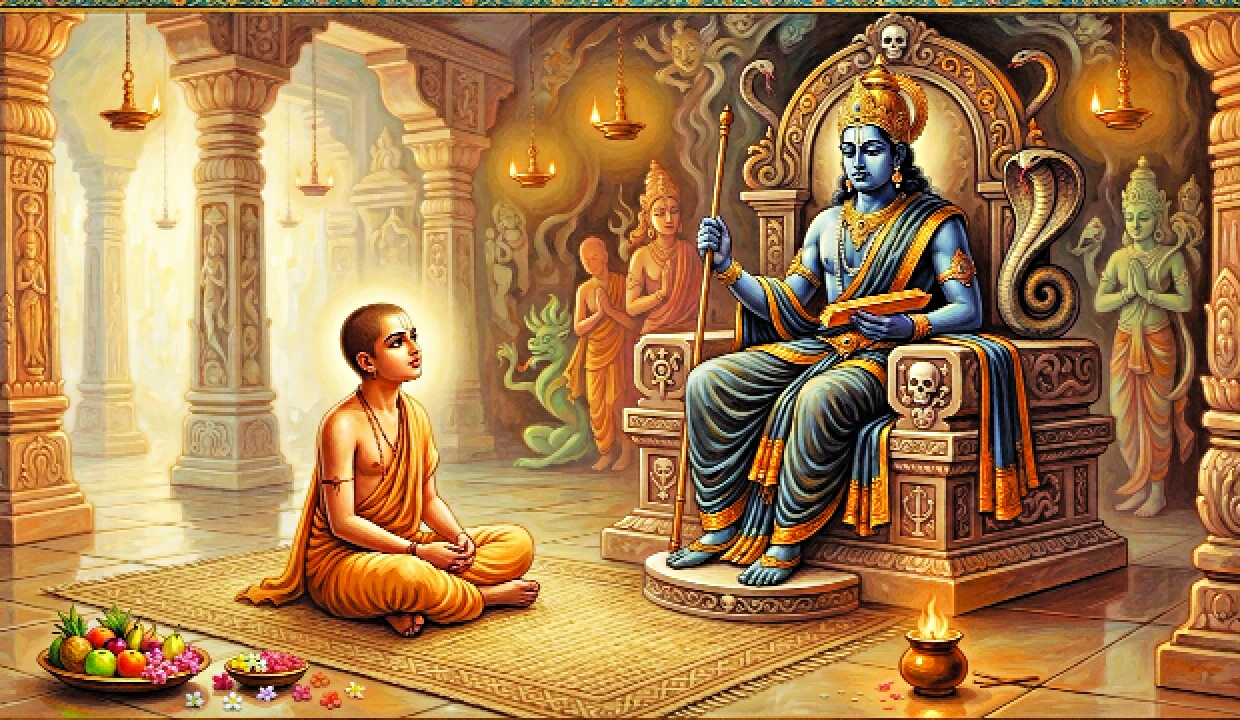
Long ago, the sage Vajashravas resolved to perform a great sacrifice and give away all he possessed. Yet he offered only old, milkless cows. His young son Nachiketa, possessing a pure heart and sharp mind, watched with quiet distress. Knowing that such a sacrifice demanded the gift of everything, the boy approached his father and asked, "father, to whom will you give me?"
Twice the question went unanswered. The third time, Vajashravas, shouted with anger, "I give you to Yama, the God of Death!"
True to his father's word, Nachiketa journeyed to the realm of death. Yama was away, and none dared admit the boy. For three days Nachiketa waited at the gate without food or water. When Yama returned and saw the young boy, he was filled with regret. He said, "child, I have wronged you by keeping you waiting. Ask of me three boons."
First Nachiketa prayed, "may my father's anger vanish, and may he receive me happily when I return." Yama granted it at once.
For the second boon Nachiketa asked to be taught the proper ritual of the fire sacrifice. Yama instructed him and invited the third request.
Nachiketa asked, "Is there life beyond death? What is the truth?"
Yama hesitated. Even the gods, he said, were uncertain on this matter. He offered the boy long life, wealth, power, and every earthly pleasure if only he would choose another gift. But Nachiketa stood firm. "All these are fleeting," he answered. "They cannot give lasting happiness. I seek only the eternal."
Seeing the boy's resolve, Yama finally spoke: "The self is immortal. It is neither born nor does it die. It does not come from anything, nor does anything come from it. When the body falls, the self remains. He who thinks he slays, and he who thinks he is slain, both are mistaken, for the self neither kills nor is killed.
"Smaller than the smallest, greater than the greatest, the self dwells in every being. It cannot be grasped by argument, intellect, or learning; it reveals itself only to the pure and deserving.
Thus, the young seeker received the eternal wisdom.
Moral of the fable: With determination, one can achieve any goal