MJ Akbar reveals how the stars guided India’s most powerful dynasty
“The deep faith of Mughal kings in astrology has been hidden in plain sight, ignored by those who failed to understand its relevance.” This opening line from former Union Minister MJ Akbar’s After Me, Chaos, Astrology in the Mughal Empire, really strikes a chord because it forces us to rethink everything we thought we knew about the Mughal era.
This is not a boring history book. It shows the real men behind the big titles. We think of the Mughals as untouchable, but Akbar shows they were actually vulnerable. He writes about rulers who felt small under the stars, just searching for answers. They stop being legends and start feeling like real people dealing with fear and doubt. It is the same stuff we all go through, which makes history feel alive.
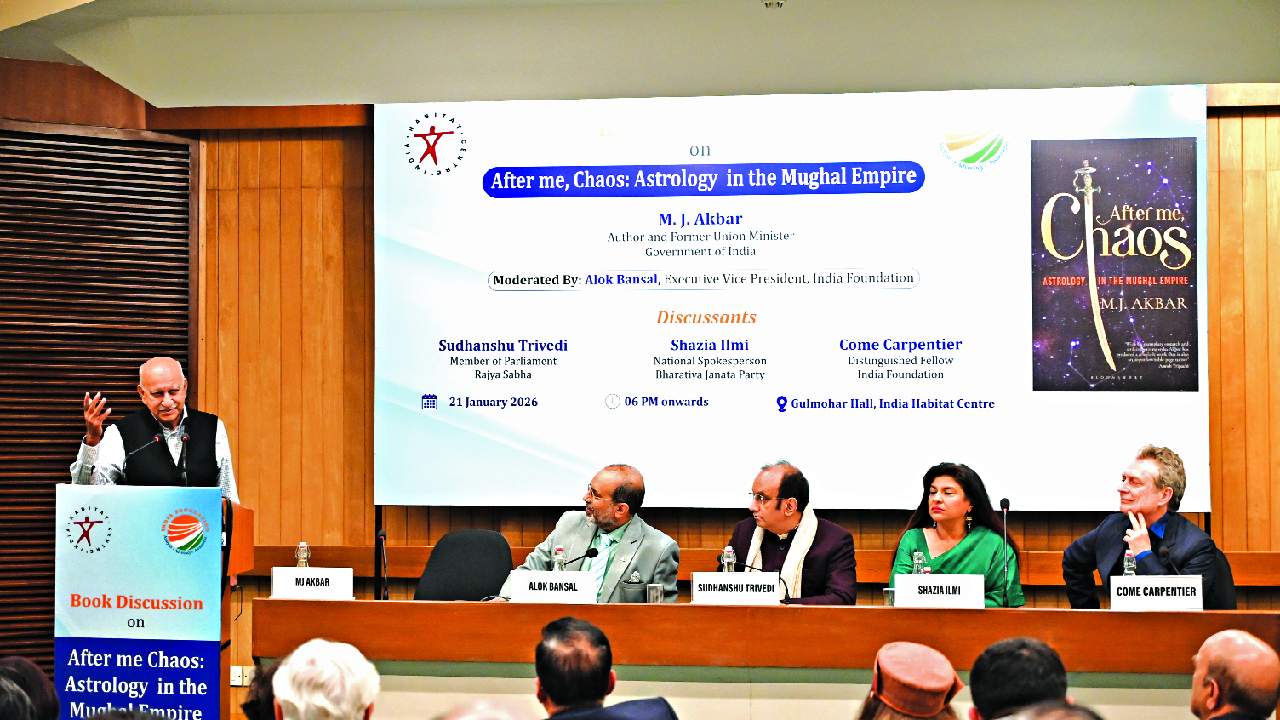
The heart of the book talk on Wednesday was that weird tug-of-war between power on earth and what the stars have planned. Alok Bansal from the India Foundation led the chat, and it felt more like a group of people just being genuinely curious than a formal event. Akbar, Author and Former Union Minister, Goverment of India, told some incredible stories showing that even the toughest, most serious rulers were secretly obsessed with following the heavens.
He noted: “Even Aurangzeb... his astrologers postponed his coronation by three, four, five years. He told his son... everything that has happened in my life was predicted.” Sudhanshu Trivedi, Member of Parliament, Rajya Sabha, made a very pointed observation about how history is often ‘filtered’ for us today.
He called out the irony of modern scholars, stating: “One set of historians... used that same Ain-i-Akbari... to portray Akbar as great, but in the same move, the basis of the greatness before mentioned — the horoscope of Akbar — they deny it.” It was a powerful reminder that we tend to scrub out the parts of history that don’t fit our current worldviews. Shazia Ilmi, National Spokesperson, BJP, spoke about the cinematic and emotional weight of the
narrative, remarking: “He paints history... we see these emperors not just as distant creatures... but as ordinary-hopeful, anxious, but seeking.” Meanwhile, Come Carpentier, Distinguished Fellow at the India Foundation, added a
global layer to the talk, reminding us that this was a respected science of the time: “Astrology and astronomy were part of the quadrivium in mediaeval learning... astrology being sometimes eulogised and sometimes decried.”
These rulers start to feel like real people. In his book, After Me, Chaos: Astrology in the Mughal Empire, MJ Akbar shows them standing there, just staring up at the sky with that same shaky feeling and wonder we all get. It is a reality check that no matter how much power you have, at the end of the day, everyone is just trying
to find a bit of light to help them get through the mess. (L-R) MJ Akbar, Author and Former Union Minister, Govt. of India; Alok Bansal, Executive Vice President, India Foundation; Sudhanshu Trivedi, Member of Parliament, Rajya Sabha; Shazia Ilmi, National Spokesperson, BJP and Come Carpentier, Distinguished Fellow, India Foundation PANKAJ KUMAR.