Markets cautious worldwide as fragile US-Iran ceasefire keeps investors on edge
Global shares were mixed in cautious trading on Wednesday, as investors watched for the next steps in the US-Iran conflict after President Donald Trump extended a ceasefire that was set to expire.
France’s CAC 40 slipped 0.2 per cent in early trading to 8,221.18, while the German DAX inched down less than 0.1 per cent to 24,256.40. Britain’s FTSE 100 was virtually unchanged at 10,497.60.
US futures were set to drift higher, with Dow futures up 0.4 per cent at 49,509.00. S&P 500 futures rose 0.4 per cent to 7,131.00. Inflation in the UK climbed in March after a sharp jump in prices at the pump in the wake of the disruption to energy supplies caused by the Iran war, official figures showed on Wednesday. In Asian trading, Japan’s benchmark Nikkei 225 rose 0.4 per cent to finish at 59,585.86.
The Government reported a trade deficit of 1.7 trillion yen ($10.7 billion) in the fiscal year that ended in March, the fifth straight fiscal year of deficits.
However, exports jumped nearly 11.7 per cent in March and imports rose almost 10.9 per cent in a sign that manufacturers may be bouncing back from the shocks of the higher tariffs Trump imposed after returning to office last year.
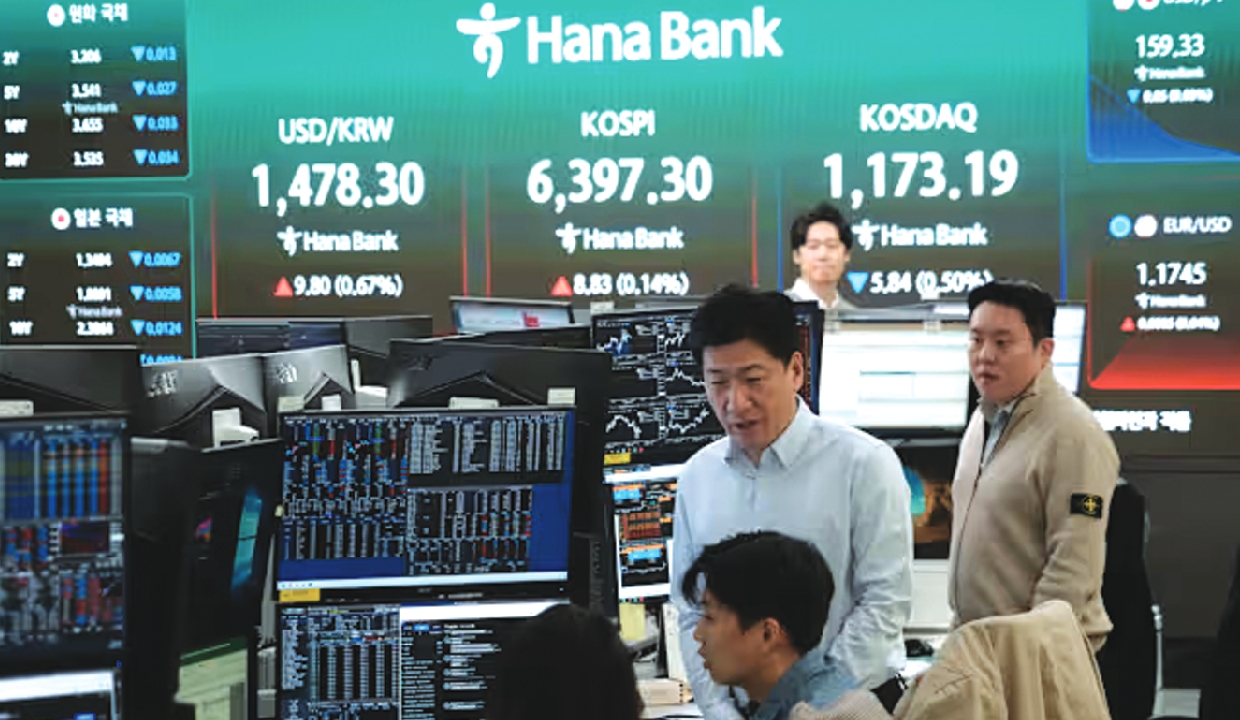
Australia’s S&P/ASX 200 declined 1.2 per cent to 8,843.60. South Korea’s Kospi added 0.5 per cent to 6,417.93. Hong Kong’s Hang Seng lost 1.2 per cent to 26,163.24, while the Shanghai Composite gained 0.5 per cent to 4,106.26. Oil prices have been wavering. In Asian trading Wednesday, benchmark US crude fell at first but later rose 50 cents to $90.17 a barrel. Brent crude, the international standard, gained 81 cents to $99.29.
The moves were milder than the vicious swings that rocked Wall Street earlier in the war, when the price for a barrel of Brent crude briefly topped $119 and the S&P 500 dropped nearly 10 per cent below its prior all-time high. Much of the tension in financial markets has focused on what will happen to the Strait of Hormuz, a narrow waterway off Iran’s coast that oil tankers use to exit the Persian Gulf.
Japan, for instance, imports just about all its oil, and much of it previously came through the strait. The Government has released its oil reserves and is working on alternative routes.
US Vice President JD Vance called off a trip to Pakistan, where he was expected to lead US negotiators in talks with Iran to extend the ceasefire.
Iran had not yet responded to Trump’s announcement of the ceasefire extension, and both countries have warned they were prepared to resume fighting if a deal isn’t reached.
In currency trading, the US dollar edged down to 159.32 Japanese yen from 159.38 yen. The euro cost $1.1748, up from $1.1744.