Mark Tully remembered for trustworthy journalism
“Stand aside and live another day to tell a new story.” It was advice Sir William Mark Tully gave to a younger reporter while reporting from a conflict zone. Do not become the story, he said. Tell it.
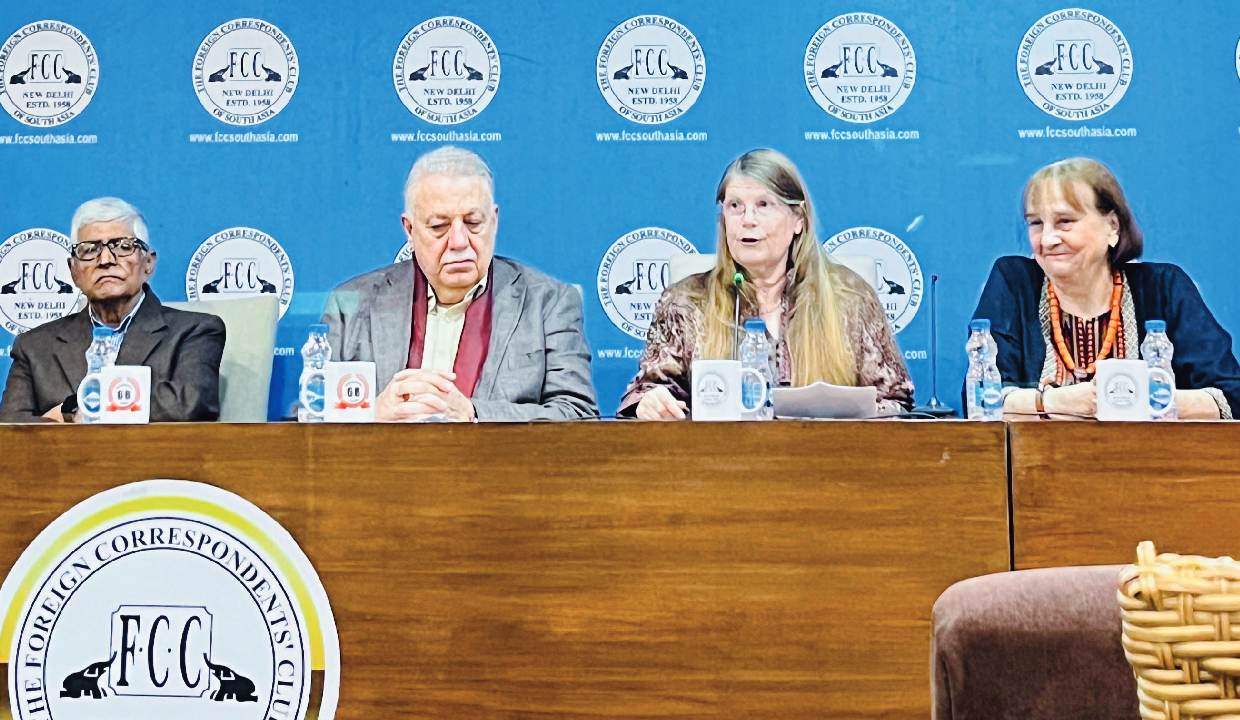
That line echoed through the auditorium of the Foreign Correspondents’ Club of South Asia on Thursday evening, as colleagues, friends, and admirers gathered to remember the veteran journalist who became one of the most trusted narrators of India’s modern history.
The memorial meeting, held at the Foreign Correspondents Club (FCC) premises on Mathura Road, drew senior journalists, editors, and members of the diplomatic community. The club also adopted a formal resolution to name its auditorium in his honour.
“This decision is not symbolic alone,” the resolution stated. “By associating his name with this hall, we ensure that his legacy remains part of our daily institutional life. His name will remain with us not as a memory alone, but as a standard,” said Dr Waiel Awwad, President of the FCC, South Asia. Sir Mark Tully, who died on January 25, 2026, at the age of 90, served as the BBC’s Chief of Bureau in Delhi for over two decades.
He reported on some of the most turbulent chapters of India’s post-Independence history: the Emergency, Operation Blue Star, the assassination of Indira Gandhi, the Bangladesh war, and moments of political upheaval and reform. Yet those who spoke at the memorial said his true legacy was not just the events he covered, but the way he covered them.
“When events were chaotic, his reporting was calm,” one senior journalist said. “When politics was shrill, his tone was measured. When rumours swirled, he waited for facts. Journalism is not about being the loudest voice in the room. It is about being the most reliable one,” he added. Gillian Wright, his partner and fellow writer, spoke with emotion about the tributes that poured in after his death. “The whole Tully family has been overwhelmed by the many tributes paid in India and abroad,” she said. She traced his unusual path into journalism. Tully’s first BBC posting was in the personnel department in London, which he found “dreadfully boring”.
A chance administrative opening in Delhi changed his life. His first radio feature was on the Statesman Vintage Car Rally. From there, he moved into serious reporting, writing analysis during the Bangladesh war when access was limited and dangerous. He was expelled from India during the Emergency for refusing to comply with censorship.
He returned and rebuilt the BBC’s Delhi bureau with a small team and a vast network of Indian stringers. “He always acknowledged that the BBC’s strength came from those Indian journalists across the country,” Wright said. Long-time colleague Satish Jacob recalled Tully’s deep love for Indian languages. “Mark’s passion was not just English. He loved Hindustani,” Jacob said. “He would speak to anyone, even the smallest person in the street, and you could see the delight on his face.”
Jacob said he learned journalism from Tully. “He gave me confidence. He was my guru. He was very honest. I learned things from him that I never got from academic books.” As the evening drew to a close, the message was clear. Sir Mark Tully earned something rare: the trust of India. In a profession where trust is fragile, that may be his greatest achievement.