Lebanon’s tragic transformation
As the Middle East teeters on the edge between fragile peace and the looming threat of devastating war, Lebanon — a once thriving beacon of modernity and prosperity-frequently makes headlines for all the wrong reasons. Here lies a compelling story that highlights how demographics can ultimately shape a nation’s destiny.
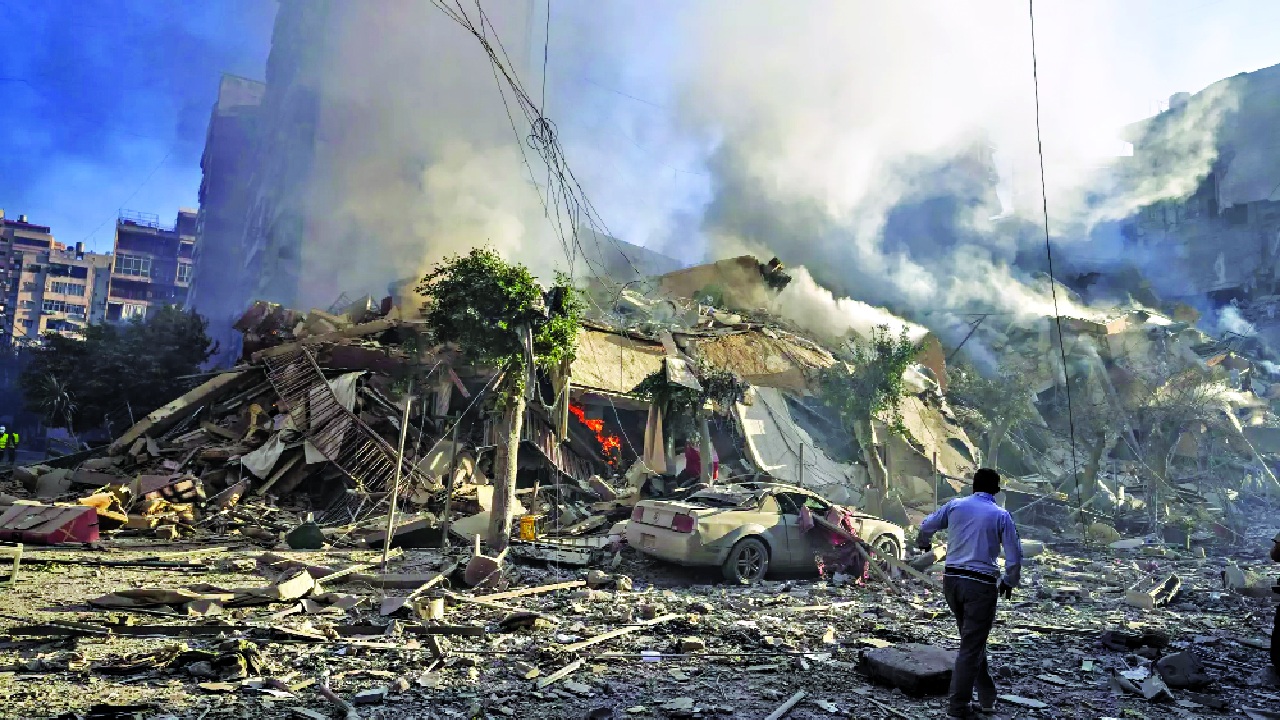
The country’s decline from the “Paris of the Middle East” to a scene of repeated death and destruction is not only a regional tragedy but also a warning to vulnerable civilisations. Recent events, including Israel’s increased strikes against Hezbollah during the ongoing Gulf crisis-one of which reportedly killed over 300 people-have once again brought global focus to a nation that once symbolised cultural elegance, economic strength, and diverse harmony.
To understand the gravity of Lebanon’s current situation, one must look back at its history. In the 1960s and early 1970s, Lebanon was recognised for its progressive character within the Arab world. Beirut was not just metaphorically but genuinely the “Paris of the Middle East” — a centre of intellectual debate, artistic achievement, and cosmopolitan life. Its universities drew students from across the Arab region, its banking sector matched international standards, and its society represented a unique blend of tradition and liberalism. All that is history.
Beneath this veneer of prosperity lay structural weaknesses. Lebanon’s political architecture was based on a fragile demographic balance, institutionalised through a confessional system that distributed power along religious lines. The presidency was held by a Maronite Christian, the premiership by a Sunni Muslim, and the speakership of Parliament by a Shia Muslim.
This arrangement was a breakthrough, functioning smoothly while the demographic balance remained steady. But as conditions shifted, it collapsed, plunging the country into the chaos we see today. Warning: systems built on such patchwork solutions are destined to fail in the long run.
Over the decades, differential fertility rates, particularly among Shia Muslims, coupled with sustained emigration of Christians, altered Lebanon’s demographic composition. What was once a Christian-majority state gradually transformed into a Muslim-majority society. This shift was not merely numerical; it fundamentally eroded the legitimacy of the existing power-sharing
framework.
The consequences were both immediate and catastrophic. The influx of Palestinian refugees in the 1970s-welcomed under humanitarian impulses-introduced new fault lines. Jihadi elements embedded within refugee populations brought with them ideologies and conflicts that Lebanon was ill-prepared to absorb. By 1975, the nation was engulfed in a brutal civil war that lasted fifteen years, leaving deep scars on its social and political fabric.
The rise of Hezbollah and other jihadi organisations further entrenched instability. What began as a struggle for political representation increasingly morphed into armed radicalism. International reports have, in recent years, described Lebanon as a sanctuary for various terrorist groups, underscoring the extent to which the state’s sovereignty has been compromised.
Lebanon’s story underscores a sobering reality: when even a fraction of a society succumbs to radical extremism, the silent majority-however peace-loving-risks becoming irrelevant. Institutions weaken, governance falters, and the very identity of the nation is redefined by forces antithetical to its founding ethos.
This transformation is neither ancient nor abstract; it has unfolded within living memory. The Lebanon of today stands in stark contrast to the Lebanon of just a few decades ago. History does not merely recount; it warns.
It is, therefore, imperative for nations, particularly those with diverse and pluralistic societies, to draw lessons from this trajectory. Vigilance against destabilising forces-whether demographic, ideological, or geopolitical — is not an act of intolerance but of preservation.
The writer is an eminent columnist, former Chairman of the Indian Institute of Mass Communication (IIMC), and the author of ‘Tryst with Ayodhya: Decolonisation of India’ and ‘Narrative ka Mayajaal’ ; views are personal