Landmark India-EU FTA seals mother-of-all deals
India and the European Union (EU) on Tuesday formally concluded negotiations on a long-pending Free Trade Agreement (FTA), hailed by leaders on both sides as the mother-of-all deals. The pact marks a watershed moment in economic ties between the world’s fourth-largest and second-largest economies amid rising geopolitical uncertainty, supply-chain realignments and growing protectionism.
The agreement was announced at the 16th India-EU Summit by PM Narendra Modi and European Commission President Ursula von der Leyen, bringing to a close nearly 18 years of negotiations first launched in 2007 and revived in 2022.Describing it as India’s largest and most ambitious trade pact, PM Modi said the FTA was “not merely a trade deal, but a new blueprint for shared prosperity.” He noted that the agreement would deliver unprecedented market access for Indian goods and services, strengthen resilient supply chains and expand mobility opportunities for Indian professionals in Europe.
“This historic agreement will facilitate easier access for our farmers and small enterprises to European markets, create new opportunities in manufacturing, and deepen cooperation across our services sectors,” PM Modi said in a joint press statement with European Council President Antonio Costa and von der Leyen.External Affairs Minister S Jaishankar said the FTA, along with parallel agreements on security, defence and mobility, marked a decisive step in advancing India-EU relations. “These agreements constitute the foundation of a broader, deeper and stronger partnership and will help derisk the global order,” he said.
Commerce and Industry Minister Piyush Goyal termed the pact a “balanced, fair and win-win” agreement. He said the FTA would be fast-tracked for legal scrubbing and translated into all 24 EU languages, with the aim of bringing it into force within calendar year 2026.
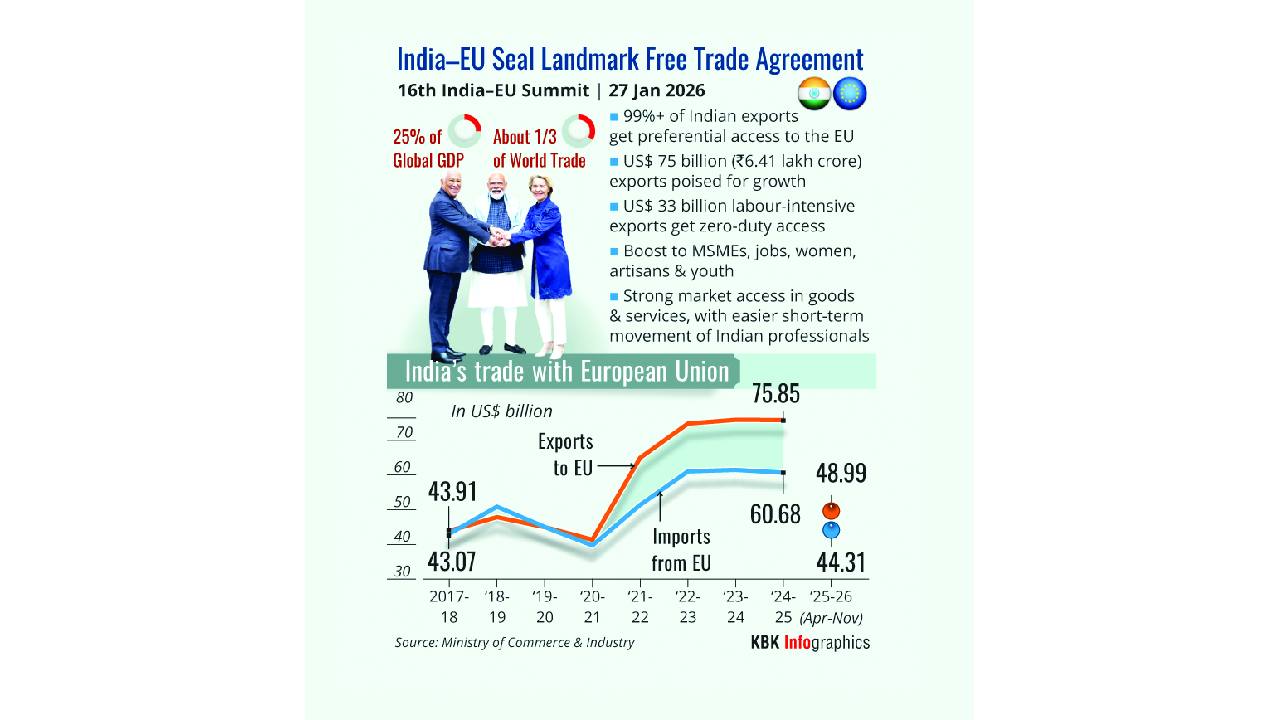
Foreign Secretary Vikram Misri described the summit outcomes as “deeply strategic,” reflecting the growing convergence between India and the EU in an increasingly multipolar world.Under the FTA, over 99 per cent of Indian exports by value will receive preferential access to the EU market. Labour-intensive sectors such as textiles, apparel, leather, footwear, gems and jewellery, marine products and handicrafts will see tariffs of up to 26 per cent eliminated, covering exports worth around $33 billion.
Services trade has received strong commitments, with enhanced access across key sectors including IT, professional services, education and finance, alongside a future-ready mobility framework for professionals and students.With India-EU goods trade at $136.54 billion and services trade at $83.10 billion in 2024-25, officials said the FTA positions India as a trusted, forward-looking global partner in line with its Viksit Bharat 2047 vision.
A Goan thread in EU-India ties
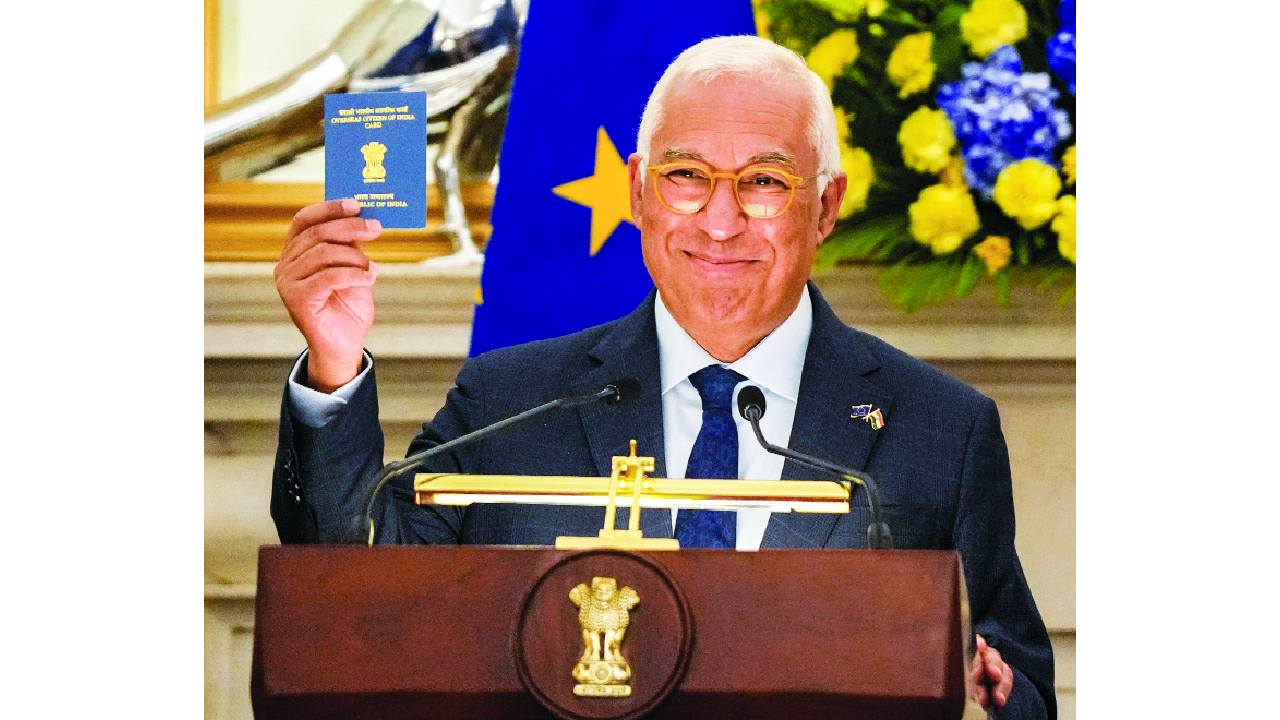
New Delhi: European Council President Antonio Luis Santos da Costa flaunted his Overseas Citizen of India (OCI)card, revealing his links to Goa, when the India-European Union trade deal was announced. Prime Minister Narendra Modi and European President Ursula von der Leyen were present when Costa talked about his Goa roots. “I am the President of the European Council, but I am also an overseas Indian citizen,” Costa said as he took out the OCI card from his pocket. His father was born and brought up in Goa, the former Portuguese colony. He emigrated to Portugal when he was 18, following the liberation of Goa.Costa, who was called ‘Babush’ as a child, a popular nickname in Konkani, brought this up as he addressed the joint briefing on Tuesday.“As you can imagine, for me it has a special meaning. I am very proud of my roots in Goa, where my father’s family came from, and the connection between Europe and India is something personal to me,” the former Portuguese Prime Minister, who served from 2015 to 2024, said.
While Costa was born in Lisbon in 1961, he first visited Goa as a teen with his parents. Costa’s grandfather was born and lived for much of his life in Margao. His father, Orlando, was a noted writer whose work contains strong Goan influences as well as writings on Rabindranath Tagore.
His ancestral house, which is over 200 years old, is still there in Margao on Abade Faria Road, where his extended family still reside. During his 2017 visit, Costa visited the house and interacted with his family members.The 64-year-old leader is often referred to as the “Gandhi of Lisbon” due to his Goan heritage and calm negotiating style.The OCI card provides long-term visa-free travel and residence rights in India for foreign citizens of Indian origin (except those from Pakistan or Bangladesh).