Land acquisition appeals not barred under limitation law: SC
A significant decision, the Supreme Court on Monday ruled that appeals filed against the compensation awarded for land acquisition are not barred under the limitation act, and the High Court can condone the delay upon filing such petitions.
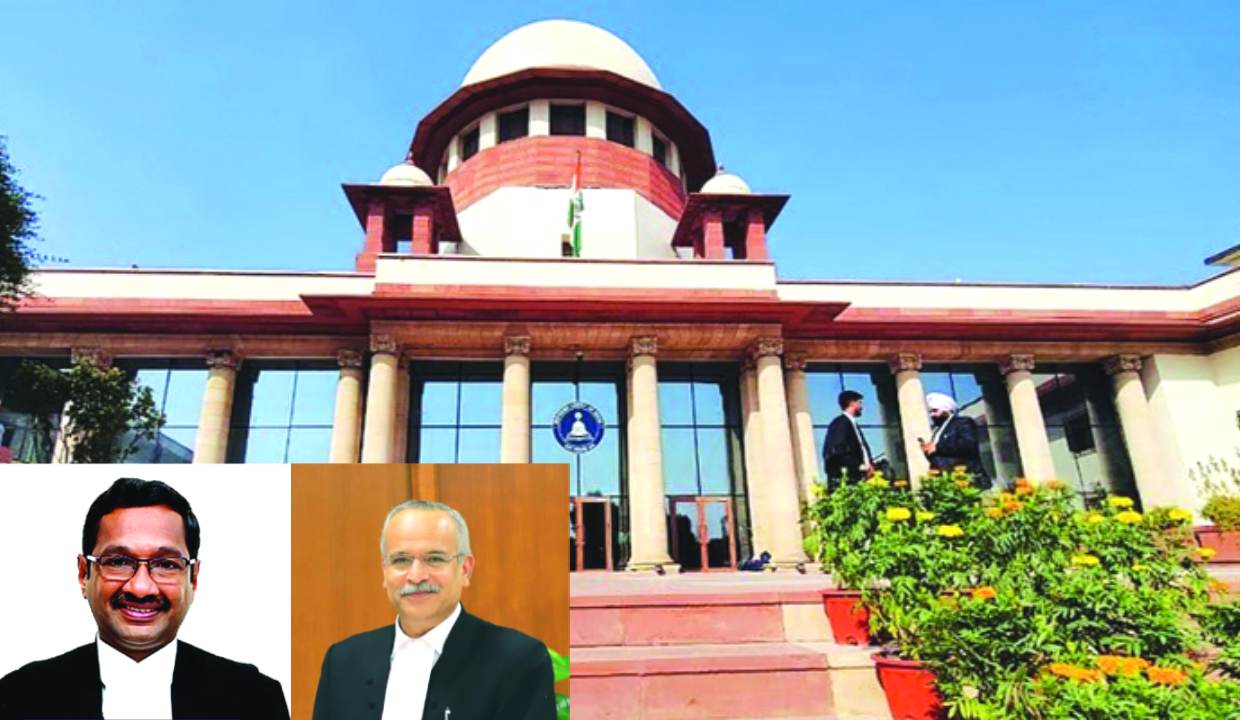
A bench of Justices MM Sundresh and Satish Chandra Sharma answered the legal question while deciding the interplay between Section 74 read with Section 103 of the Right to Fair Compensation and Transparency in Land Acquisition, Rehabilitation and Resettlement Act, 2013 and provisions of the Limitation Act, 1963.
The bench held that for land acquisition proceedings initiated under the earlier 1894 law, where no award was made before the 2013 law came into force on January 1, 2014, the compensation must be determined under the new law.
“Section 24(1)(a) of the 2013 Act is applicable to all those cases where awards are passed after the commencement of the 2013 Act,” the bench held.
Section 24(1)(a) of the 2013 Act stipulates that for land acquisition proceedings initiated under the Land Acquisition Act, 1894, where no award under Section 11 of the said Land Acquisition Act has been made, then, all provisions of the 2013 Act relating to the determination of compensation shall apply.
The Supreme Court said that for passing the award under Section 24(1)(a), the provisions of the 2013 Act alone will have to be followed, except for the rehabilitation and resettlement entitlements.
It said aggrieved parties can file appeals in the High Courts against the award passed by the Land Acquisition, Rehabilitation and Resettlement Authority established under the 2013 Act, which will be treated as the first appeals and as ones under Section 74 of the 2013 Act. “Section 74 of the 2013 Act does not bar the application of Section 5 of the 1963 (Limitation) Act,” it ruled and directed that all the applications seeking condonation of delay in preferring the first appeals before the High Courts under Section 74 of the 2013 Act stand allowed.
The bench said section 74 of the 2013 Act provides for a statutory right to appeal against the award passed by the Authority and the existence of such an appellate remedy reinforces that the proceedings before the Authority are original in nature and the award passed by it is a judgment and a decree.
“Further, Section 74 explicitly permits the requiring body or any person aggrieved by the award of the Authority to approach the High Court. Thus, one cannot presume that appeals under the said provision are only filed by one set of parties,” it said.
The Supreme Court, however, said that Section 74 provides a period of 60 days from the date of the award for filing an appeal before the High Court and the computation of the said 60 days would be from the date of the receipt of the said award by the aggrieved person.
“There is no difficulty in holding that the 2013 Act is a special Act. It may also be called a complete code to an extent, especially when an award passed by the Authority becomes a decree, and the jurisdiction of the Civil Court is barred,” the Supreme Court said.
It said Section 103 of the 2013 Act clearly states that the provisions of this law shall be in addition to and not in derogation of any other law for the time being in force.
“It also facilitates adequate borrowing from other enactments. In fact, the completeness of the 2013 Act comes from such borrowing. We have absolute clarity in our understanding of Section 103, as it explicitly states that the provisions of the 2013 Act shall be in addition to and not in derogation of any other law in force,” the bench said, while upholding the applicability of the limitation law. Analysing the 2013 law, the bench said it is a unique piece of legislation where the Collector is given two different and distinct roles up to a certain stage of the acquisition process, under which the first role is to facilitate the acquisition on behalf of the Government, and the other is with respect to the determination of the compensation.
“For both these roles, there is no question of application of any provisions of the 1963 Act, as the Collector either acts as a statutory authority on the executive side or as a quasi-judicial authority while determining the compensation or as an authority dealing with rights having civil consequences while making a reference,” it said.
The Supreme Court set aside all the orders of the High Courts, which had dismissed the first appeals filed by the farmers under Section 74 of the 2013 law as being barred by limitation.
The Supreme Court directed, “The respective State Governments will have to take necessary measures and issue appropriate directions to the officers dealing with the appeals under Section 74 of the 2013 Act against the awards passed after the commencement of the 2013 Act to ensure that the appeals are filed as provided under Section 74 of the 2013 Act.”
It said that the High Courts shall avoid a pedantic approach as against a pragmatic one in dealing with the applications seeking condonation of delay.