Ladakh on the cusp of ushering in people’s rule
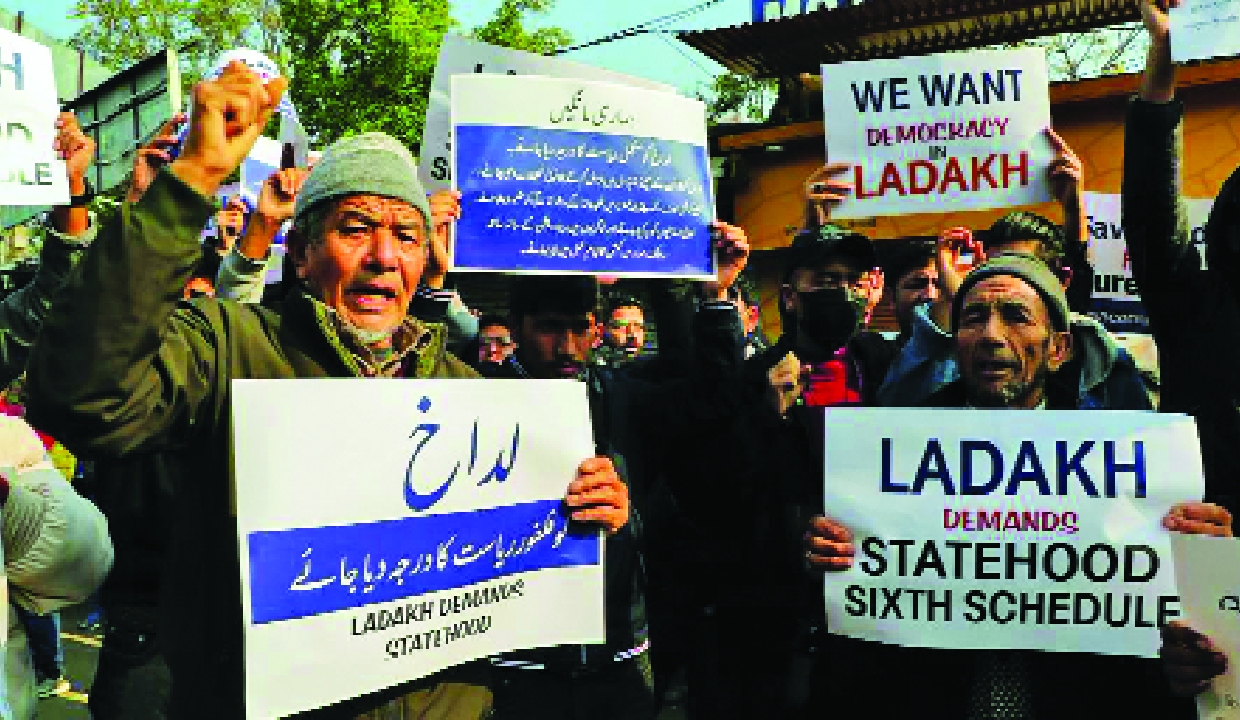
Valour and chivalry of Ladakh, the hilly desert of India, is exemplary. It is the largest Lok Sabha constituency of India, area-wise, which in contemporary India has a rich history of standing up during war times to defend the nation. During peace times, Ladakhis have been persistently fighting for their dignity, identity, political empowerment and protection of basic rights. They may be less in number, with nearly 3.50 lakh people inhabiting the large and barren swath of Ladakh, but their resilience in fighting for their identity, ethnicity and culture, while steadfastly remaining nationalist, is remarkable and unmatched. This commitment has once again borne fruit, with an adamant Centre, after trying all weapons of statecraft to disregard people’s demand for protective rights and political empowerment, agreeing to their demands, short of granting statehood and bringing the tribal-dominated area under the Sixth Schedule of the Constitution to safeguard its tribal identity. There is a breakthrough after talks with representatives of the Apex Body, Leh (ABL), and Kargil Democratic Alliance (KDA), held in Delhi after a discomforting delay. The leaders have reached an “in-principle understanding” with the Centre on “restoring democracy in Ladakh” and providing “constitutional safeguards on the lines of Article 371A, 371F and 371G”, following talks with senior Union Home Ministry officials. Incidentally, these are provisions applicable in states such as Nagaland, Sikkim and Mizoram.
The parent UT of Jammu and Kashmir, out of which Ladakh UT was carved, is also demanding the same, but without any worthwhile public pressure, though its main demand is restoration of statehood. The Ladakhis excelled once again because they stood united, unmindful of the wrath of the powers that be, which is not the case in Jammu and Kashmir, particularly the Jammu region, which has wholeheartedly supported the BJP in successive elections. On the contrary, Jammu and Kashmir, particularly Jammu, stands politically and socially divided, thereby giving a leeway to the Centre to disregard its feelings. It also signals that the Ladakh civil society groups have scaled down their demand for Sixth Schedule status and full statehood. However, there is a caveat attached to this “in-principle understanding”, with a promise to invoke provisions of Article 371, which was earlier not acceptable to Ladakh leaders. Leaders such as former BJP MP Mr Thupstan Chhewang, who later quit the party and is also a former head of the Ladakh Buddhist Association, were of the view that acceptance of this provision is a stepping stone and not an end in itself, with people reserving their right to agitate in future. Surely, it is a step forward and an ode to the rare unity between the Leh and Kargil regions of Ladakh on broader issues of identity, overcoming all their differences.
As per the talks, Ladakh will have full legislative, executive and financial powers vested in elected representatives through a UT-level Assembly. The elected executive head (proposed to be a Chief Minister) will have direct administrative control over the entire UT bureaucracy, headed by the Chief Secretary. The UT’s budget will be managed by the elected body, unlike the present mechanism where the Lieutenant Governor is the supreme controlling authority. Safeguards for the protection of Ladakh’s land, environment, culture and jobs will be established under Article 371.
August 5, 2019, was a historic day in the history of Ladakh when the long-standing demand for separation from Jammu and Kashmir and the creation of a Union Territory (UT) was accepted, though not fully in accordance with the wishes of the people. It did not happen suddenly but came after more than four decades of struggle in varied forms.
Definitely, a history of sorts was created, but simultaneously a new phase of struggle began, centred on the protection of the tribal identity of the people through the Sixth Schedule of the Constitution, along with political and administrative empowerment. These factors are missing in the UT model, which is more Delhi-centric and has increased the sensitivity of the hilly region, thereby making it more vulnerable than ever before. All this was promised by the ruling BJP, resulting in the party winning the Ladakh Lok Sabha seat twice before losing it the third time for failing to deliver on its promises. The biggest among these was the protection of identity and the fragile environment.
Ladakh is once again on the cusp of taking a step forward after a prolonged agitation resulting in casualties and the arrest of prominent environmentalist and social activist Mr Sonam Wangchuk under the draconian National Security Act (NSA), followed by his deportation to a Rajasthan jail in a climatically diverse environment. This proved to be a turning point. His NSA detention was suddenly withdrawn by the Centre just before the Supreme Court was to take a final call on his petition. Ostensibly, mounting public pressure showed its impact. Both the ABL and KDA leaders feel that the offer, which has been agreed upon “in principle”, is an ice-breaking move. However, they are keeping their fingers crossed until they discuss the proposal back home with the people of Leh and Kargil and a formal notification is issued after subsequent meetings.
The leaders felt that “restoring democracy in Ladakh” and providing “constitutional safeguards under the spirit of Articles 371A, 371F and 371G”, as proposed by senior Home Ministry officials, is a step forward. These provisions are applicable in states such as Nagaland, Sikkim and Mizoram. The UTs of Ladakh and Jammu and Kashmir have been demanding similar safeguards for the last six years pending restoration of statehood.
“In this model, the legislative, executive and financial powers will rest with elected representatives through a Union Territory-level legislative body,” the ABL and KDA said in a statement, adding: “All bureaucrats of the UT, including the Chief Secretary, will come under the executive head of the UT-level elected body (proposed to be Chief Minister).”
The “in-principle” agreement is silent on the demand for inclusion under the Sixth Schedule of the Constitution and the granting of statehood status. Are the people of Ladakh (read their representatives) ready to forgo these demands? Maybe for the time being. Apex Body of Ladakh co-chairman Chhering Dorje Lakruk said, “A broad agreement has been reached on having a representative administration. It would have legislative and financial powers.
The bureaucrats will work under the authority of the Chief Minister. Land, jobs and culture would be protected under Article 371. Finer details will be worked out in further meetings.” “Discussions are still underway,” Kargil Democratic Alliance (KDA) co-chairman Sajjad Kargili said in a statement. “We have shared our draft proposals demanding statehood and Sixth Schedule safeguards, and the government has now responded with certain suggestions. It is expected to come up with a formal draft before the next meeting,” said Kargili.
The writer is a political and national affairs analyst; Views presented are personal.