Sri Aurobindo: Advocate of Sanatana Dharma
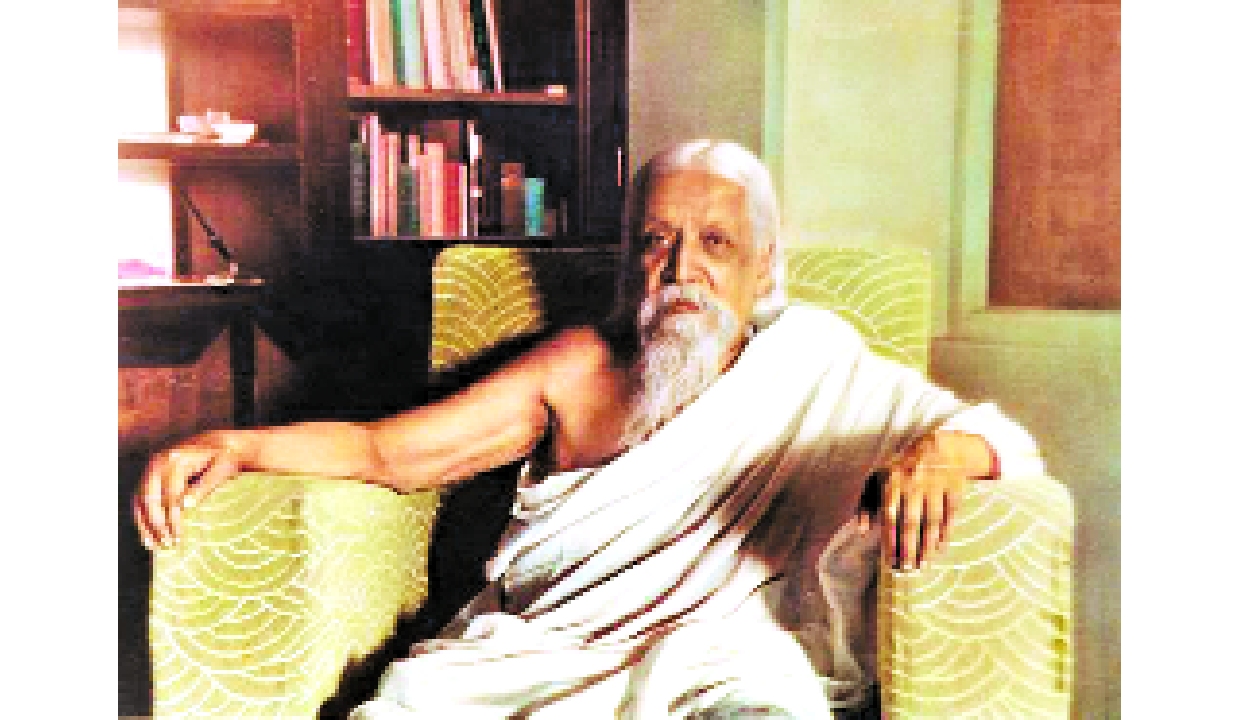
Of the many ancient knowledge systems humanity developed, India's Religion proved outstanding. She developed a coherent system, harmonizing values of inclusivity and concordance into a balanced worldview. "India is an epitome of the world", commented the philosopher-historian Arnold Joseph Toynbee, who hailed her as the 'living civilization' that would unite and enlighten the future humanity.
India's was a turbulent history, with invaders pounding her recurrently, leaving her geographically and psychically torn. Bled white in terrorist violence, her glory often seemed almost irretrievably lost with enemies disturbing her national life. Denunciation of the motherland, derogatory writings against her and declining it for pay-offs were common. Problems confronting our nation are legion. Yet, she sojourns to her destination, determined and untouched by the turbulent surroundings.
India's all-inclusiveness, its readiness to imbibe and harmonize the noble aspects, steeled her spirit. Greece was an aesthetic culture that glorified everything beautiful, notwithstanding whatever defect what it deemed beautiful had. They would ignore everything but Beauty. Hence the aesthetic nature of the Greek culture, opined Sri Aurobindo. Ancient Romans ran in contrast. They discarded Beauty for the ethical aspects. Aesthetics gave way to ethics and disciplines of life.
A strong and muzzled body was preferred to the beautiful. Romans never thought of a beauty attainable through discipline like the Greeks, who never cared the discipline leading to a higher beauty. Beauty and discipline thus had run parallel, never to meet in a creative unity. But India harmonized the both, making discipline a means to realize the beauty.
Ethical life helped her realize the ultimate beauty, Saundarya, which is a "joy forever". India's culture was both ethics and aesthetics perfectly mixed. It was satyam-sivam-sundaram - Truth-Bliss-Beauty, synonyms of the divine.
Though many in modern times interpreted Sanatana Dharma, Sri Aurobindo's emendation looms most important. dharayateti dharma - that which sustains is dharma. To sustain what is not specified, and hence the meaning 'sustain all and everything,' including the very cosmic order. Rhythm or in Sanskrit the rita, is the law of cosmic order. What is not rita runs in contrast to the natural order. Everything moves in symmetry as if directed by an unseen power. This symmetry and harmony found in cosmic dynamism puzzled even scientists like Einstein as to whether God plays dice.
Even the very aim of diversity, it appears, is to lead things to a creative unity requiring coherence at all levels. For this, one must identify oneself with the entirety, see oneself in others and vice versa, which is the quintessence of Sanatana Dharma. This universal mutuality is the natural law working behind the secret of the existence. Lokasamgraha - 'holding together' has for long been in India's vision. 'Others first and oneself last' was India's ideal that looked to the world as one family - vasudhaivakutumbakam. Individual consciousness being the split portion of universal consciousness, any action of man would affect the entire cosmos, opined Erwin Schrodinger when he addressed the question 'What is Life'.
Definitely, our thought and action affect the universe and its consciousness both positively and negatively. Having realized this idea, ancient Indian thinkers made this dharma the ideal of national life. To Aurobindo, India represented this dharma and believed, nation is parasakti or universal energy in geographical entity and dharma the priestess in its sanctum. Sidetracking this eternal dharma, nothing can thrive, especially the dharmarashtra or the spiritual nation that is India. Hence the content of his Uttarapara speech, "The Sanatana Dharma, that is nationalism".
Man-making was the mission of this dharma and turning the life divine was its end. To it man was of prime importance and the love of man was pivotal to Aurobindonian vision, which is centered on the worship of man. It aims at discovering and acknowledging the inherent divinity and the intrinsic superiority of man. Summing up India's religion of man Sri Aurobindo wrote: "Man must be sacred to man regardless of all distinction of race, creed, colour, nationality, status, political or social advancement. The body of man is to be respected, made immune from violence of outrage, fortified by science against disease or preventable death. The life of man is to be held sacred also, given scope, protected from violations, from suppression, from mechanization, from belittling influences.
The mind of man is to be released from all bonds, allowed freedom and range and opportunity, given all its means of self-training and self-development and organized in the play, of its powers for the service of humanity. And all this too is not to be held as an abstract or pious sentiment but be given full and practical recognition in the presence of men and nations and mankind".
This intellectual religion of man reflects a nation's aspiration, to quote Aurobindo, "to raise the world to god in deathless light, to bring god to the world on earth we come, to change the earthly life into life divine". This is the 'eternal religion' of India that stands above all fetters, limitations and confinements of creed, group or narrow-minded nationalism.
The author is Kerala State President, Bharatiya Itihasa Sankalan Samiti; Views presented are personal.