December 26, 2025
Key takeaways from WBA India Congress 2025 sessions
By Pioneer Neews Service
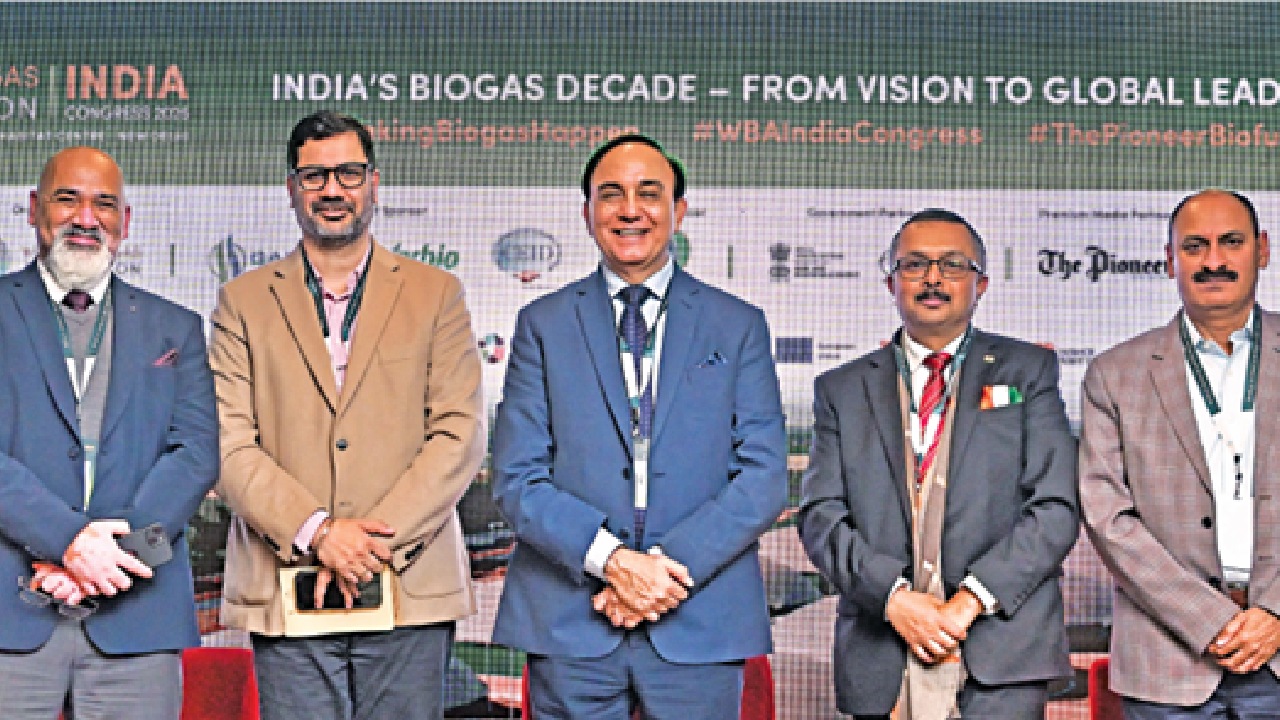
CBGs - A timely paradigm shift for India
- With only 2% of the world's 105 billion tonnes of annual organic waste currently utilised for energy, the biogas sector is a sleeping giant. Scaling this technology could single-handedly deliver half of the 2030 methane- reduction goals and generate 15 million green jobs, creating a cornerstone for climate-resilient development
- India holds 62 MMT biogas potential-enough to meet ~9% of national energy demand and significantly advance methane-reduction goals.
- Rapid scale-up underway: 17X5 CBG plants operational, 800 under construction, and 400 retail outlets established nationwide.
- Biogas offers a triple benefit of energy security, climate mitigation, and rural circular-economy growth, especially through dairy-linked models.
- Integrated biogas + bio-fertiliser value chains and unified regulatory frameworks are essential for commercial viability and sectoral acceleration.
- Strong alignment across WBA, NDDB, MOPNG, IEA, IRENA positions India to become one of the world's fastest- growing biogas markets.
Fuelling India's Biogas Decade
- India's mandate for CBG blending under SATAT remains pivotal, with the dairy sector projected to drive expansion as NDDB's Biogas Board scales up to 1,000 units per day. Bio mitigation alone could reduce methane emissions by up to 17%.
- The national biogas vision positions the dairy sector as the primary growth engine, leveraging 650 million tonnes of manure annually, with the potential to supply nearly 40% of India's fertiliser requirement.
- Support and blended financing models particularly via partnerships with multilateral development banks (MDBs)— are critical for accelerating plant deployment and ensuring commercial viability. The need for policy and blended finance mechanisms was further underlined, emphasising improved cost recovery and stable revenue frameworks.
- Advanced biogas ecosystems in Denmark, Germany, and Brazil offer relevant lessons; however, India's unique advantage does not lie in backyard but in centralised biogas systems, where it can emerge as a global leader.—
Delivering on India's Biogas Vision Making Biogas Happen Programme
- Top-down implementation framework with specific, measurable targets and economically viable models— addressing delayed CBG cost recovery and ensuring seamless access to carbon markets.
- A partial risk-guarantee mechanism, integrated with carbon markets, is considered essential. Under the National Manufacturing Mission 2025, biogas can benefit from emerging technologies such as blockchain traceability systems and expansion of green-skills employment.
- India must accelerate home-grown biogas technologies, prioritizing rural socio-economic upliftment, biomass mapping at the regional level, storage infrastructure, and technological self-reliance with economic viability while investors seek predictable revenue streams, India must strengthen CBG equity and market confidence.
- Carbon markets must transition from purely voluntary to partially mandatory frameworks. Streamlined taxation, reduced fiscal burdens, and harmonized debt-financing norms are needed to avoid administrative bottlenecks.
India's Leadership in delivering on the Global Biogas Agenda
- CBG has transformative potential for clean cooking, with eventual substitution of LP Social-energy modelling shows India ranking third globally on the hunger-energy index, highlighting the urgency of affordable clean energy access.
- Sector leaders highlighted the need for SATAT 2.0, infrastructure optimisation, improved capex frameworks, enhanced R&D, and region-specific technological customisation.
- The inherent value of CBG is widely acknowledged; while prices may remain strong initially, they are expected to decline over time-provided there is a robust, predictable price-discovery mechanism.
- Existing policy gaps persist, but strong intent and progress are visible-for instance, Maruti Suzuki incorporating CBG into its mobility ecosystem.
- From technical and policy standpoints, support schemes must not rely solely on
- average revenue prices. Innovative mechanisms-such as executive cess (CES) or gra based levies-can help reduce the delta burden. Crucially, funding must be performance-linked to ensure public expenditure efficiency.
City Gas to Green Gas – Roadmap for a Biomethane Future
- The marine sector offers significant demand for green ammonia, clean fuels, and biogas, although challenges remain around developing viable refuelling infrastructure and feasibility models.
- Seasonal availability of agro-waste, variability in project economics, poc segregation of non-agro waste, and the need for initial premium pricing (with gradual, market-driven correction) were highlighted as key constraints.
State & Sectoral Action Plans, Policies & Standards
- A dedicated National Biofuel Mission must define clear mandates, functions, and achievable targets.
- Biogas holds strong integration potential within the broader natural gas ecosystem, positioning itself as a credible, clean alternative to fossil fuels.
- . Given the differences between central and state operational frameworks, establishing a national-state coordination committee could significantly enhance target achievement and policy alignment.
0 Comments