Jharkhand learners unveil smart-agri, health bots at State hack event
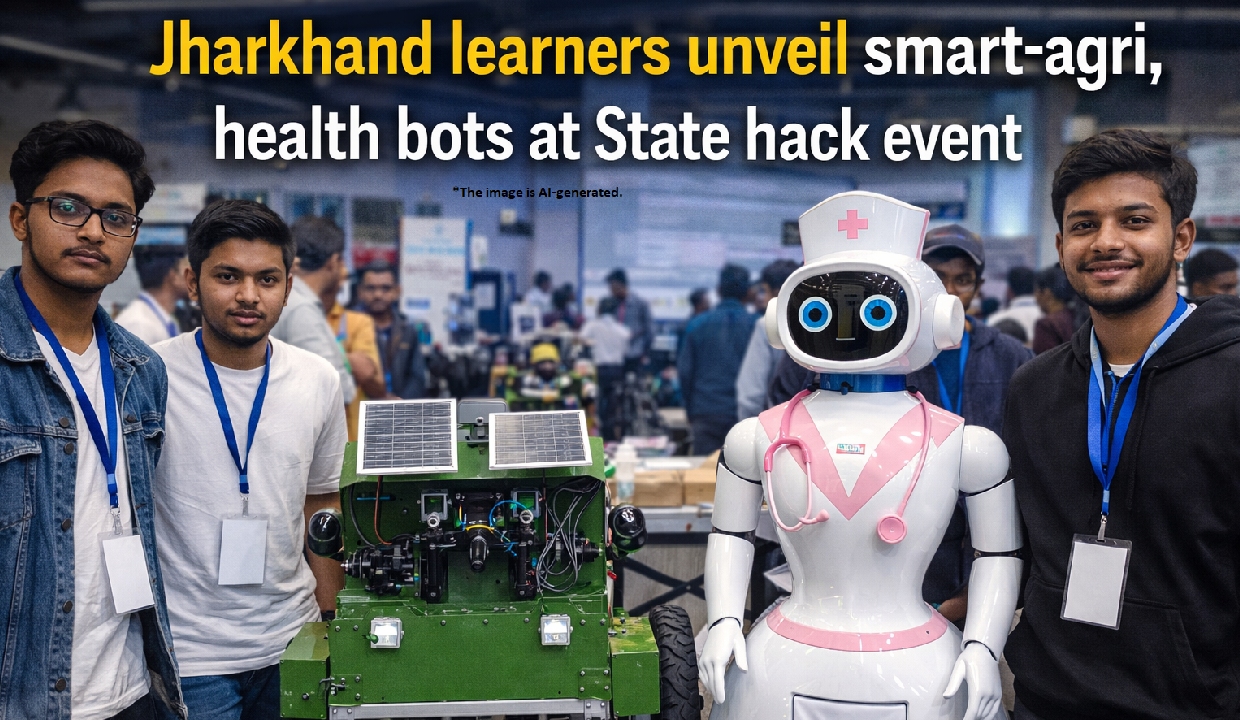
Quest Alliance, in collaboration with the Jharkhand Education Project Council (JEPC), organised the state-level event “Hack to the Future” in Ranchi. It brought together young learners, educators, Government officials, and civil society organisations to explore innovation and future readiness in education.
A key highlight was the live exhibition of student-developed prototypes, where learners showcased their ideas and engaged directly with stakeholders. Around 35 students and 9 teachers from Ramgarh, Dumka, and Deoghar presented solutions to real-world challenges using design thinking and technology, demonstrating creativity, critical thinking, and problem-solving.
Prototypes included solutions like a Smart Agriculture Recommendation System and Smart Drip Irrigation System to support farmers with crop decisions and efficient water use; a Water Body Cleaning Robot to tackle local pollution; and health and safety innovations such as an AI-Based Health Monitoring Box for adolescent girls and a Wild Watch Defence System to prevent crop damage from animals.
Speaking at the event, Neha Parti, Director of the Schools Program at Quest Alliance, shared insights on India’s vision for 2047. She highlighted a rapidly transforming world shaped by automation and artificial intelligence. “While technology is expected to take over instruction-based tasks, human creativity, decision-making, and ethical judgement will remain critical,” she said.
Youth voices added powerful perspectives. During an interactive session, a learner shared: “I imagine that robots will take over petty jobs and we may have to work regularly, just with the robots.”
Dr Avinash Kumar, State Program Officer (SPO) at Jharkhand, attended as the Chief Guest and highlighted key challenges in the education landscape. “Only 11.92 per cent of students opt for science in Class 12, indicating the need to strengthen STEM engagement,” he said. The event reinforced the importance of strengthening partnerships between the government, schools, and communities, with a key priority of supporting teachers through practical approaches that enable meaningful integration of future-ready skills into classrooms.