Investment-led productivity, growth in agriculture budget
Executive summary
The initiatives under budget 2026 are aptly prioritised towards specific high-value commodity value chains with emphasis on enhancing productivity, branding, and competitive aggregated initiatives through FPOs. Emphasis on infrastructure and mechanisation is also apparent. The previous budget and initiatives had emphasised on horticulture production, which has now even surpassed food crop production and the present thrust on specific high-value commodity value chains distinguishes this budget. Notably, DBT and MSP support has not witnessed any increase reflecting renewed focus on investment spent for growth.
Commodity value chain focus
Very appropriately, the budget emphasises on high-potential value chains. Support has also very rightly focused on the higher growth sub-sectors of fishery and livestock. “Amrit Sarovars” or 500 related reservoirs, fishery and livestock FPOs and integrated livestock value chain promotion programmes are envisaged. Further, coconut, sandalwood and cashew, all high value crops with potential are to be particularly targeted. Also, high-density cultivation of almonds, walnut and pine nut is to be a focus. Notably, Indian cashew and cocoa are to be developed into global brands by 2030.
Coconut farmers are also to be supported through re-plantation and advisory related assistance. Importantly, an AI integrated agri-stack is to support all related initiatives providing customised crop advisory.
The numbers
The total Agriculture budget has increased from INR1,23,089 crore to INR1,30,561.38 that is by 6.07 per cent in budget FY 2026-27 with respect to the revised budget of FY 2025-26.
There have been no major changes in different components ranging from insurance schemes, irrigation supporting schemes, interest subvention schemes etc.
MSP Support by way of Pradhan Mantri Annadata Aay Sanrakshan Yojna (PM-AASHA) the price support scheme for pulses, oil seeds and copra has increased to INR 7,200 crore, that is an increase of 3.7 per cent.
Pradhan Mantri Kisan Samman Nidhi (PM-Kisan) support by way of direct benefit transfer (DBT) to farmers continues at INR63,500 crore.
Formation and Promotion of 10,000 Farmer Producer Organisations (FPOs) scheme continues to be supported with a rather similar outlay of INR500 crore for the year FY 2026-27. Support under the Agri Infrastructure Fund is also continued with an outlay of INR910 crore for the year FY2026-27.
A major change has been in terms of an increase to INR200 crore as support for Innovation and Adoption of Technology.
The important initiative has been a substantial increase in outlay towards the NAMO Drone Didi Scheme witnessing an increase from INR100 crore To INR676.85 crore.
The Bharat-VISTAAR (Virtually Integrated System to Access Agricultural Resources) Scheme and assistance towards High Value Agriculture have been launched with an outlay of INR150 crore and INR350 crore respectively.
The Rashtriya Krishi Vikas Yojna Scheme also enjoys a 22 per cent increase in the budget outlay and stands at INR8,550 crore The Krishionnati Yojna initiative involving schemes such as the Mission for Integrated Development of Horticulture (MIDH) and Sub-mission for Agricultural Mechanization (SMAM) has also witnessed a substantial increase in outlay to the tune of 64 per cent and amounts to INR11,200 crore.

Investment led growth orientation
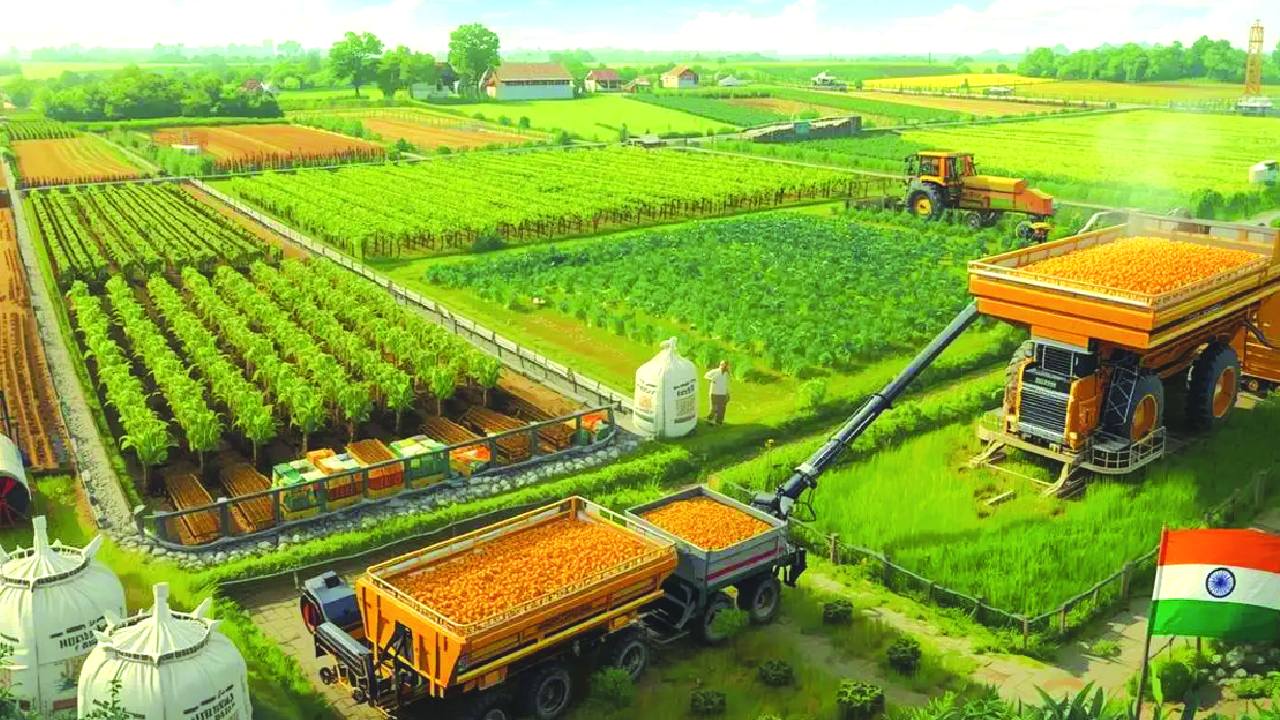
Basically, micro-irrigation, farm mechanisation, de-centralised post-harvest infrastructure will enjoy thrust through the Rashtriya Krishi Vikas Yojna (RKVY) and Krishionnati Yojna schemes. It will be apt to appreciate the fact that there is no increase in Direct Benefit Transfer (DBT) and MSP related consumption oriented spend.
The thrust on infrastructure, productivity, farm-mechanisation and high-value production is a highlight of this budget, which is more investment and growth oriented.
The author is an acknowledged global expert on Agri-business, livelihood development, and MSME, He is an alumnus of the University of Cambridge and is a fellow of the Cambridge Commonwealth Society; views are personal