International treaties can’t be used to avoid tax: SC
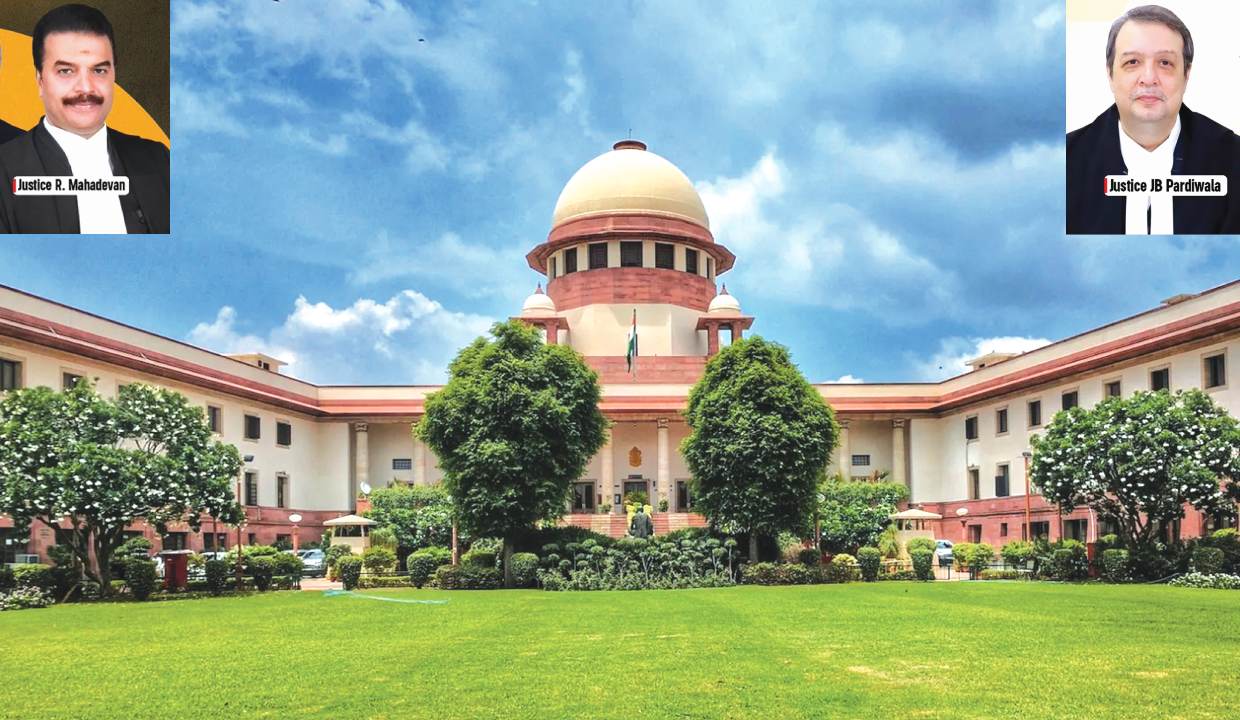
In a landmark judgment, the Supreme Court has said that international tax treaties should not become instruments that weaken India's sovereign right to tax income generated from its own soil. Justices JB Pardiwala and R Mahadevan ordered that the foreign fund firm, Tiger Global, must pay more than Rs 15,000 crore as capital gain tax to Income Tax, which they earned as profit by selling shares of Flipkart in the Walmart acquisition, a deal worth more than 10 billion dollars.
Interestingly, the Supreme Court was quashing the stay order on paying tax by Tiger Global by a Delhi High Court Division Bench order passed by controversial Justice Yashwant Varma, who is now facing impeachment by Parliament, after huge bundles of cash were found burnt at his residence in March 2025. Tiger Global was represented by a battery of lawyers led by Harish Salve.
The Bench, headed by Justice Varma, comprising Justice Purushaindra Kumar Kaurav, in August 2024, rejected the Income Tax demand of Rs 15,000 crore from Tiger Global as capital gain tax. Income Tax served notice to Tiger Global in mid-2018, and the foreign fund firm claimed that all tax claims were not applicable to them, citing the Mauritius tax treaty. Tiger Global is a US-headquartered firm that acquired major shares of Flipkart through its shell companies in Mauritius and Singapore.
Stressing on the sovereignty of India, in a 152-page order, the Supreme Court judges Justices Pardiwala and Mahadevan said: “The power of an independent Republic to levy and collect tax forms part of its inherent sovereign functions, and such power is circumscribed only by the requirement of being within the authority of law.” Article 265 of the Constitution of India envisages the same.
In a world where nations must necessarily engage with each other for mutual economic growth through trade, commerce and business, and for reasons of economic policy, international cooperation, and diplomatic balance, the power of each nation is often exercised in tune with such bilateral or multilateral agreements, which do not take away such inherent power but which now stand shaped by the legal framework agreed to between the parties. "In our view, once it is factually found that the unlisted equity shares, on the sale of which the assessees derived capital gains, were transferred pursuant to an arrangement impermissible under law, the assessees are not entitled to claim exemption under Article 13(4) of the DTAA.
The Revenue has proved that the transactions in the instant case are impermissible tax-avoidance arrangements, and the evidence prima facie establishes that they do not qualify as lawful.
“The applications preferred by the assessees relate to a transaction designed prima facie for tax avoidance and were rightly rejected as being hit by the threshold jurisdictional bar to maintainability, as enshrined in proviso (iii) to Section 245R (2).”
Accordingly, capital gains arising from the transfers effected after the cut-off date, i.e., April 1, 2017, are taxable in India under the Income Tax Act, read with the applicable provisions of the DTAA. The judgment of the High Court, therefore, deserves to be set aside.”
Concurrent with the judgment written by Justice Mahadevan, Justice Pardiwala wrote 12 more pages separately, stressing the sovereignty of India in deciding on taxation on foreign fund companies gaining profits from India.
“Taxing an income arising out of its own country is an inherent sovereign right of that country. Any application of filters or diffusers to this is a direct attack or threat to its sovereignty, which can affect a nation’s long-term interests.
“Tax treaties, international agreements, protocols and safeguards should be very engaging, transparent and capable of periodical reviews with the power to renegotiate with strong exit clauses to avoid unfair outcomes safeguarding the nation’s strategic and security interests, preventing erosion of the tax base and loss or “weakening of democratic control and introducing explicit carve-outs safeguarding the sovereign’s right of taxation,” pointed out Justice Pardiwala, suggesting measures to plug the tax avoidance by the International firms, making profits from Indian business.