India’s Heritage: From Pilgrimage to Sustainable Tourism
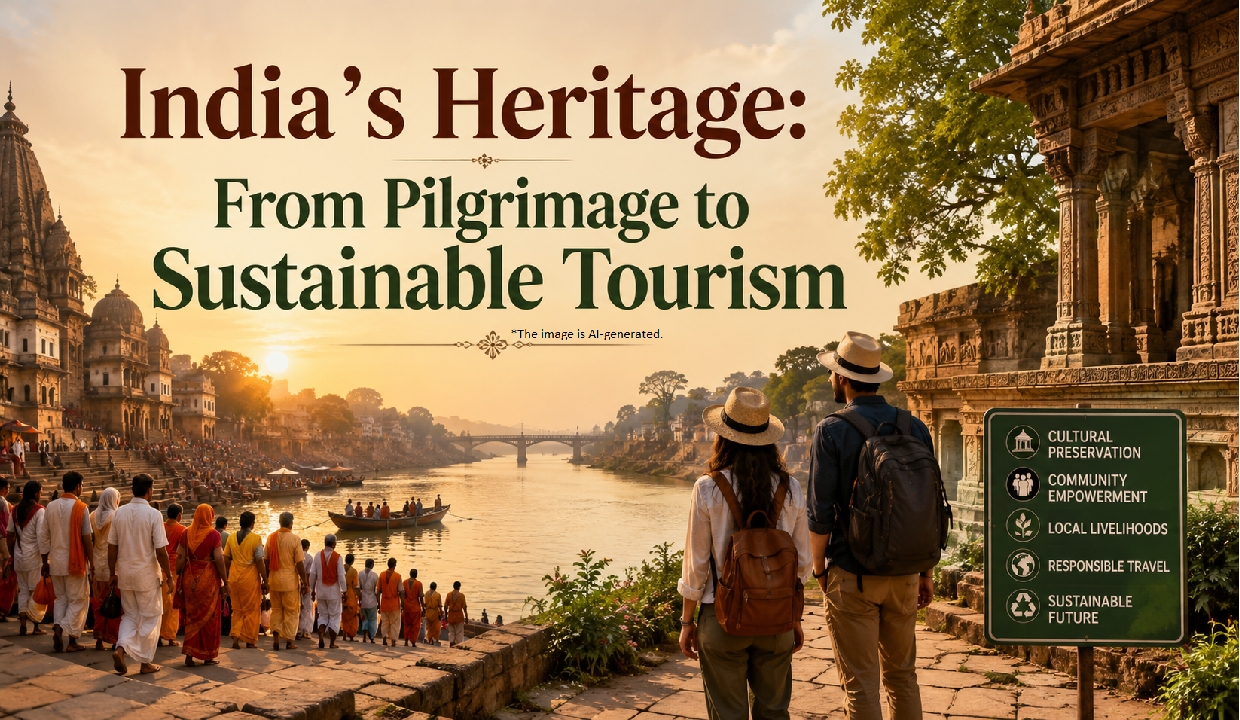
India’s ancient pilgrimage traditions can inform a modern model of sustainable heritage tourism by linking cultural preservation, community ownership, local livelihoods, responsible travel, and development.
Heritage is more than a collection of monuments, traditions, and cultural practices inherited from the past. It is a repository of collective memory, identity, and civilisational continuity that shapes how societies understand themselves and their place in the world. Increasingly, heritage is also recognised as an economic resource. When linked with tourism, it can generate employment, stimulate local enterprise, support regional development, and create opportunities for sustainable growth.
Ancient India did not have tourism in the modern sense. There were no travel agencies, no packaged itineraries, no government schemes to promote leisure travel. What India had instead was something older and, in many ways, more sophisticated: tirthayatra. As noted in the Mahabharata, Anusasana Parva.
"There is no merit equal to that obtained from a sacred pilgrimage; there is no austerity equal to pilgrimage; there is no gift equal to pilgrimage. Therefore, one should resort to sacred places (tirthas)."
Ancient pilgrimage networks connected distant regions of the subcontinent, creating centres of religious devotion, economic activity, and social interaction whose vitality depended on the sustained movement of pilgrims and commerce. The Mahabharata's Tirthaparvan and texts like the Matsya Purana enumerate pilgrimage routes that doubled as trade routes. In this sense, tirthayatra functioned as heritage tourism—travel that generates employment, supports local economies and connects people to cultural traditions and spiritual practices.
At its core, tirthayatra was an immersive form of cultural engagement. Pilgrims participated in rituals, festivals, and community life, ensuring that economic benefits accrued directly to local custodians of heritage. In modern terminology, tirthayatra may be understood as an indigenous model of heritage governance in which cultural preservation, economic exchange, and community stewardship were embedded within the same institutional ecosystem. Many of the principles embedded in this historical model continue to shape contemporary understandings of heritage tourism.
Tourists today want to participate in local traditions, understand spiritual practices, and connect with communities. This shift has led to what can be called experience-based tourism. Heritage is no longer presented as something static but as something living and interactive. Initiatives like Subah-e-Banaras allow visitors to experience cultural practices such as yoga, music, and rituals in a meaningful way. It works because it is rooted in something real-a living tradition that the city has sustained over centuries.
Recognising the economic, cultural, and social potential of such forms of heritage engagement, the Government of India has launched a number of initiatives aimed at integrating cultural preservation with tourism, infrastructure, and local livelihoods. Programmes such as PRASAD (Pilgrimage Rejuvenation and Spiritual Augmentation Drive), HRIDAY (Heritage City Development and Augmentation Yojana), and Swadesh Darshan seek not merely to improve visitor facilities but to strengthen the cultural, economic, and social ecosystems that sustain heritage destinations. Together, these initiatives reflect an increasingly integrated approach in which heritage is viewed not as a relic of the past but as a living asset capable of generating employment, supporting local enterprise, revitalising historic urban centres, and strengthening cultural identity. In many respects, these efforts represent a contemporary attempt to reconnect tourism, community welfare, and cultural continuity in ways that echo the historical logic of tirthayatra.
Ancient India developed a model in which heritage, mobility, community welfare, and economic activity were interconnected; contemporary policy is seeking to revive and adapt that logic for modern development. Yet the long-term sustainability of heritage tourism ultimately depends on the communities that sustain these traditions. Temples, pilgrimage routes, festivals, traditional crafts, oral histories, and ritual practices survive only when the communities that sustain them remain economically and socially viable. In the Indian context, this principle resonates strongly with the civilisational ethos of tirthayatra, where sacred places were maintained through collective responsibility and sustained community engagement.
However, challenges remain. Excessive commercialisation can transform living traditions into performances staged solely for visitors, while unchecked tourist flows may strain local resources, generate waste, and erode the very cultural authenticity that attracts visitors in the first place. Cleanliness and environmental management, waste disposal, sanitation, river conservation, crowd management, and the maintenance of public spaces are not merely municipal concerns but heritage concerns. The success of heritage tourism ultimately depends upon whether local communities, religious institutions and devotees themselves regard preservation as a shared responsibility rather than a governmental obligation alone.
As reflected in the Vishnu Purana, the responsibility of preservation has long been recognised.
A widely cited tirtha-mahatmya verse (traditional) declares, (All sacred places on earth must be protected by those who seek well-being and prosperity)
Conclusion: The significance of the Indian experience lies in the fact that it offers not merely examples of heritage tourism but a civilisational framework for thinking about the relationship between culture, economy, and society. The institution of tirthayatra demonstrated that mobility, devotion, commerce, and community welfare could coexist within a mutually reinforcing system. The lesson for contemporary policy is therefore not simply to attract more tourists, but to create conditions under which heritage remains meaningful, communities remain empowered, and economic benefits remain locally rooted. Heritage survives not because it is protected by law, but because communities continue to find value in preserving it. The future of heritage tourism in India will depend on how successfully this principle is translated into practice.
Justice Vineet Saran, Former Judge, Supreme Court of India; Dr. Suchi Dayal, Senior Research Fellow, Bharat Ki Soch; Views presented are personal.