Indian innovator’s 3D tech to transform med-tech, space research
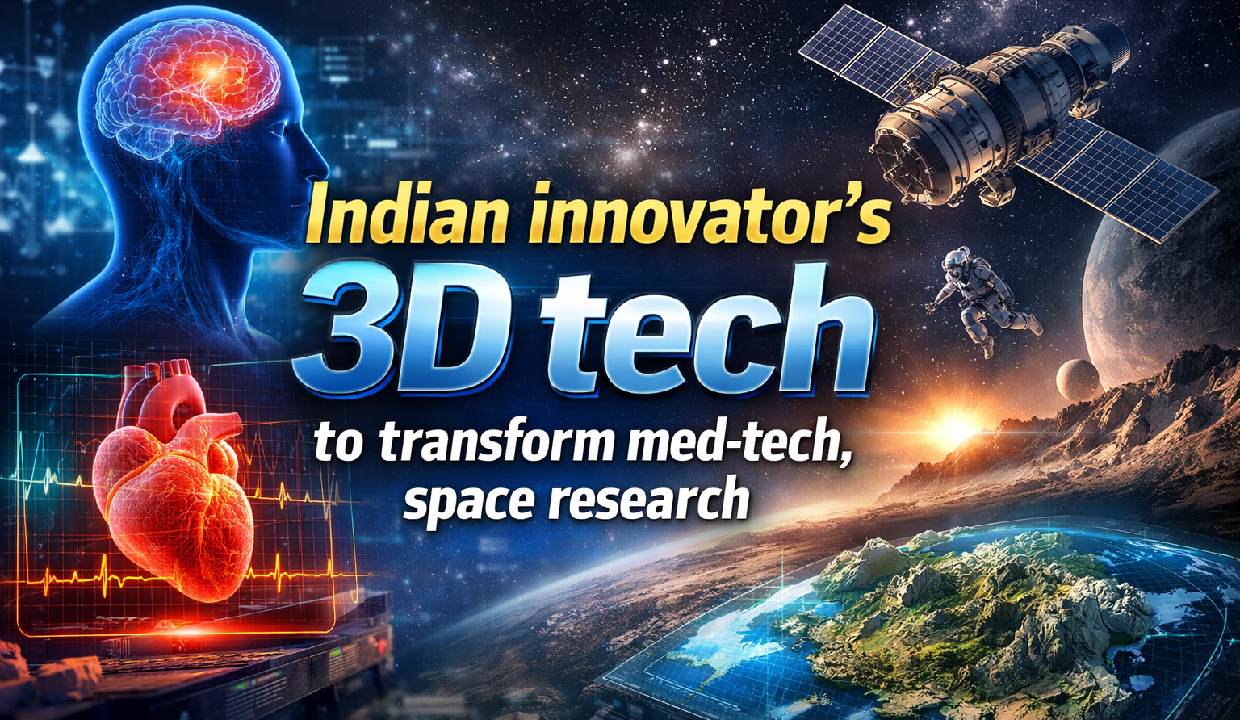
Indian innovator Sandip Chatterjee has unveiled a patented breakthrough in stereoscopic 3D imaging, which is poised to redefine global standards in medical diagnostics, space exploration and environmental monitoring. The technology utilises Chatterjee’s unique Shadow Matrix Scale, a depth-gauging method that converts standard 2D images into high-fidelity 3D visuals.
By integrating Artificial Intelligence (AI), the system now offers real-time 360-degree reconstructions and automated diagnostic reports, effectively bypassing the need for expensive dual-camera hardware.
The integration of this 3D engine with AI promises to revolutionise fields such as cardiology, oncology, and neurology. Through the use of depth-cue analysis, the system provides improved accuracy in identifying abnormalities and pre — disease indicators.
Furthermore, surgeons can now rotate and scale diagnostic data from any angle in real-time, allowing for more precise surgical planning and earlier detection of complications.
The technology also empowers patients by allowing them to view their own MRI, CT, and X-ray scans in interactive 3D, which fosters better communication and a clearer understanding of complex medical conditions.
The applications of the Shadow Matrix Scale extend far into the frontiers of science and industry.
In space and satellite research, the technology provides sharper depth perception for analysing planetary terrains and atmospheric shifts. For environmental monitoring, it enables precise 3D modelling to track soil erosion and predict flood patterns with enhanced precision. Additionally, the innovation holds immense potential for education and research, offering immersive tools for next-generation content creation.
Unlike existing systems, Chatterjee’s innovation extracts spatial geometry directly from flat images, making it a highly scalable and cost-effective solution for global industries.
Based in Kolkata, Chatterjee has already secured patents in India, drawing significant international interest for his contribution to computational depth analysis.
As his research continues, this pioneering technology is set to lead the next generation of immersive imaging on the global stage.