India flays ‘lethal’ action on mariners
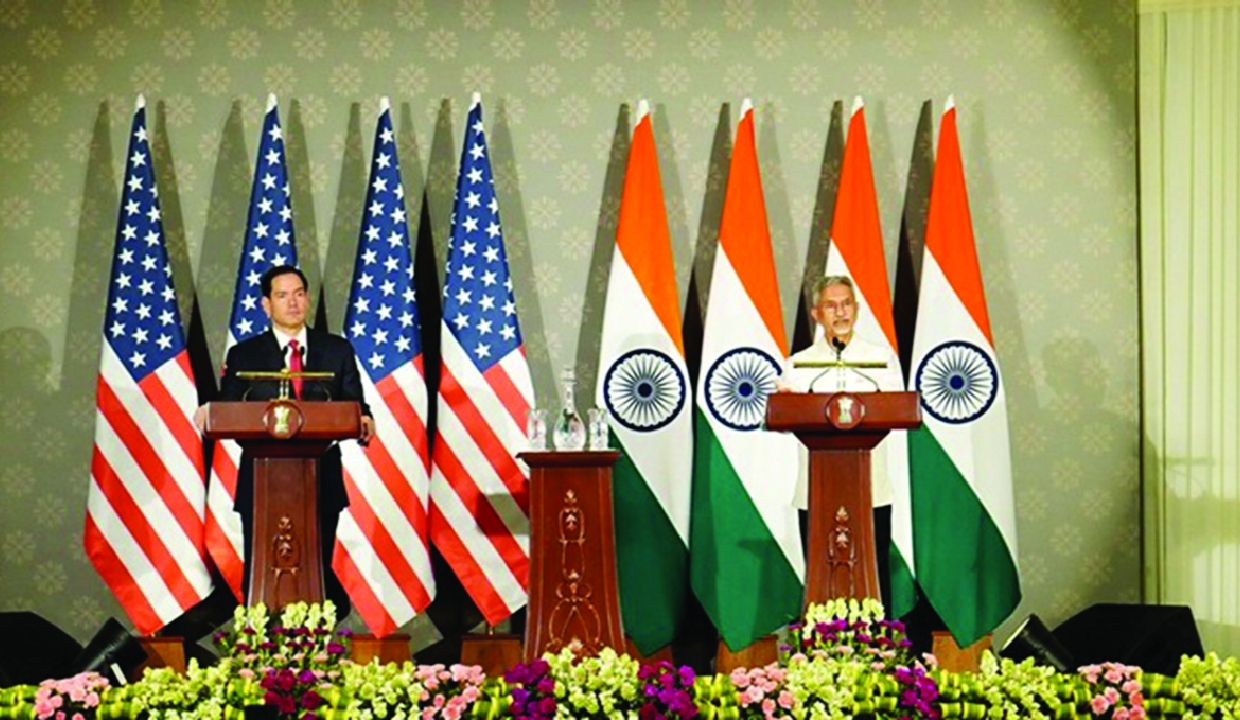
Jaishankar raises issue with Rubio who warns against violations in Hormuz
Secretary of State Marco Rubio told External Affairs Minister S Jaishankar that the US will not tolerate any violations of its naval blockade or illegal transport of Iranian oil through the Strait of Hormuz. This message was delivered during a phone call on Friday evening, when Jaishankar strongly protested the deaths of three Indian seafarers in recent US military actions against commercial ships off the coast of Oman.
State Department spokesman Tommy Pigott said Rubio emphasised that all commercial ships should immediately follow US forces’ orders to help maintain peace and security in the Strait. Rubio also made it clear that breaking the US blockade or illegally transporting Iranian oil will not be accepted.
These incidents are the first confirmed deaths among merchant sailors since the US began strictly enforcing its naval blockade on Iran in April 2026. This week, three ships with mostly Indian crews were attacked in the Gulf of Oman near the Strait of Hormuz. The worst attack happened on Wednesday, when US forces hit the Palau-flagged oil tanker MT Settebello. Three Indian crew members died, and the Omani Navy rescued 21 others.
The three who died were Cadet Aditya Sharma from Himachal Pradesh, fitter Shivanand Chaurasia from Uttar Pradesh, and chief engineer Patnala Suresh. On June 8, US forces also turned off another Palau-flagged tanker, MT Marivex, which had 24 Indian sailors on board; all were rescued safely. A third ship with about 20 Indian crew members was targeted around June 11.
The Strait of Hormuz and the Gulf of Oman are at the centre of the current crisis. This narrow waterway carries about 20 per cent of the world’s oil trade. According to US Central Command, the ships that were targeted did not follow orders, ignored several warnings, and tried to move Iranian oil against the blockade.
For the Settebello, US aircraft reportedly fired directly into the engine room after the crew did not follow instructions.
India has firmly opposed the use of deadly force against commercial ships. After speaking with Rubio, Jaishankar posted on X: “I reiterated India’s strong protest at the attacks by the US Navy in the Gulf that killed three Indian mariners. Such lethal actions against commercial shipping are not justified.” Earlier, New Delhi called in the US chargé d’affaires, Jason Meeks, to express its “deepest concerns.” The Shipping Ministry has warned Indian seafarers working in dangerous waters, and the Indian Navy has helped with rescue and damage control.
The current standoff began after the US-Iran conflict escalated in 2026. After US and Israeli strikes on Iranian targets in late February, Iran put restrictions on shipping through the Strait of Hormuz. On April 13, the US answered by setting up a naval blockade on Iranian ports and ships suspected of carrying sanctioned Iranian oil. The Strait of Hormuz is the world’s most important oil route, located between Iran in the north and Oman and the UAE in the south. Any trouble here affects global energy markets. The US blockade is meant to stop Iran from exporting oil and making money during the conflict, while Iran uses its location to its advantage. Many targeted ships are part of the ‘shadow fleet’, older tankers flying flags of convenience like Palau or Guinea-Bissau that carry Iranian oil despite sanctions. Indian seafarers make up a large share of the global maritime workforce and often work on these ships for higher pay, despite the job’s risks.
Families in states such as Uttar Pradesh, Himachal Pradesh, and Andhra Pradesh are mourning the loss of breadwinners who left home to work at sea. Opposition parties have criticised the government’s handling of the issue, while maritime unions have called for better protection of Indian crew on tankers operating in conflict zones.
This incident comes at a delicate moment for India-US relations. The two countries have strong strategic ties through the Quad, defence cooperation, and trade. Still, protecting Indian citizens is a top priority for New Delhi. Jaishankar’s direct talks with Rubio show India’s commitment to addressing the issue at the highest level while seeking to avoid further conflict.
The United States says its actions are defensive and meant to enforce international sanctions and keep shipping lanes open. US officials argue that ships which do not follow orders and ignore warnings put US forces and regional stability at risk. Behind the public posturing, quiet diplomacy continues.
There are indications of possible US-Iran interim understandings that could ease the blockade and reopen safe passage through the Strait in exchange for concessions on nuclear and regional issues. As the world watches oil markets closely, keeping navigation safe in the Strait of Hormuz is both a strategic and humanitarian need.
US-IRAN peace deal TODAY: Trump
Washington: US President Donald Trump said on Saturday that a deal to end the war with Iran will be signed on Sunday and the Strait of Hormuz will be “open to all” immediately after that.
“The Deal is scheduled to get signed on Sunday, and immediately after it is signed, the Hormuz Strait is OPEN TO ALL,” the President Donald Trump said in a post on Truth Social.
Trump also contrasted the proposed agreement with the 2015 nuclear deal negotiated under former president Barack Obama.
"Barack Hussein Obama's Deal with Iran, the JCPOA, was an easy, beautiful, smooth road to a Nuclear Weapon, which Iran would have had six years ago, and would have used long before now.
"My Agreement with Iran is the exact opposite, A WALL TO NO NUCLEAR WEAPON! In fact, they no longer want a Nuclear Weapon, nor will they have one, either through purchase, development, or any other form of procurement," he said.
Trump further claimed that Iran's nuclear programme had been effectively neutralised and said the remaining nuclear material would be disposed of at a later stage.
"At the appropriate time, when all is calm, we will go in and get the Nuclear Dust, buried deep under the powerful sunken granite mountains, thanks to our beautiful B-2 Bombers and their brilliant pilots, and downblend and destroy it, whether in Iran, or the United States," he said.
Pakistan's Foreign Office earlier said the United States and Iran were in the final stage of negotiations and that an electronic signing ceremony for the agreement was scheduled for Sunday.