India, EU conclude historic trade talks

Ahead of India and the European Union summit on Tuesday, European Commission President Ursula von der Leyen on Monday said a successful India makes the world more stable, prosperous and secure — and for all to benefit. She described the participation of an EU military contingent in the Republic Day parade as a strong signal of deepening security cooperation, adding that the engagement would culminate in the signing of a Security and Defence Partnership.
“A successful India makes the world more stable, prosperous and secure — and we all benefit,” von der Leyen said who alongwith European Council President Antonio Costa are likely to finalise a strategic security and defence partnership and unveil a framework to facilitate the mobility of Indian professionals to Europe. The meeting is expected to articulate a shared roadmap to navigate shifting global geopolitics, particularly amid policy uncertainties emerging from Washington on trade and security.
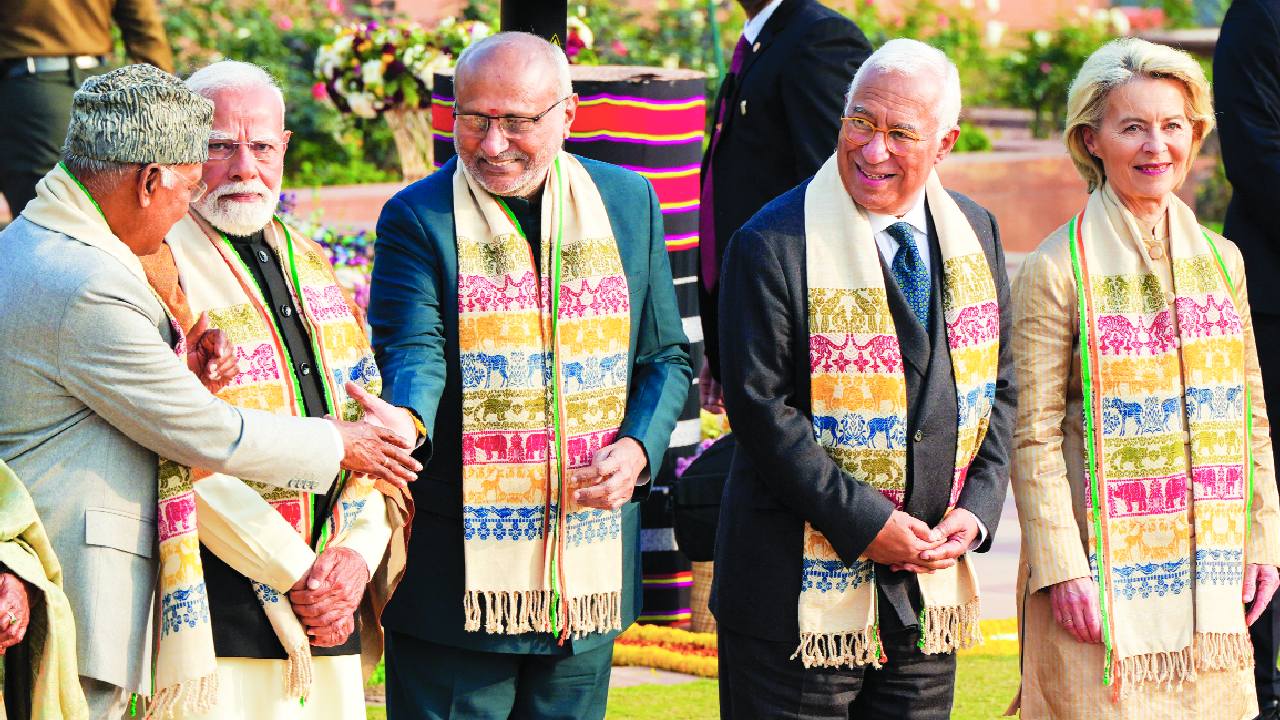
Costa and von der Leyen were the chief guests at India’s 77th Republic Day celebrations at Kartavya Path, underscoring the growing political and strategic warmth between New Delhi and Brussels.
Prime Minister Narendra Modi will host Leyen and Costa at the summit with the conclusion of talks on an ambitious free trade agreement (FTA) expected to headline the outcomes. Major breakthroughs in trade, defence and mobility cooperation are expected at the high-level summit in New Delhi on Tuesday.On Monday evening, Commerce Secretary Rajesh Agrawal confirmed that India and the European Union (EU) have successfully concluded negotiations for the proposed free trade agreement
EU Commissioner for Trade and Economic Security Maros Sefcovic also indicated that the long-pending India-EU FTA would be finalised at the summit. Calling his presence at the Republic Day ceremony a “profound honour,” Sefcovic said the occasion provided an ideal moment to strengthen ties through the conclusion of a comprehensive trade deal.Von der Leyen had earlier said India and the EU were on the verge of a “historic trade agreement” that would create a combined market of nearly two billion people, accounting for almost a quarter of global GDP.
Negotiations on the FTA were first launched in 2007 but stalled in 2013 due to differences over ambition and scope. Talks were revived in June 2022, and the agreement is now expected to significantly deepen cooperation across sectors ranging from manufacturing and services to technology and sustainability.Trade, defence and security, climate action, critical and emerging technologies, and support for a rules-based international order will dominate the summit agenda. Alongside the FTA, the two sides are expected to unveil a broader strategic agenda and a defence framework pact.
India and the EU have been strategic partners since 2004. The proposed Security and Defence Partnership is aimed at enhancing interoperability, expanding joint security initiatives and opening avenues for Indian companies to participate in the EU’s SAFE (Security Action for Europe) programme. SAFE is a €150 billion financial instrument designed to help EU member states strengthen defence preparedness.The summit is also expected to launch negotiations on a Security of Information Agreement, which would facilitate closer industrial and technological cooperation in the defence sector.
Another key outcome is likely to be a memorandum of understanding on mobility, providing a framework for EU member states to expand opportunities for Indian workers and professionals. Countries such as France, Germany and Italy already have migration and mobility arrangements with India.In addition to formal agreements, leaders are expected to exchange views on major global challenges, including the ongoing Russia-Ukraine conflict. European officials have said the summit will provide an opportunity to convey their position that the war poses an existential threat to Europe and challenges the rules-based international order, with implications extending to the Indo-Pacific.
Despite differences on certain global issues, both sides acknowledge a shared interest in stability, economic resilience and multilateral cooperation. Over the past few years, India-EU ties have steadily strengthened, with trade emerging as a central pillar of the relationship.The EU, as a bloc, is India’s largest trading partner in goods. In the 2024–25 financial year, bilateral goods trade stood at around USD 136 billion, with Indian exports valued at approximately USD 76 billion and imports at about USD 60 billion.