India as Global South’s voice in Artificial Intelligence at the India AI Impact Summit 2026
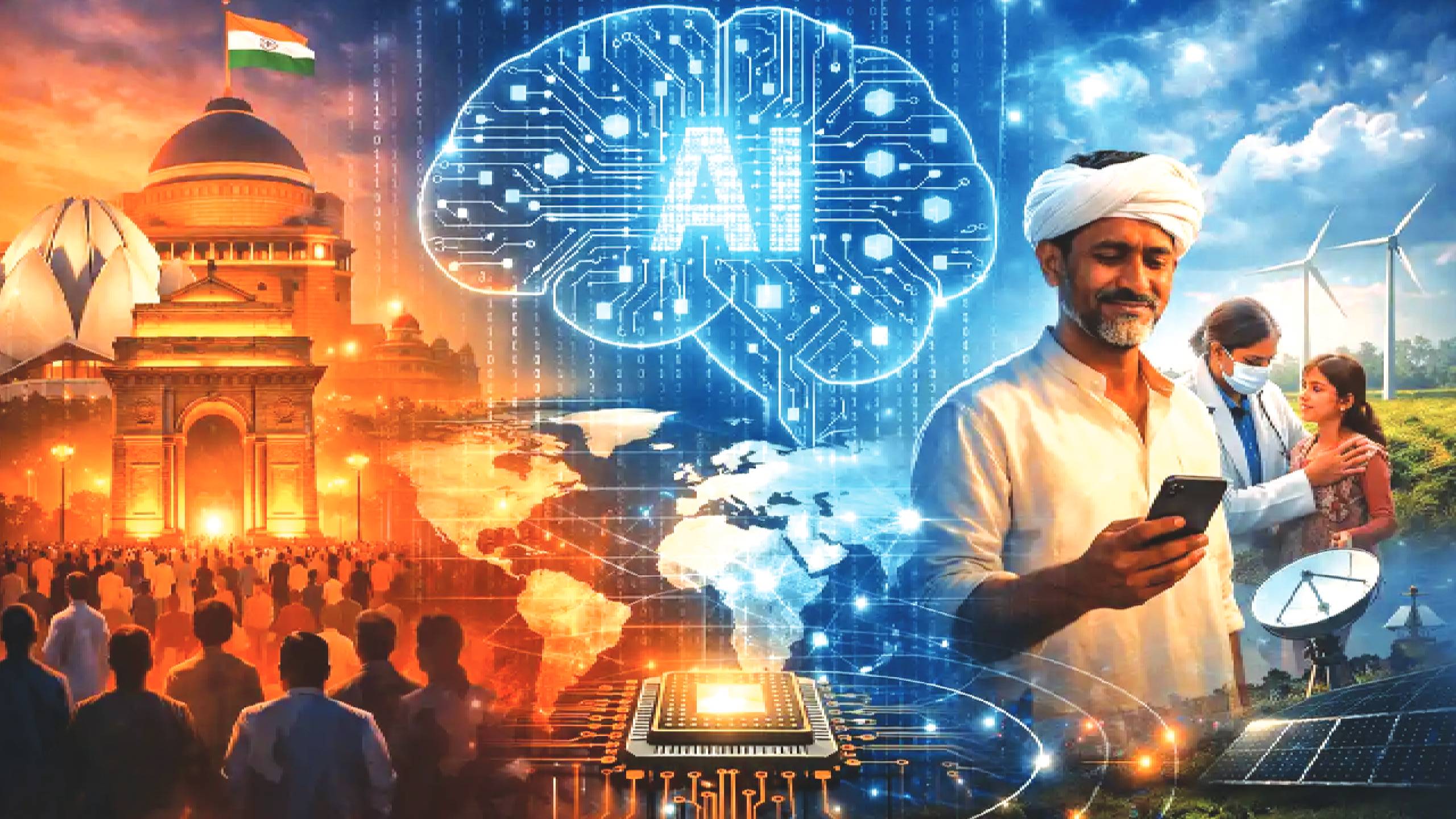
As artificial intelligence transitions from technological novelty to economic necessity, a fundamental question confronts the international community: whose values will shape its development, and who will benefit from its transformative power? The ongoing India AI Impact Summit 2026, at New Delhi, has emerged as a deliberate answer positioning emerging economies not as passive recipients of technology, but as active architects of an AI-driven future. The AI mantra narrative is everywhere.
This gathering represents far more than another conference on emerging technologies. It signals India’s strategic ambition to reframe artificial intelligence through the lens of developing nations. At its heart lies a philosophy rooted in the Indian philosophy of “Vasudhaiva Kutumbakam”— the world as one family reimagined for the digital age as JanAI, or AI for the people. It marks the next major milestone for India following its G20 presidency in 2023.
The timing of this summit carries particular significance. With AI markets expanding rapidly across developing regions and India’s own sector projected to exceed seventeen billion dollars by 2027, New Delhi seeks to establish itself as more than a technology consumer. The country aims to become the conceptual bridge between cutting-edge innovation and meaningful societal transformation, particularly for nations often marginalised in technology governance discussions.
India’s approach rests on three foundational principles which organisers term “Sutras”— that prioritise people, environmental sustainability, and comprehensive progress. These pillars reflect a conscious departure from AI development models focused primarily on commercial velocity or geopolitical advantage. Instead, they acknowledge the complex realities facing developing nations: limited infrastructure, diverse linguistic landscapes, vast rural populations, and pressing developmental challenges that technology must address rather than exacerbate.
Translating broad philosophy into tangible outcomes, summit organisers have identified seven interconnected domains of cooperation, termed “Chakras” in reference to centers of energy and focus. These areas-spanning human capacity building, social inclusion, trustworthy AI systems, institutional resilience, scientific advancement, resource democratisation, and economic development, provide a structured framework for international collaboration.
This architecture matters because it moves beyond abstract commitments to AI ethics, outlining specific areas where developing nations face common obstacles and could benefit from coordinated action. Whether addressing the computational resource gap that constrains AI research in smaller economies or establishing safety protocols appropriate for diverse regulatory environments, these domains acknowledge that emerging markets require tailored solutions rather than technology transfer alone.
The emphasis on human capital development recognises that technological advancement without skilled workforces creates dependency rather than empowerment. Similarly, the focus on democratising AI resources tackles head-on the concentration of computational power that threatens to entrench existing global inequalities in the AI era.
India brings particular credibility to this conversation through its demonstrated capacity for large-scale digital implementation. The country’s experience deploying digital public infrastructure, from biometric identification systems reaching over a billion citizens to unified payment interfaces processing millions of transactions daily, offers practical insights into equitable technology distribution.
This track record becomes especially relevant as developing nations confront a growing computational divide. Access to high-performance computing resources, essential for training sophisticated AI models, remains concentrated in wealthy nations and major technology corporations. New Delhi’s proposal to address this asymmetry through shared infrastructure and collaborative research facilities represents a potentially significant shift in how AI capabilities might be distributed globally.
The infrastructure question extends beyond raw computing power to include datasets, algorithmic frameworks, and technical expertise, resources that determine whether nations can develop AI solutions tailored to their specific contexts or must rely on imported systems designed for different realities. The summit’s value proposition extends across different constituencies.
For developing nations, it provides a platform to collectively articulate technology governance priorities before international standards become entrenched. For multinational enterprises, it offers entry points into rapidly expanding markets characterised by unique challenges and opportunities, from multilingual natural language processing to AI applications in resource-constrained environments.
Development institutions and bilateral partners gain exposure to policy frameworks attempting to balance innovation encouragement with social protection, particularly relevant as AI’s economic impacts intensify. For India itself, the gathering serves as a statement of technological maturity and policy leadership, positioning the nation as a convener capable of shaping rather than merely responding to global technology trajectories.
The convergence of these interests creates potential for substantive outcomes beyond ceremonial declarations, whether through joint research initiatives, shared computing facilities, or coordinated approaches to AI regulation that respect national sovereignty while enabling cross-border collaboration.
Perhaps most significantly, the summit represents an attempt to shift AI discourse beyond zero-sum competition toward collaborative problem-solving. While geopolitical tensions increasingly frame technology development as strategic rivalry, India’s emphasis on inclusive growth and shared challenges offers an alternative framework-one particularly appealing to nations seeking to benefit from AI without becoming dependent on any single technology ecosystem.
The focus on trustworthy, secure systems alongside economic growth reflects hard-learned lessons about technology adoption in diverse societies. Questions of algorithmic bias, data sovereignty, energy consumption, and workforce displacement carry different implications across contexts, requiring governance approaches that accommodate varied developmental stages and priorities.
By centering discussions around concrete challenges improving agricultural yields, expanding healthcare access, enhancing educational outcomes the summit grounds AI conversations in developmental imperatives rather than abstract technological capabilities. This reorientation may prove crucial in ensuring AI serves genuine societal needs rather than creating solutions in search of problems.
As the summit unfolds, its success will ultimately be measured not by diplomatic attendance or declaration language, but by whether it catalyzes genuine cooperation on AI development reflecting Global South priorities. Can shared infrastructure initiatives materialise? Will collaborative research networks emerge? Can alternative governance models gain international traction?
For India, the stakes extend beyond immediate outcomes. The nation seeks recognition as a pivotal force in technology’s trajectory not through market size alone, but through intellectual leadership on questions of equity, sustainability, and human-centered design. Whether this vision resonates beyond New Delhi will shape both AI’s evolution and the developing world’s place within it.
The summit takes place at a moment when technological trajectories remain fluid enough for intervention, yet momentum toward concentration of AI capabilities accelerates daily. India’s gambit is that collective action among emerging economies can still influence outcomes that the Global South can move from being shaped by artificial intelligence to actively shaping it.
Writer is a former civil servant, who writes on cinema and strategic communication. With inputs from Zoya Ahmad and Vaishnavie Srinivasan