In inequality we believe & trust
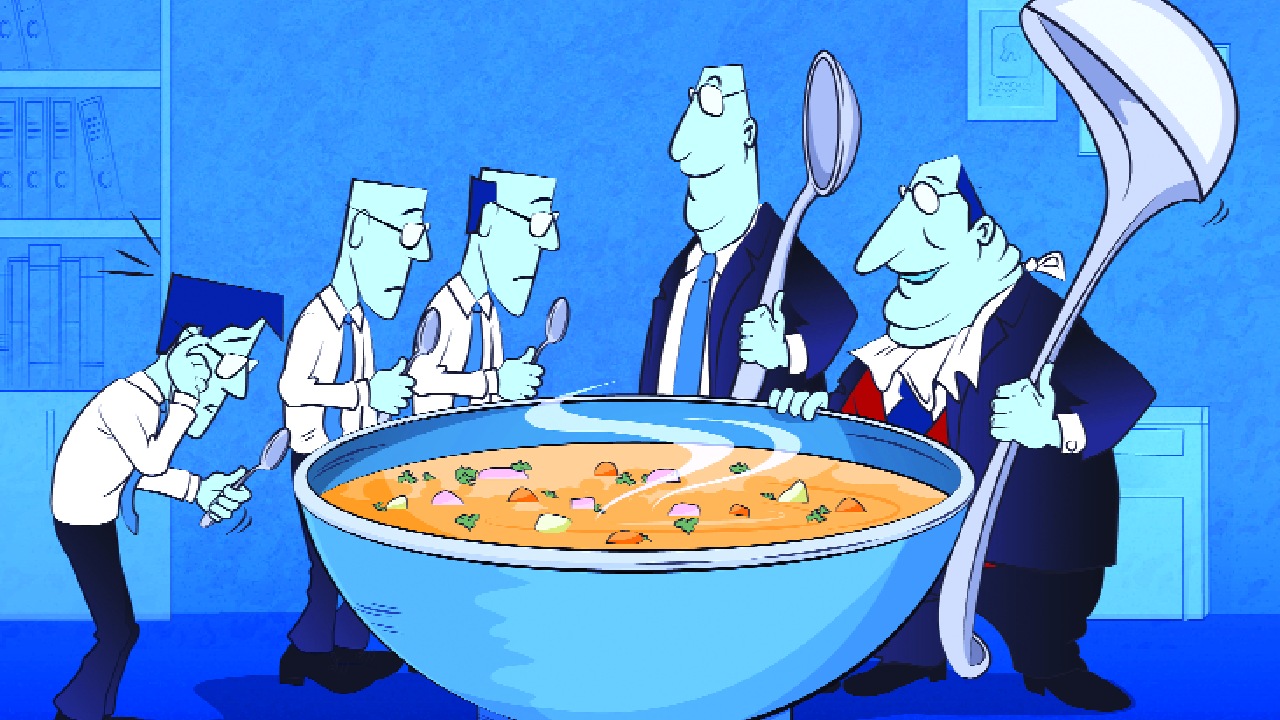
It is a scary scenario. The richest 10 per cent in the world own nearly 75 per cent of the global wealth, compared to barely two per cent by the poorest 50 per cent. Less than 60,000 at the top of the pyramid control three times more wealth than half of humanity combined. More crucially, the rich contribute “disproportionately little to public finances” because the taxes rise for the bulk of the people, and fall sharply for the millionaires and billionaires. Inequality extends beyond incomes and wealth, and incorporates gender, opportunity, and climate. Women capture a quarter of global labour income.
It is well-known that India ranks high among the inequality indices in most respects. In terms of wealth and incomes, the top 10 per cent own two-thirds, and just under 58 per cent, respectively, compared to 6.5 per cent, and 15 per cent, respectively, for the poorest half. Indeed, the top one per cent control more than 40 per cent of the nation’s wealth. The income inequality has sharply widened since the 1980s, when the difference between the top 10 per cent (which controlled 30 per cent of the income), and bottom 50 per cent was five per cent or so. Since then, it sharply and wildly diverged.
On the positive side, “The income gap beween the top 10 per cent, and the bottom 50 per cent,” states the latest World Inequality Report (2026), “remained stable between 2014 and 2024.” This implies that although the wealthy are making more money than ever, more people are getting out of poverty, and the incomes of the middle class and lower class are on the upswing. This upward transition at the lower levels enabled the income gap to remain steady, neither rising nor falling. Yet, as the report summarises, “Overall, inequality in India remains deeply entrenched across income, wealth, and gender dimensions,
highlighting persistent structural divides.”
Compared to the BRICS economies, India’s position vis-à-vis income seems weaker compared to its reality as per wealth. The ratio or multiple between the top end and bottom end determines the potential strength and weaknesses in a nation’s inequality. In India, the income difference ratio between the top 10 per cent, and bottom 50 per cent is nearly 4X, which is higher than China (just above 3X), and Russia (over 3X). Thus, income distribution is better in the latter two nations, although the ratios for Brazil (more than 6X), and South Africa (just under 12X) are way ahead of India’s.
In terms of wealth distribution, India (10X) is better than the other four nations. Only China (just under 11) compares with India, with the other three showing vast variations and differences. In the case of Brazil and Russia, the ratios are 30 times, or thereabouts. South Africa seems an outlier; the wealth of the bottom half declined by 2.5 per cent, even as the top 10 per cent owns more than 85 per cent of the wealth. One can contend that while India’s case is bad, it is better off than the BRICS counterparts, or similarly-placed economies.
The 2026 report, apart from looking at national and regional dynamics, seeks to explore new avenues related to climate and wealth, unequal access to human capital, and gender disparities. Although the average gaps between the GDPs in sub-Saharan Africa, and Europe and North America are enormous, the gaps in average spending per child is 1 to 40, or nearly three times the gap in GDPs. “Such disparities shape life chances across generations, entrenching a geography of opportunity that exacerbates global wealth hierarchies.” In essence, it implies that the income and wealth variations may only increase in the future among these regions.
Despite the ongoing debates on pollution and emissions due to consumption, the report indicates that capital ownership plays a crucial role in the inequality of emissions. The wealthiest 10 per cent account for 77 per cent of the global emissions associated with capital ownership, and 47 per cent linked to their consumption. Thus, the climate crisis is intertwined with the concentration of global wealth. Hence, there is a need to realign the financial and investment structures that fuel both emissions and inequality. Addressing inequality, contrary to some beliefs, may address the issues of climate change, rather than lead to higher effects.
On average, women earn less than a third of what men earn per working hour, when one accounts for paid and unpaid work. If the unpaid work by women is left out, the earning per hour is less than two-thirds for the men. This highlights persistent discrimination, as also deep inefficiencies between the societies. Despite the higher entry of women in the labour force, which remains low in India, the income disparity and, hence, wealth variations remain. There s a need to involve more women in work, and pay them higher. Of course, unpaid work will remain an ongoing issue.
“Women continue to work more, and earn less than men…. Yet their work is consistently valued less…. These disproportionate responsibilities restrict women’s career opportunities, limit political participation, and slow wealth accumulation. Gender inequality is, therefore, not only a question of fairness but also a structural inefficiency: Economies that undervalue half of their population’s labour force undermine their own capacity for growth and resilience,” states the report. Nations under-express the role of women at their own peril. In India, where the women participation in work is low, it underscores the need to empower the women to reduce inequalities.
“While inequality within countries is severe everywhere, its intensity follows clear patterns. Europe and much of North America & Oceania are among the least unequal, though even here, the top groups capture far more income than the bottom half. The United States stands out as an exception, with higher levels of inequality than its high-income peers. At the other end of the spectrum, Latin America, southern Africa, and the Middle East & North Africa combine low incomes for the bottom 50 per cent with extreme concentration at the top, which yields some of the highest T10/B50 gaps worldwide,” states the report. This is evident among the BRICS nations.
Economic divides, as is logical, spill into politics. In the second half of the last century, the poor and less-educated supported left-aligned, and centrist political parties. The pattern is fractured as voters with lower degrees but higher incomes, and self-employed vote for the rightist parties. There are political gaps between the metros, and smaller towns, as also urban and rural areas. The influence of wealth in politics compounds the inequality in political influence.