In Delhi, Hasina challenges Yunus regime
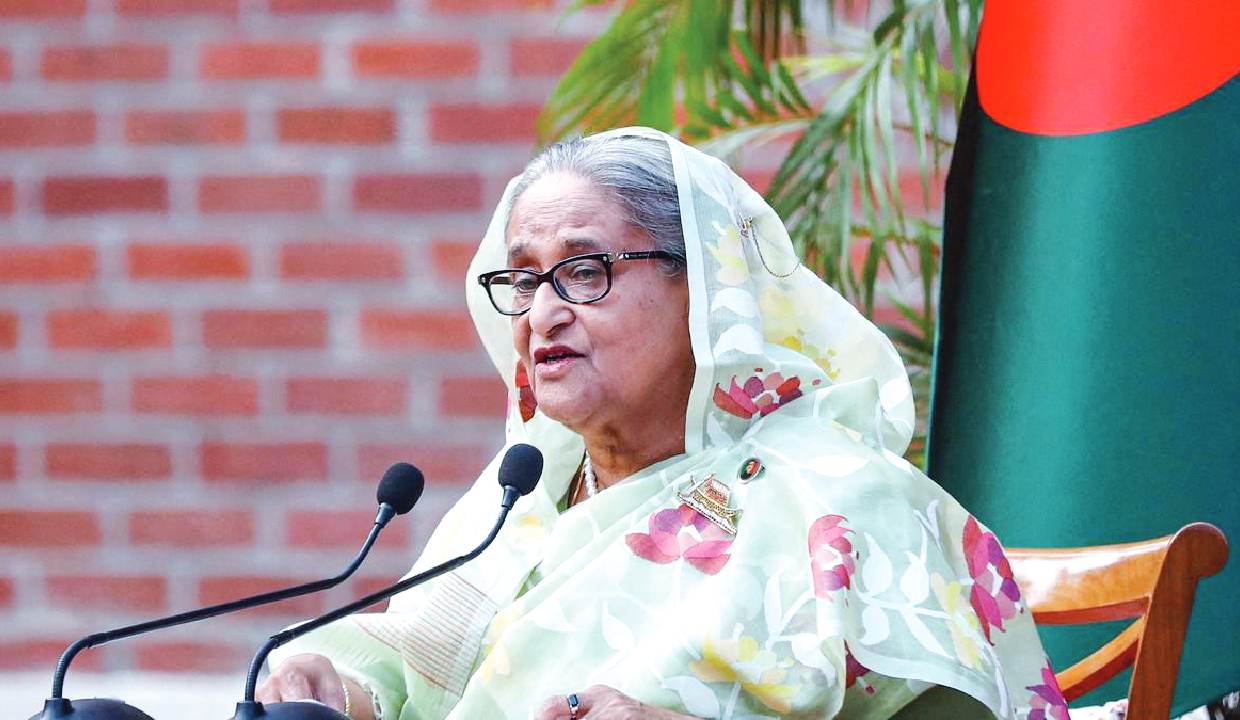
Former Bangladesh prime minister Sheikh Hasina has launched a fresh political offensive against Nobel laureate Muhammad Yunus from New Delhi, accusing his administration of dismantling democracy and pushing Bangladesh into turmoil ahead of the country’s next general election.
Addressing the nation through an audio message broadcast at the Foreign Correspondents’ Club (FCC) in Delhi, Hasina described the current situation in Bangladesh as one of the gravest crises since independence. She alleged widespread lawlessness, curbs on press freedom, persecution of religious minorities, and the erosion of constitutional rule following her removal from office on August 5, 2024.
Framing the crisis as an existential struggle, Hasina invoked the legacy of the Liberation War and the leadership of Bangabandhu Sheikh Mujibur Rahman, claiming that extremist and foreign-backed forces had seized control of the State.
According to her, democratic institutions have been hollowed out and replaced by what she called an unelected and illegitimate regime. Hasina directly blamed Yunus for the breakdown of law and order, economic distress, and alleged human rights violations. She asserted that women, children, journalists, and minorities were facing growing insecurity, while the education system and judiciary were mired in chaos.
In sharply worded remarks, she accused Yunus of betraying national interests and repeatedly used harsh epithets to describe him-remarks that underscored the intensity of the political confrontation.
Warning of what she termed a conspiracy to compromise Bangladesh’s sovereignty by transferring national resources to foreign interests, Hasina urged citizens to unite “in the spirit of the Liberation War” to defend the Constitution and reclaim democratic governance. Reasserting the Awami League’s central place in Bangladesh’s political history, Hasina said the party remained inseparable from the country’s democratic and pluralistic foundations. She vowed that the Awami League would continue its struggle to restore what she described as a “snatched-away homeland” to the people.
Hasina also outlined a five-point roadmap to resolve the crisis. Her demands included the removal of the Yunus administration to pave the way for free and fair elections, an immediate halt to political violence, firm guarantees for the safety of minorities and women, an end to politically motivated legal actions against journalists and opposition figures, and an independent United Nations investigation into the events of the past year.
The FCC event, titled “Save Democracy in Bangladesh,” was attended by several former ministers from Hasina’s Awami League Government as well as members of the Bangladeshi diaspora. Although Hasina did not appear in person, her speech-played to a packed hall-was marked by sweeping rhetoric and a call to action, urging supporters to mobilise against what she described as a “foreign-serving puppet regime.”
Concluding her address, Hasina appealed to both the Bangladeshi people and the international community, saying unity was essential to restoring democracy and constitutional order in Bangladesh.
Widespread lawlessness, curbs on press freedom, persecution of religious minorities and the erosion of constitutional rule in Bangladesh
— Sheikh Hasina