How ABHA Card Changes the Way Medical Records Are Managed
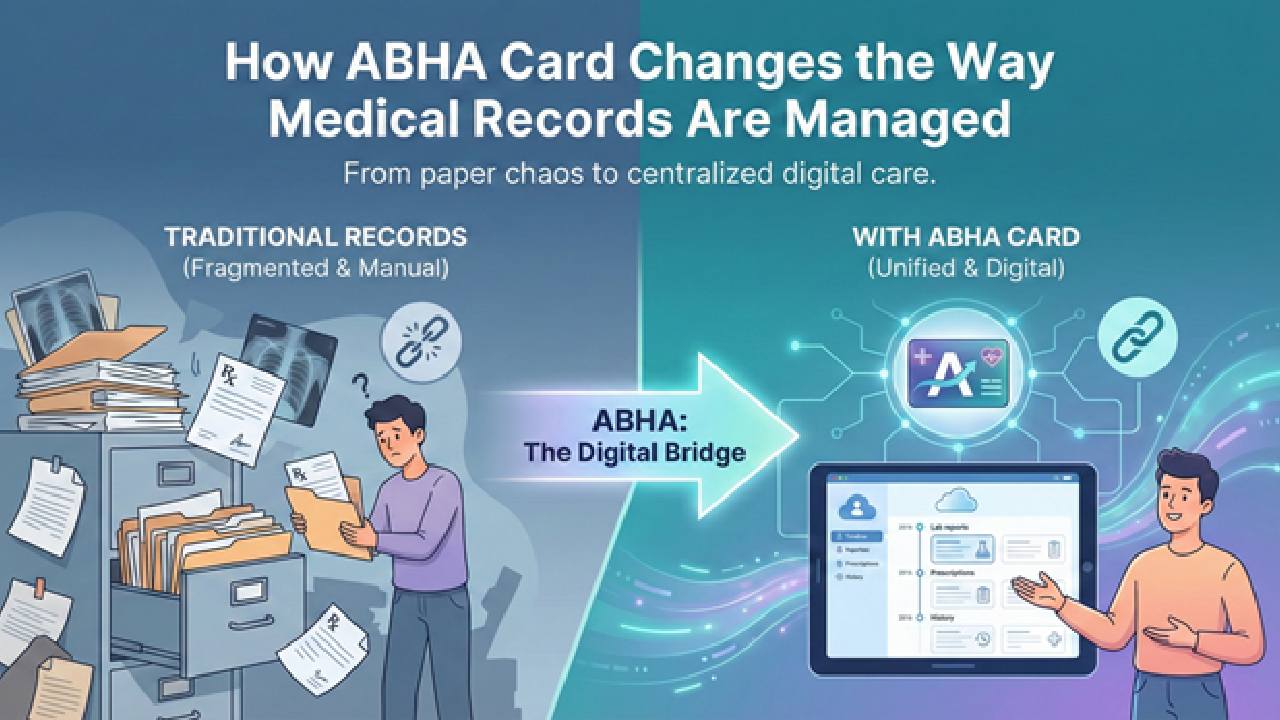
For decades, medical records in India have existed as paper files lying in hospital cabinets, reports saved on personal computers, prescriptions getting lost over time, and medical histories remaining spread across different places. The ABHA Card offers a new approach to handling medical information in a more organised and connected way.
What the ABHA Card Introduces
The Ayushman Bharat Health Account card (ABHA Card) is an initiative that provides every citizen with a digital health ID, uniquely identifying the individual without duplication. One of the key ideas here is that medical records are attached to a person rather than a health institution, which is currently the case.
An ABHA ID can link your health information, like prescriptions, diagnostic reports, discharge summaries, and consultation notes, to a single digital account. These records can only be shared with others if you give permission. That means the medical data you previously had to request from a provider is now in your hands.
For people who decide to make it, the ABHA card download procedure is straightforward and totally digital, so they can use the system whenever it seems necessary without any trouble.
How Record Access Becomes Easier and Safer
Controlled access is one of the key changes introduced by the ABHA Card. Patients can decide what level of access different doctors, hospitals or labs will have to their records and for how long. Sharing data in this manner with the patient's consent is a means of safeguarding sensitive health information from exposure to unintended access.
In a very practical way, this allows doctors' visits to be more productive. Medical practitioners will be able to quickly get familiar with the patient's previous reports and treatment history, thus making more accurate decisions. Meanwhile, patients will no longer need to explain their medical histories or bring their physical files to each visit. Furthermore, digitising health records effectively lessens the possibility of losing documents over time.
Impact on Continuity of Care
Medical care in some cases may extend through years and involve multiple caregivers. The ABHA Card facilitates continuity by making sure that a patient's records are always linked, no matter where treatment is carried out.
When people change their residence, see a specialist, or change hospitals, their ABHA-linked record will serve as their common point of reference. In the long run, this continuity enables a more comprehensive view of health patterns, reaction to treatments, and the evolution of chronic conditions.
The value of this becomes especially clear in cases that involve regular follow-ups for chronic conditions, repeated treatments, or preventive care.
Supporting Digital Health Services
With the rise of telemedicine and online consultations, having access to verified medical records is getting more and more important. The ABHA Card facilitates digital health services by enabling authorised platforms to access relevant records with consent.
Doctors no longer have to rely solely on patients’ verbal descriptions of symptoms or past treatments during teleconsultations, thereby enhancing the quality of remote consultations. Besides, it facilitates the creation of a more integrated healthcare service by helping labs, pharmacies, and diagnostic centres to collaborate. Thus, the ABHA Card is basically a digital health adoption amplifier.
What the ABHA Card Does Not Do
Understanding the limits of the ABHA system is essential. The ABHA Card is not a Health Insurance card, will not pay for medical bills, nor determine eligibility for medical schemes. It will not automatically collect or upload your medical records either.
Medical records are only added when the healthcare providers participate digitally and give the patients the opportunity to consent. The ABHA Card is a framework, not a substitute for insurance or government benefit schemes.
When the Change Becomes Most Visible
The advantages of the ABHA Card become more evident over time. The more healthcare interactions are linked to an ABHA ID, the more complete and useful the record becomes. By starting early, records build up gradually instead of being put together in the middle of a health emergency.
Conclusion
The ABHA Card fundamentally changes the management of medical records by giving control to individuals instead of institutions. It turns disconnected storage of medical records into a connected, consent-based digital system that facilitates continuity, safety, and efficiency in healthcare. It is not meant to substitute for insurance or treatment systems, but it is increasingly playing a role in the organisation and access to medical information in the rapidly changing healthcare environment in India.