Govt seeks $30b compensation from Reliance, BP
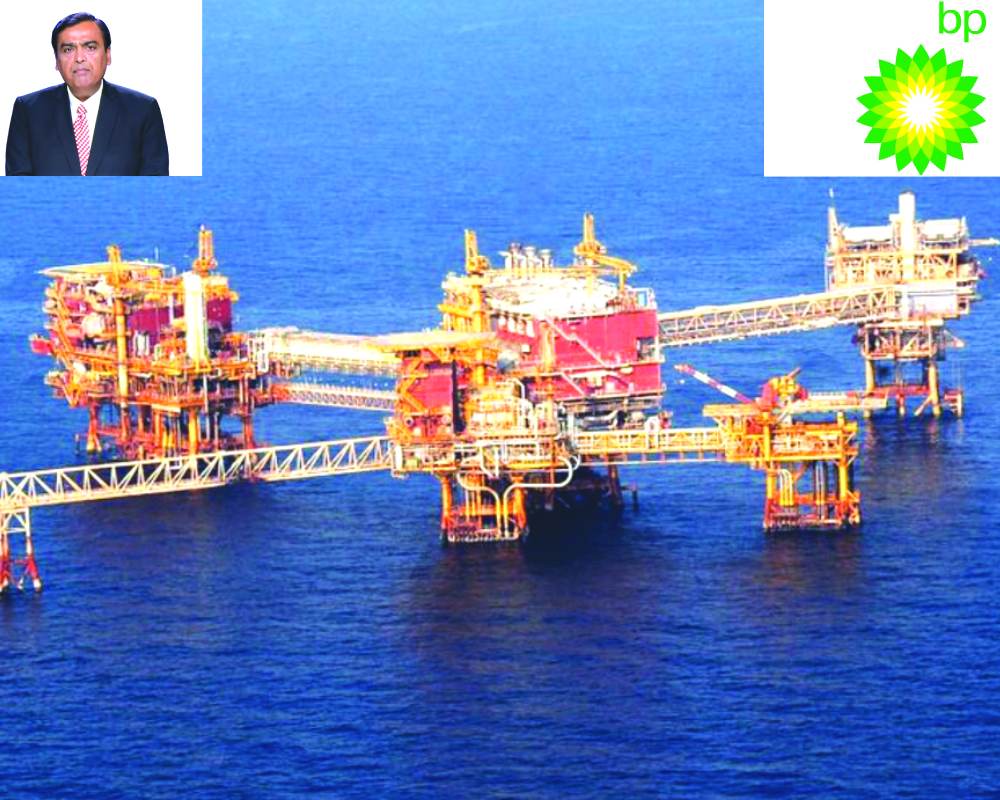
The Government has sought over $30 billion from Mukesh Ambani-led Reliance Industries Ltd and BP as compensation, alleging the partners built larger-than-required facilities at the KG-D6 fields and subsequently failed to meet natural gas output targets. The Government made the claim during its submissions before a three-member arbitration tribunal that on November 7 concluded hearings on the 14-year-old dispute. The tribunal is expected to give its award sometime next year and the party that loses will most likely challenge it before the Supreme Court, three sources aware of the matter said.
Officials said the Government in the arbitration proceedings sought the monetary value of the natural gas that wasn’t produced as well as a compensation for the excess amount spent on installations, fuel marketing, and interest. It put the value for all of this at over $30 billion. The dispute stems from alleged failure of Reliance to comply with the approved investment plan that led to under-utilisation of capacity at the Dhirubhai-1 and 3 fields - the first and the largest of discoveries in the Krishna Godavari basin KG-DWN-98/3 (KG-D6) block to be put on production.
Natural gas output from Dhirubhai-1 and 3 (D1&D3) gas fields started to lag company projections from the very second year of production in 2010, and the field ceased to produce in February 2020, much ahead of its projected life. Reliance, in an initial field development plan, had proposed a $2.47 billion investment to produce a peak of 40 million standard cubic meters per day of gas. In 2006, it revised this to $8.18 billion, projecting a doubling of that output by drilling 31 wells by March 2011. But it drilled only 22 wells, of which only 18 were put to production. The well started shuttering earlier than expected due to unanticipated sand and water ingress, leading to the company mid-way revising the reserves in the field to only 3.10 trillion cubic feet (Tcf) instead of 10.03 Tcf estimated in the 2006 plan.
The Government blamed the phenomenon on the company not sticking to the approved development plan, and in the initial years, disallowed $3.02 billion of costs that Reliance and its partners had incurred on developing the fields.
The company disputed this, saying there is no provision in the KG-D6 contract which entitles the Government to disallow cost recovery on that basis. On November 23, 2011, Reliance served an arbitration notice, seeking to resolve the dispute. The arbitration proceedings, however, couldn’t begin as the Government refused to accept the judges appointed to the three-member tribunal. Reliance had in 2014 named former UK judge Sir Bernard Rix as its arbitrator on the tribunal in place of its original choice, SP Bharucha, a former Chief Justice of India. Justice Bharucha had recused himself from the tribunal where the Government had named former Chief Justice of India VN Khare as its arbitrator. Michael Kirby, a former judge of the Australian High Court, was appointed in September 2014 appointed by the Supreme Court as the neutral arbitrator and chairman of the panel.
The Government moved the Delhi High Court seeking the removal of Rix and Kirby, alleging their ex facie bias against the Union Government. The court in December 2022 dismissed the Central Government’s plea as “not maintainable”. The Government then moved the Supreme Court, which, on January 11, 2023, dismissed the petition. Thereafter, the tribunal began hearing on the dispute.
Reliance and BP, which had bought a 30 per cent stake in KG-D6 and 21 other blocks in 2010 for $7.2 billion, contended that the production sharing contracts (PSCs) under the New Exploration Licensing Policy (NELP) explicitly allow an operator to first recover all its development costs fully, before sharing profits from the production with the Government.
They argued that finding oil and gas is a high-risk business, solely borne by the operator. In the case of D1&D3, the reserves were downsized due to geological factors and the output lagged targets because of unforeseen geological surprises.
The reserve downgrade is not a new phenomenon and companies worldwide have done the same.
The same thing has happened in the KG block, which was originally with Gujarat Government firm GSPC but was later sold to the state-owned ONGC.
They claimed to have followed all rules and all investments incurred on the block were approved by a management committee (MC) that had representatives of the Directorate General of Hydrocarbons (DGH) and the Oil Ministry. The companies termed the Ministry’s action of “retroactively” disallowing some of the costs already incurred as being against the signed PSC.
Gas output from D1&D3 fields in the KG-D6 block was supposed to be 80 million standard cubic meters per day but actual production was only 35.33 mmscmd in 2011-12, 20.88 mmscmd in 2012-13 and 9.77 mmscmd in 2013-14. The output continued to drop in the subsequent years and the fields ceased to produce in February 2020.
The Government, by its letters dated May 2, 2012, November 14, 2013, July 10, 2014, and June 3, 2016, disallowed $3.02 billion costs which the PSC entitled Reliance and its partners to recover.
This disallowance was for missing the target during six years beginning April 1, 2010. In these four notices, the Government sought $ 247 million of additional profit petroleum after cost recovery was disallowed.
Reliance and its partner BP have maintained that a contractor is entitled to recover all of its costs under the terms of the PSC and there are no provisions that entitle the Government to disallow the recovery of any cost. The PSC allows them to deduct all capital and operating expenses from the sale of gas before sharing profits with the Government.