Global experts deliberate future of AI scaling at summit
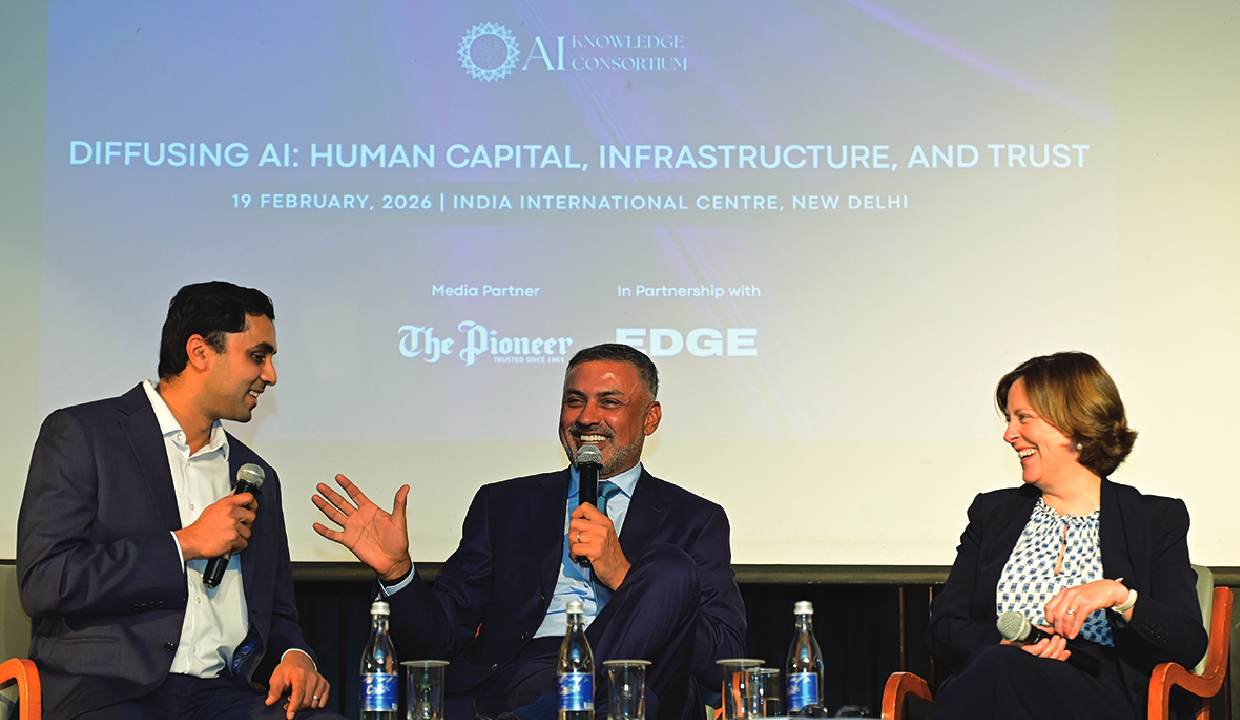
There is going to be no slowdown. “And if safety is not built in from the start, we are heading for a trust crisis.” These powerful remarks defined the tone of a high-level discussion on Artificial Intelligence (AI) at the AI Knowledge Consortium event titled “Diffusing AI: Human Capital, Infrastructure, and Trust”, held on Thursday at India International Centre in the national Capital.
The event brought together global technology and regulatory leaders to debate how AI should scale in countries like India.
Palo Alto Networks CEO Nikesh Arora made it clear that the AI wave cannot be paused. “Anyone who tries to slow it down will just give up competitive advantage,” he said. He pointed to the billions of dollars being invested globally in building massive data centres and faster AI models. According to him, this is the fastest technology curve the world has seen.
Arora used a personal story to explain society’s position in the AI era. Growing up in India, playing cricket, and later moving to the US, he said he never became a “native” to American sports.
“None of us are natives to AI. We are all immigrants,” he said. He warned against overconfidence in judging or controlling a technology that is still evolving.
Leading national daily The Pioneer, published from eight cities including New Delhi, was the media partner of the event organised in partnership with EDGE. The Pioneer group chairman, Prashant Tewari and Printer Publisher, Kushan Mitra, were present on the occasion along with top functionaries of the EDGE.
He also addressed fears about job losses. “We don’t have a job problem,” Arora said. He argued that AI will create demand for five times more developers and skilled professionals. From robotics to automation, he said, every sector will require programming and AI training.
“Heavy industry jobs will also become developer jobs,” he added. While short-term disruption may happen, he said, history shows workers adapt over time.
Arora made a bold prediction about the future of applications. He said most of today’s apps may disappear in the next five to ten years. Instead of clicking through multiple platforms, users will speak directly to AI agents. Booking flights, reserving hotels, and arranging transport could happen through a single natural language command. “The user interface will change completely,” he said.
Melanie Dawes, Chief Executive of Ofcom, the UK’s communications regulator, agreed that AI cannot be slowed. But she warned that speed without responsibility could damage public trust. “If companies launch first and think about safety later, we are heading into difficult territory,” she said.
Dawes said people already have concerns about how social media platforms handled safety over the past two decades.
She stressed that AI companies must conduct proper risk assessments before launching new tools, especially those used by children.
“The risks created by technology are often best solved by technology,” she said, adding that regulators must work collaboratively with companies.
She highlighted Ofcom’s work in online safety enforcement, including investigations into new AI features and the introduction of age assurance systems for adult content platforms in the UK.
According to her, effective regulation is not about stopping innovation but about enabling it responsibly.
Both speakers acknowledged that AI is unfolding in a highly competitive global environment.
Dawes described Silicon Valley as being in a “gold rush” moment. But she also said national regulators can no longer fully control digital markets, as services now operate globally.
The discussion repeatedly returned to one theme: balance. AI offers a massive opportunity for countries like India. It can transform services, boost productivity, and create new industries. But without trust, safety, and skilled human capital, the gains may not last.
The message in the presence of an eminent audience was clear. The AI race is accelerating. The real challenge is not whether it will reshape the world. It is whether Governments, companies, and citizens can shape it wisely.