Fuel prices hiked for third time in 10 days
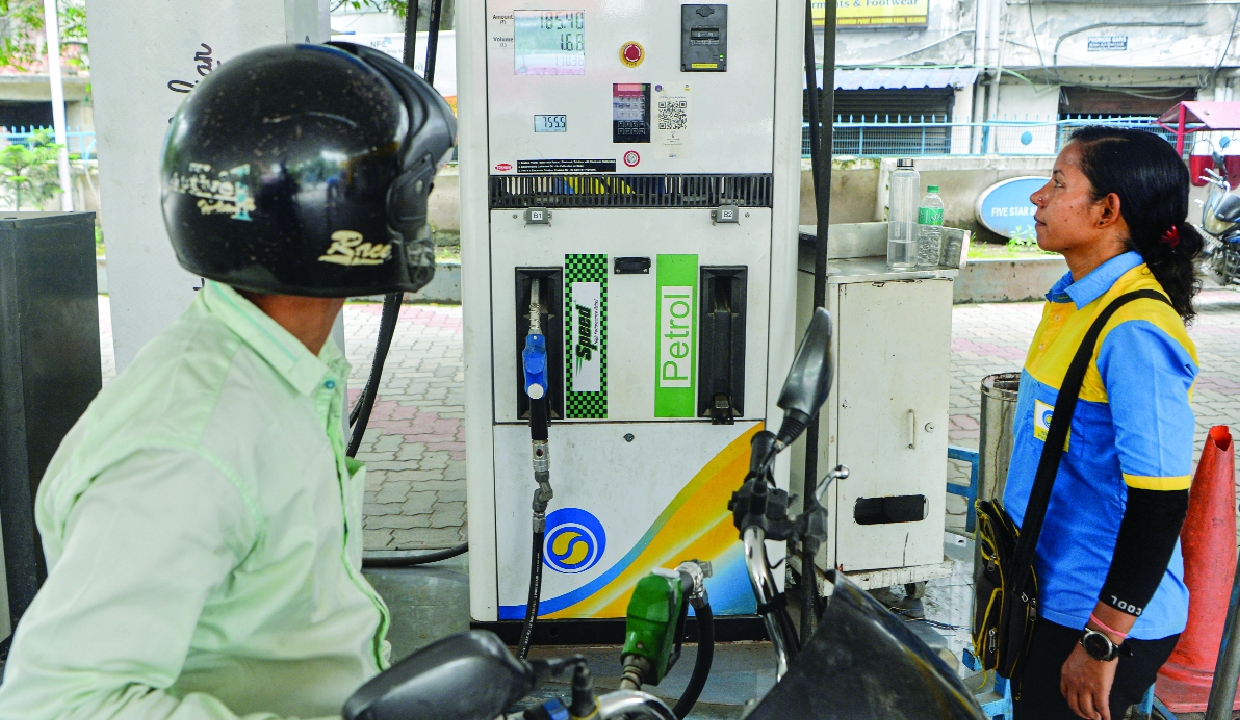
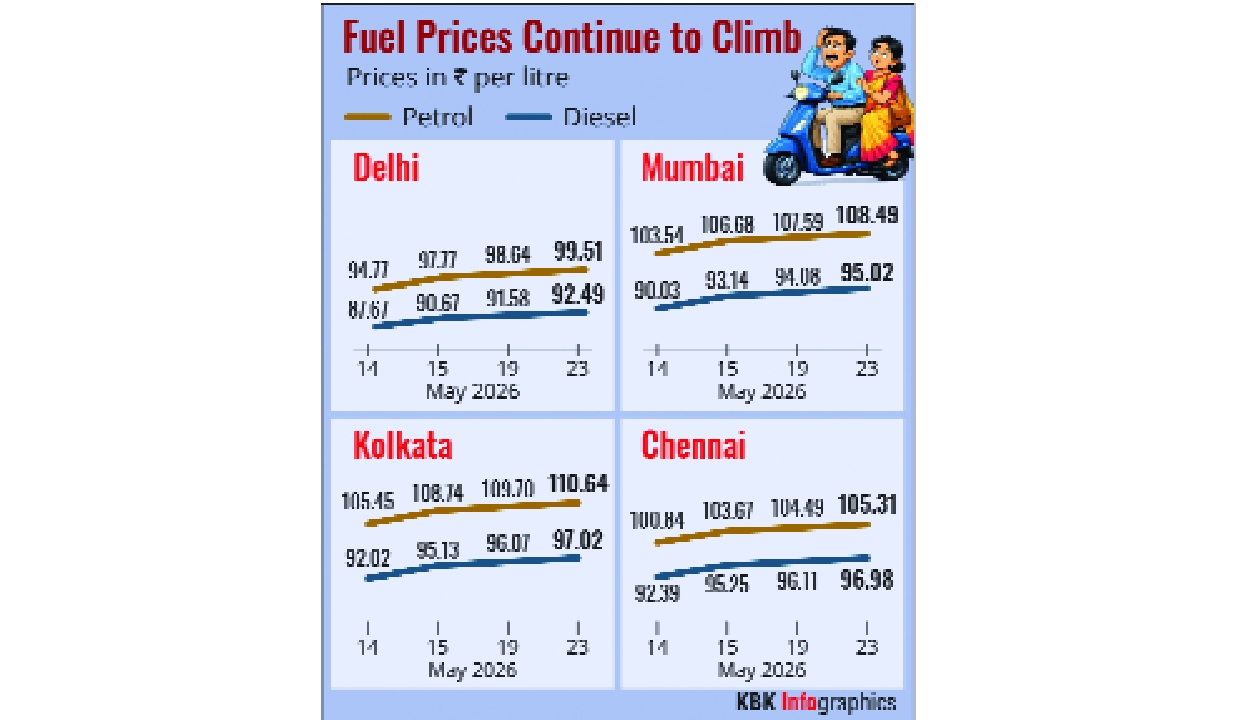
In the third hike in 10 days, petrol prices went up by 87 paise, and diesel prices are up by 91 paise as of Saturday. The price of petrol now stands at Rs 99.51 per litre, while diesel costs Rs 92.49 per litre.
Additionally, Compressed Natural Gas (CNG) prices were raised by Rs 1 per kg, marking the third increase in recent days and taking the cumulative hike to Rs 4 per kg. It now costs Rs 81.09 per kilo in the National Capital.
This is the third increase in rates since May 15, when State-owned oil companies started passing on the elevated energy prices arising from the Middle East conflict in a calibrated manner. With the latest hike, petrol and diesel prices have risen to nearly Rs 5 a litre.
As political sparring intensifies over the latest fuel price hikes, a detailed note defending the Centre’s fuel pricing strategy claims that State-level taxes, and not central excise duty alone, are the biggest reason behind the sharp variation in petrol and diesel prices across India.
In an informal note, the Government, in the backdrop of three consecutive fuel price revisions this month, argues that petrol and diesel remain the costliest in States such as Telangana and Kerala due to higher Value Added Tax (VAT), while rates are relatively lower in Gujarat, Uttar Pradesh, Delhi, Haryana, Goa and Assam.
It said the Centre maintains a uniform excise duty structure nationwide, retail prices differ from State-to-State because of varying Value Added Tax (VAT) rates imposed by individual State Governments.
“The States with the highest VAT impose effective rates of 30% and more, layered with per-litre additions and infrastructure cesses. The States with the lowest impose rates closer to 20 per cent, no per-litre addition, and no further cess,” said a notification issued by the Centre.
The Government further said after the latest price revisions, petrol in three States — Andhra Pradesh, Telangana, and Kerala — cost over Rs 112/litre, of which Telangana and Kerala are governed by parties of the INDIA bloc.
Stating that these three States levy the highest VAT rates across the country, the Centre said, “Andhra Pradesh charges 31 per cent VAT plus Rs 4 a litre plus a road development cess, taking the effective rate close to 35 per cent. Telangana takes petrol close to Rs 116. Kerala adds a social security cess on top of its base VAT,” it said. According to the Centre, six BJP-ruled States — Gujarat, Uttar Pradesh, Delhi, Haryana, Goa, and Assam — have priced petrol at or below Rs 102/litre. “The same opposition leaderships that ask the Central Government to cut excise duty for the relief of the consumer have at no point cut the VAT their own State Governments levy on the same litre of fuel,” it added.
Diesel prices have increased by 95 paise, 94 paise, and 87 paise from May 23 levels to Rs 97.02 in Kolkata, Rs 95.02 in Mumbai, and Rs 96.98 in Chennai. Together, the three State-run OMCs — Indian Oil Corporation, Bharat Petroleum, and Hindustan Petroleum —control more than 90 per cent of the domestic fuel market and concurrently adjust pricing. CNG price in Delhi was increased to Rs 81.09 per kg from Rs 80.09, according to information posted by Indraprastha Gas Ltd on its website. This is the third increase in CNG prices, and together with the earlier hikes of Rs 2 per kg on May 15 and Rs 1 per kg on May 17, it takes the cumulative increase to Rs 4 per kg.
According to the government’s data, every major developed economy now retails petrol above Rs 150 a litre and most above Rs 180; the EU 27 weighted average sits at Rs 179 on petrol and Rs 184 on diesel. Second, India’s two large neighbours — Pakistan and Nepal — have moved well past Rs 135 a litre on petrol despite lower nominal incomes; Sri Lanka, Myanmar, and the Philippines have crossed Rs 130. Third, the only economies retailing petrol consistently below the Indian range are direct subsidisers (the UAE and Malaysia) or the US, which has structurally low fuel taxation. India therefore prices petrol and diesel at or below most of the developing world and at roughly half the European pump, while still raising less than any non-subsidising peer through the present disruption.